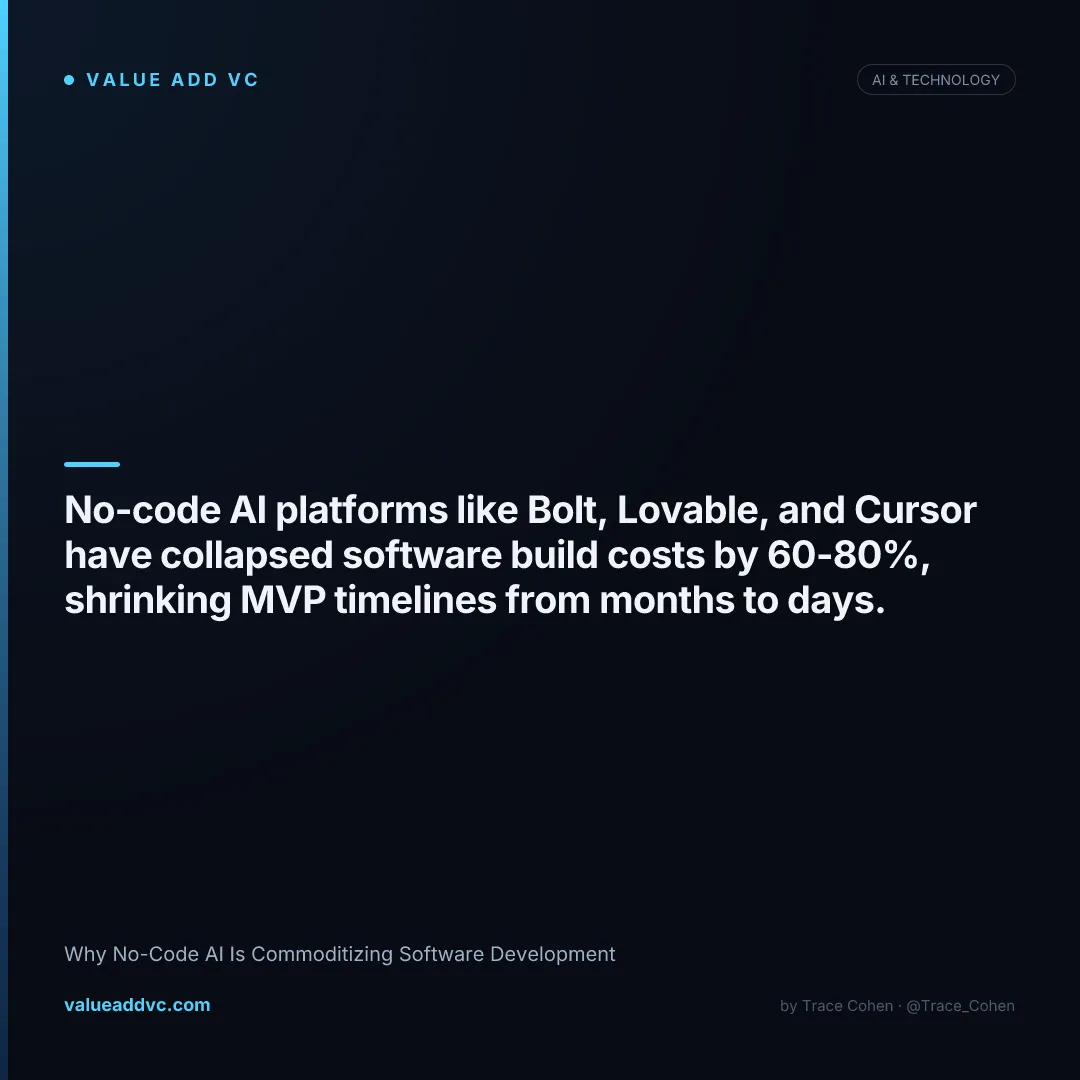
Bolt.new crossed $40M ARR in under 8 months. Lovable hit $10M ARR in 60 days. Replit Agent is generating full-stack apps from a single prompt. The no-code AI wave is not a trend — it's a structural compression event for the software industry.
For three decades, the ability to write software was a genuine moat. It was scarce, expensive, and slow. That moat is eroding at a pace most people are not taking seriously enough.
The Build Cost Collapse Is Real and Measurable
This isn't anecdote — it's a repricing of the software labor market happening in real time. A few data points that tell the story:
MVP development time
3–6 months → 3–10 days
Seed-stage engineering cost (12 months)
$600K–$1.2M → $80K–$200K
Lines of code written per engineer per day
~50–100 → 500–2,000 (AI-assisted)
Time to production-ready internal tool
4–8 weeks → 1–3 days
Y Combinator W26 batch with AI-built MVPs
~15% → >60%
What No-Code AI Actually Does Well — and Where It Breaks
The mistake most people make is treating no-code AI as either a toy or a full engineer replacement. It's neither. It's a leverage multiplier that is highly capable within a specific envelope:
Handles well
- ✓ CRUD apps and admin dashboards
- ✓ Standard SaaS feature surfaces
- ✓ Marketing sites and landing pages
- ✓ Data visualization and reporting
- ✓ API integrations and webhooks
- ✓ Internal tooling and automations
Still breaks down
- ✕ Complex distributed systems architecture
- ✕ Custom ML model training and deployment
- ✕ Real-time, high-throughput infrastructure
- ✕ Security-critical and compliance-bound systems
- ✕ Multi-repo legacy refactors
- ✕ Novel algorithmic problem-solving
The "handles well" bucket is where 70–80% of early-stage startup engineering effort lives. That's the problem — and the opportunity.
What This Means for Founders
I've made 65+ investments and have been building companies since before GitHub existed. The clearest signal I'm seeing in 2026 pitches is a divergence: founders who understand this shift are shipping faster and spending less; founders who don't are burning capital on engineering teams that would have been unnecessary three years ago.
The non-technical founder ceiling just got much higher
Historically, non-technical founders hit a wall when they needed to build something custom. That wall is now much further out. A determined non-technical founder with Bolt and Cursor can now ship a functional B2B SaaS MVP that would have required a $200K seed engineering hire in 2022.
Your first engineering hire should be later and higher-level
The right first technical hire in 2026 is not a junior fullstack engineer to scaffold your app. It's a senior engineer who can architect your data layer, set up your AI-assisted dev workflow, and mentor you on what to build vs. buy. Hire later, pay more, get more leverage.
Technical co-founder premium is compressing
VCs used to give a meaningful valuation premium to technical founding teams — the logic being that shipping was expensive and slow without them. That premium is narrowing. What now commands a premium is proprietary data access, distribution relationships, and domain expertise that can't be auto-generated.
Speed is now table stakes, not a differentiator
Every well-capitalized competitor has access to the same tools. Shipping fast used to mean you were exceptional. Now it just means you're keeping up. The competitive variable has shifted to what you ship — the insight, the distribution channel, the customer relationship — not that you shipped.
What This Means for Engineering Careers
The honest answer is that the distribution of outcomes is widening. The best engineers are 10–20× more productive than they were in 2020. The median junior engineer is facing real demand compression. GitHub reported in late 2025 that Copilot users complete tasks 55% faster on average — but the teams using it aren't hiring proportionally more engineers. They're doing more with the same headcount.
The roles that are thriving: AI infrastructure engineers, ML platform teams, security engineers, and anyone who can manage fleets of AI agents and evaluate their outputs. The roles under pressure: junior CRUD developers, QA engineers doing manual testing, and mid-level engineers without specialized domain depth.
This is not the death of software engineering. It's the death of undifferentiated software engineering. The field is splitting into commodity execution (increasingly automated) and rare expertise (increasingly valuable).
The VC Implication: Defensibility Has Moved
When I look at a deal today, the question I'm asking is no longer "can they build it?" — almost everyone can build it now. The questions that matter are:
Who owns the customer relationship and distribution channel?
Does this company have proprietary data that gets better as they grow?
Is there a network effect or switching cost that compounds over time?
Can this team see something the market can't replicate with a Bolt prompt?
Is there a regulatory, compliance, or workflow moat protecting the core?
The companies that will win in the no-code AI era are not the ones that build the fastest. They're the ones that build the right thing — for an audience they uniquely understand, with data they uniquely own, through a channel competitors can't easily replicate.
No-code AI doesn't commoditize good startups.
It commoditizes the ability to build software — and forces every founder to answer the harder question: why are you the one who should build this?
Latest from the Pulse
Get VC data most people never see
— 100% free
Weekly benchmarks, valuations, and fund data. Join 5,000+ investors. No spam.