GitHub Copilot has 1.8 million paid subscribers. Cursor passed $100M ARR in under two years. Claude Code, Devin, and a dozen competitors are fighting for the same engineering workflows.
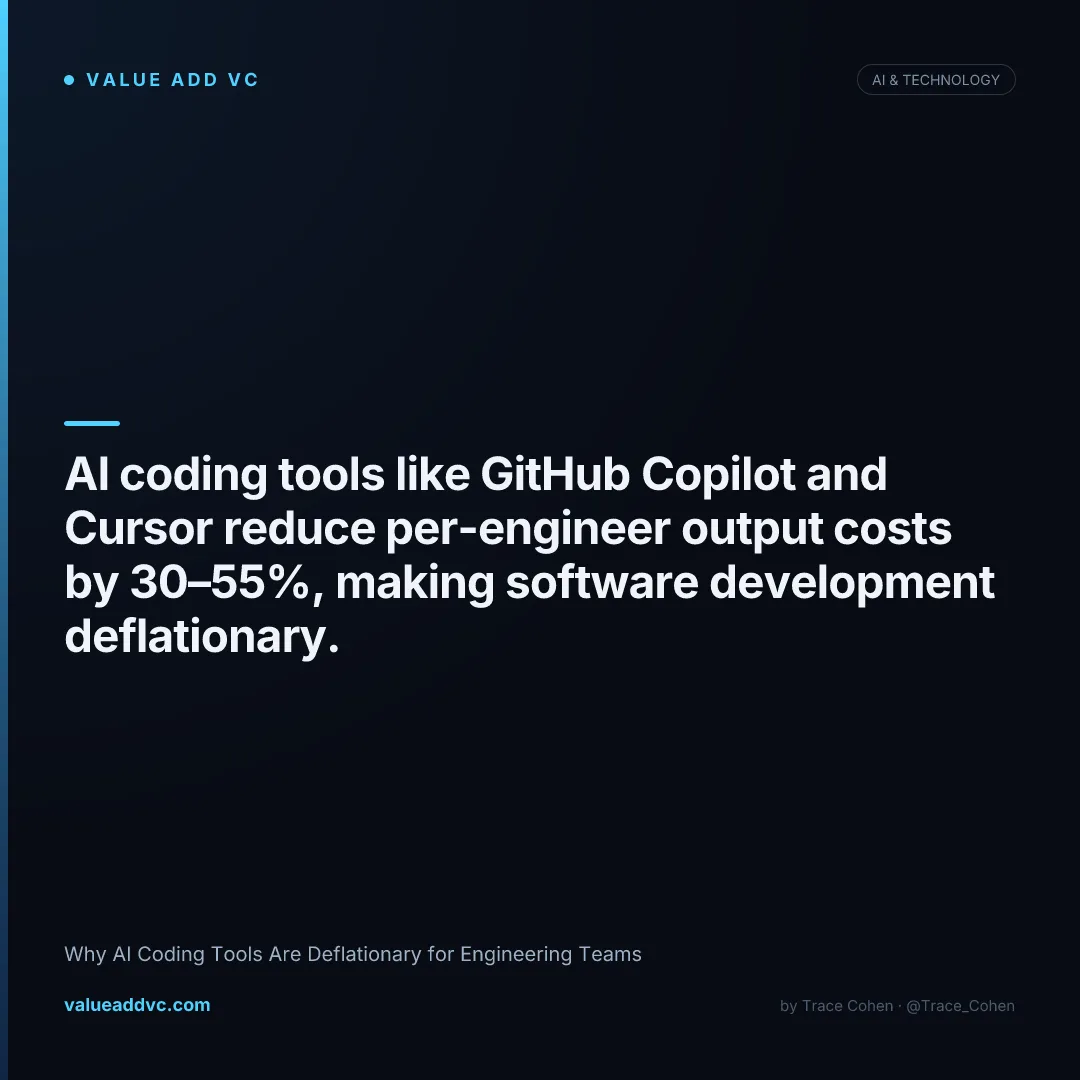
The adoption curve is steep and it's not slowing down. But the real story isn't the tools themselves — it's what happens to team economics when 30–55% productivity gains compound across a 10-person engineering org.
I've watched this play out across my portfolio. The companies embracing AI coding tools are not hiring proportionally less — they're hiring dramatically less. And the unit economics are permanently changing.
The Productivity Data Is Real
The gains from AI coding tools are not marginal. Multiple independent studies confirm meaningful productivity improvements:
55% faster task completion on routine coding with Copilot
GitHub Internal Research (2024)Measured across 95 professional developers on standardized tasks
20–45% reduction in time spent on code generation tasks
McKinsey Developer Survey (2025)Enterprise developer cohort across 40 companies
40% fewer lines of code per feature shipped
Stripe Engineering (2025)Post-Copilot adoption, maintained same feature velocity with smaller team
Median seed-stage startup engineering team down 28% vs. 2022 cohort
a16z Portfolio Analysis (2025)Same output metrics, lower headcount at founding
Deflationary Means the Marginal Engineer Is Worth Less
When a senior engineer with AI tools can produce the output of 1.5–2 engineers from three years ago, the math on headcount planning changes fundamentally. This is deflation in the most literal sense: the same output costs less to produce.
The practical effect I'm seeing across portfolio companies:
- →An engineer leaves → the role is not backfilled. Output is maintained through AI tooling.
- →A new product feature that would have required 3 engineers for 6 weeks ships in 4 weeks with 2.
- →QA and test coverage improve despite smaller QA headcount — AI writes the tests.
- →Junior engineers are being hired at lower rates. Senior engineers who direct AI well command premiums.
- →Offshore and contract engineering work is declining faster than US headcount — AI closed the arbitrage gap.
What This Means for Different Stakeholders
Founders
- ✓ Raise less capital to hit the same milestones
- ✓ Don't backfill departing mid-level engineers
- ✓ Hire fewer but pay more for AI-native senior talent
- ✓ Extend runway 20–30% with same engineering output
Engineering Leaders
- ✓ Team sizing models from 2022 are obsolete
- ✓ Evaluate candidates on AI tool proficiency, not raw output
- ✓ Code review becomes the most valuable skill on the team
- ✓ Documentation and architecture become higher leverage
VCs & Investors
- ✓ Headcount growth is no longer a proxy for product velocity
- ✓ Capital efficiency benchmarks are being reset downward
- ✓ Ask about AI tool adoption in every diligence call
- ✓ Engineering burn should be 20–30% lower than 2022 comps
The Risks Nobody Is Talking About
Deflationary pressure creates its own failure modes. Pure AI-generated code without strong engineering oversight ships bugs at scale. The companies getting burned are the ones who mistook AI productivity for an ability to hire junior-only teams or skip code review entirely.
Three things I'm watching in portfolio companies that are over-rotating:
Security debt
AI tools generate syntactically correct but insecure code. OWASP Top 10 vulnerabilities are appearing in AI-assisted codebases at higher rates than manually written code when review practices aren't tightened.
Architecture erosion
Junior teams relying heavily on AI lose the muscle memory to understand system design tradeoffs. Technical debt compounds fast when nobody on the team built the system from first principles.
False velocity signals
Lines of code and PRs merged go up with AI adoption. Actual customer value shipped doesn't always track. Measure output by customer outcomes, not engineering throughput metrics.
The engineering org of 2026 is not smaller because AI tools are replacing engineers.
It's smaller because the marginal need for additional engineers has been structurally reduced — and every headcount plan that doesn't account for that is already wrong.
Latest from the Pulse
Get VC data most people never see
— 100% free
Weekly benchmarks, valuations, and fund data. Join 5,000+ investors. No spam.