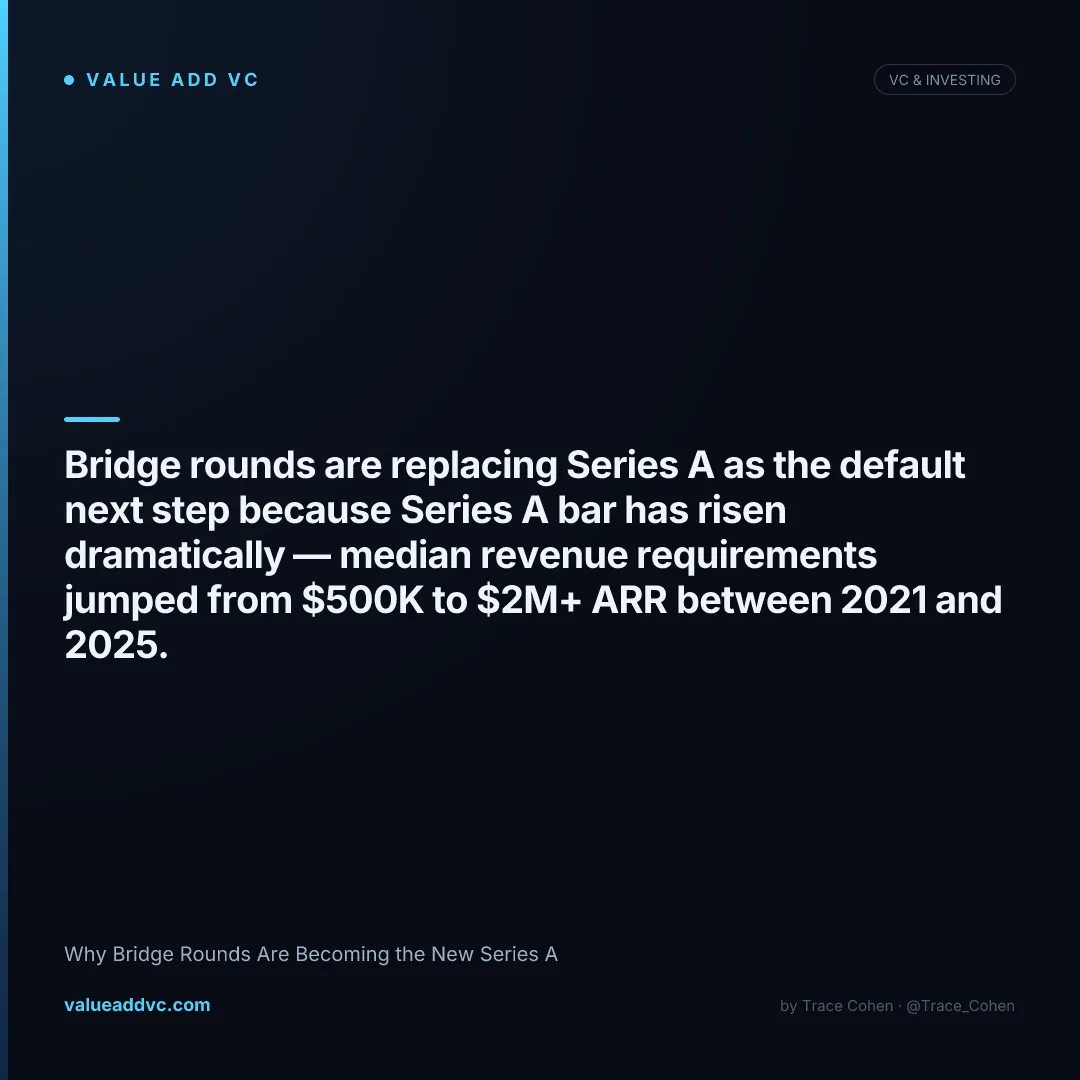
In 2021, the median Series A required roughly $500K ARR. By 2025, that number crossed $2M ARR — and top-tier firms like Benchmark and Sequoia regularly pass on companies below $3M.
That four-fold increase in bar didn't happen because founders got worse. It happened because the market repriced risk. And the gap it created — between what seed capital gets you and what Series A requires — is exactly what bridge rounds now fill.
The Numbers That Explain Everything
The Series A bar didn't just rise — it disconnected from what seed rounds can realistically deliver. Here's what the data shows:
$2M+ ARR
Median Series A threshold in 2025
Up from ~$500K in 2021
24 months
Median time from seed to Series A in 2025
Up from 14 months in 2021
38%
Seed-stage startups that raised a bridge in 2024
Up from 18% in 2020
$1.8M
Median bridge round size in 2025
Structured as SAFE or convertible note
The math is simple: if Series A requires $2M ARR and a typical seed round of $2M lasts 18 months, most companies cannot hit the bar before they run out of money. The bridge isn't a detour — it's the route, and seed extensions have quietly become the default version of it.
Why This Shift Is Structural, Not Cyclical
I've made 65+ investments across seed and early growth. What I'm seeing now isn't a temporary overcorrection from 2021 froth — it's a fundamental repricing of what institutional Series A capital requires to underwrite.
Three structural forces are driving this:
AI reduced the cost to get to first revenue
Founders can build faster and cheaper than ever. That's good — but it means the market expects more. Seed investors no longer fund idea-stage bets; they fund companies with 3-6 months of traction. Series A investors moved upstream accordingly.
LP pressure on fund performance compressed the risk appetite
Series A funds raised $30B+ in 2021-2022 at compressed fee terms. They now need to protect DPI, not just TVPI. That means leading fewer deals at higher conviction, with more evidence. The result: a smaller funnel and a higher bar.
The IPO and M&A window reset valuation expectations
Exit multiples compressed by 60-70% from peak. A Series A investor who paid 20x ARR in 2021 and underwrote a 5x exit in 3 years is underwater. The repricing flows upstream — which means seed-to-A time horizons and evidence thresholds both extended.
What a Good Bridge Looks Like vs. a Bad One
Not all bridges are equal. The difference between a strategic bridge and a distress signal is milestone clarity and investor participation.
Bridge Done Right
- ✓ Existing lead investor participates (signals conviction)
- ✓ Specific milestone attached: "$2M ARR by Q4"
- ✓ Clean SAFE with 20% discount, no board seat
- ✓ 12-18 months runway with clear use of funds
- ✓ Raised in under 6 weeks from existing relationships
Bridge Done Wrong
- ✕ Existing investors pass — no participation
- ✕ Vague use of funds: "extend runway to find PMF"
- ✕ Convertible note with punitive terms at 30%+ discount
- ✕ Only 6 months of runway after close
- ✕ Took 4+ months to close from new investors
How Founders Should Think About Bridge Strategy
The founders who navigate bridges well treat them as a milestone financing, not a survival mechanism. Here's the framework I walk my portfolio through:
- 1.Define exactly what Series A requires — pick a specific firm and ask them directly what metrics they need. Build backward from that.
- 2.Raise only what you need to hit that milestone. Over-bridging dilutes founders and signals poor capital discipline.
- 3.Start the bridge conversation with existing investors before you're out of runway. Panic bridges close on bad terms.
- 4.Structure as a SAFE where possible. Convertible notes with short maturities create hidden pressure at the worst time.
- 5.Make participation by your seed lead a public signal. If they pass, new investors will price that information.
What This Means for the Seed Ecosystem
For seed investors, the rise of bridges changes portfolio math. If 35-40% of your portfolio needs a bridge before Series A, you need to reserve capital accordingly — or accept that your ownership will dilute more than your model assumed.
The seed funds that are thriving in 2025-2026 are the ones that sized their reserves for a 24-month Series A path, not a 14-month one. That means holding back 30-40% of a fund for follow-on — compared to the 15-20% that was standard in the zero-interest-rate era.
The bridge round is no longer a signal of failure.
It's the new standard operating procedure for building a venture-backable company in a market that has permanently raised its bar.
Track VC funding trends and portfolio construction at Value Add VC. Follow Trace Cohen's weekly take in the Startups, Tech & VC newsletter.
Latest from the Pulse
Get VC data most people never see
— 100% free
Weekly benchmarks, valuations, and fund data. Join 5,000+ investors. No spam.