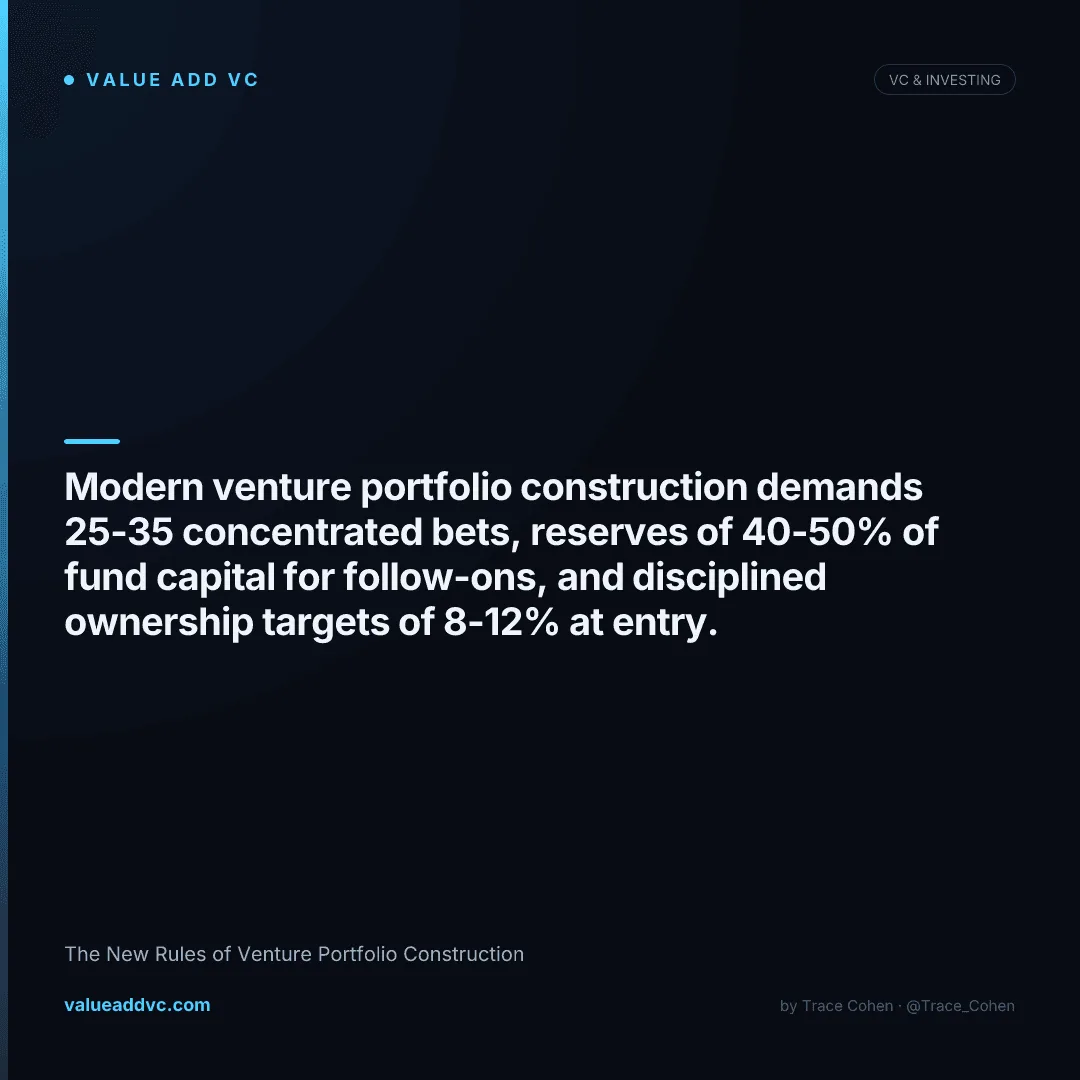
The conventional wisdom on venture portfolio construction — diversify broadly, make lots of small bets, let the winners emerge — produced a decade of mediocre DPI and LP disappointment.
Cambridge Associates data shows that the top-quartile seed funds from the 2015-2019 vintage averaged 3.1x TVPI. The bottom half averaged 0.9x — they didn't even return capital. The difference between them wasn't deal flow. It was portfolio construction discipline.
Why Spray and Pray Stopped Working
The spray-and-pray playbook made some sense when valuations were lower, exits were more frequent, and the cost of entry was cheap enough that volume could compensate for selectivity. None of those conditions hold today.
Valuations compressed follow-on math
A 50-company seed portfolio at $8-12M post means you need a $400M+ exit per company just to return the fund 1x
IPO and M&A windows lengthened
Average time to exit is now 8-11 years, meaning under-reserved funds are diluted down to irrelevance before liquidity
Pro-rata rights eroded at scale
Funds with 50+ positions rarely exercise pro-rata at growth stage, forfeiting the upside concentration that drives returns
Support capacity is finite
A GP with 60 active portfolio companies provides meaningful value to approximately zero of them
The Math Behind Concentrated Portfolio Construction
For a $50M seed fund targeting a 3x net return ($150M returned to LPs), the math forces a specific construction:
Initial investments
~$700K–$1M average check size, leaving 40-50% for follow-ons
Ownership target at entry
Below 5% is mathematically very hard to return the fund even on strong exits
Follow-on reserve
Deployed into the top 5-8 performers to maintain ownership through Series B/C
Expected returners
Power law math: top 10% of a 25-company portfolio generates ~70-80% of returns
Target exit size to return fund
At 8% entry ownership and 4-5% post-dilution at exit, a $500M exit returns ~$25M = 0.5x by itself
Reserve Strategy: The Most Underrated Lever
Most emerging managers under-reserve. They deploy 70-80% of the fund in the first three years and have nothing left to double down when their best companies raise their Series A and B. That is not a deal flow problem. It is a construction problem.
- 01
Reserve 40-50% of capital from day one
Model it explicitly in your fund construction before you write a single check. Many managers discover this constraint too late.
- 02
Deploy follow-on capital into the top 20-25% of your portfolio
Pro-rata rights exercised selectively — not reflexively. The goal is maintaining or growing ownership in your best performers, not preserving relationships across all 30 companies.
- 03
Triage by year three
Top funds formally score their portfolio by year three and stop allocating support bandwidth — and reserve capital — to companies that have stalled. This sounds obvious. Almost no one does it consistently.
- 04
Model dilution aggressively
A company that raises seed, Series A, B, C, and then does a secondary before IPO will dilute you by 50-60% from your entry ownership. If you start at 5%, you exit at 2-2.5%. The fund math evaporates.
What the Top Emerging Managers Are Doing Differently
I've reviewed the construction of dozens of emerging manager funds at various stages. The ones that are building towards top-quartile outcomes share a few common traits:
What Top Managers Do
- ✓ Define ownership targets before setting check sizes
- ✓ Model follow-on scenarios at fund inception
- ✓ Maintain a hard cap on initial portfolio company count
- ✓ Triage portfolio formally by year 2-3
- ✓ Reserve enough to lead or co-lead the Series A in 2-3 winners
Structural Mistakes to Avoid
- ✕ Investing in 50+ companies "to increase surface area"
- ✕ Deploying 80%+ of capital in years 1-2
- ✕ Accepting entry ownership below 5% without a follow-on plan
- ✕ Reflexively exercising pro-rata in every company
- ✕ Treating check size as the primary construction variable
Fund Size Changes Everything
Portfolio construction is not one-size-fits-all. It shifts significantly with fund size:
Write larger checks relative to fund; fewer bets, deeper ownership is the only path to fund-returning outcomes
The sweet spot for most emerging managers — concentrated enough to matter, diversified enough to find outliers
Needs larger fund-returners ($750M+ exits); must maintain discipline on follow-on deployment and triage
Portfolio construction is not a financial model exercise.
It is the strategic framework that determines whether you can return the fund — before you write a single check.
The managers who define ownership targets, reserve ratios, and triage timelines at fund inception are the ones who still have conviction capital when their best companies need it most.
Explore fund performance benchmarks at the VC Fund Tracker on Value Add VC. Originally published in the Trace Cohen newsletter.
Latest from the Pulse
Get VC data most people never see
— 100% free
Weekly benchmarks, valuations, and fund data. Join 5,000+ investors. No spam.