
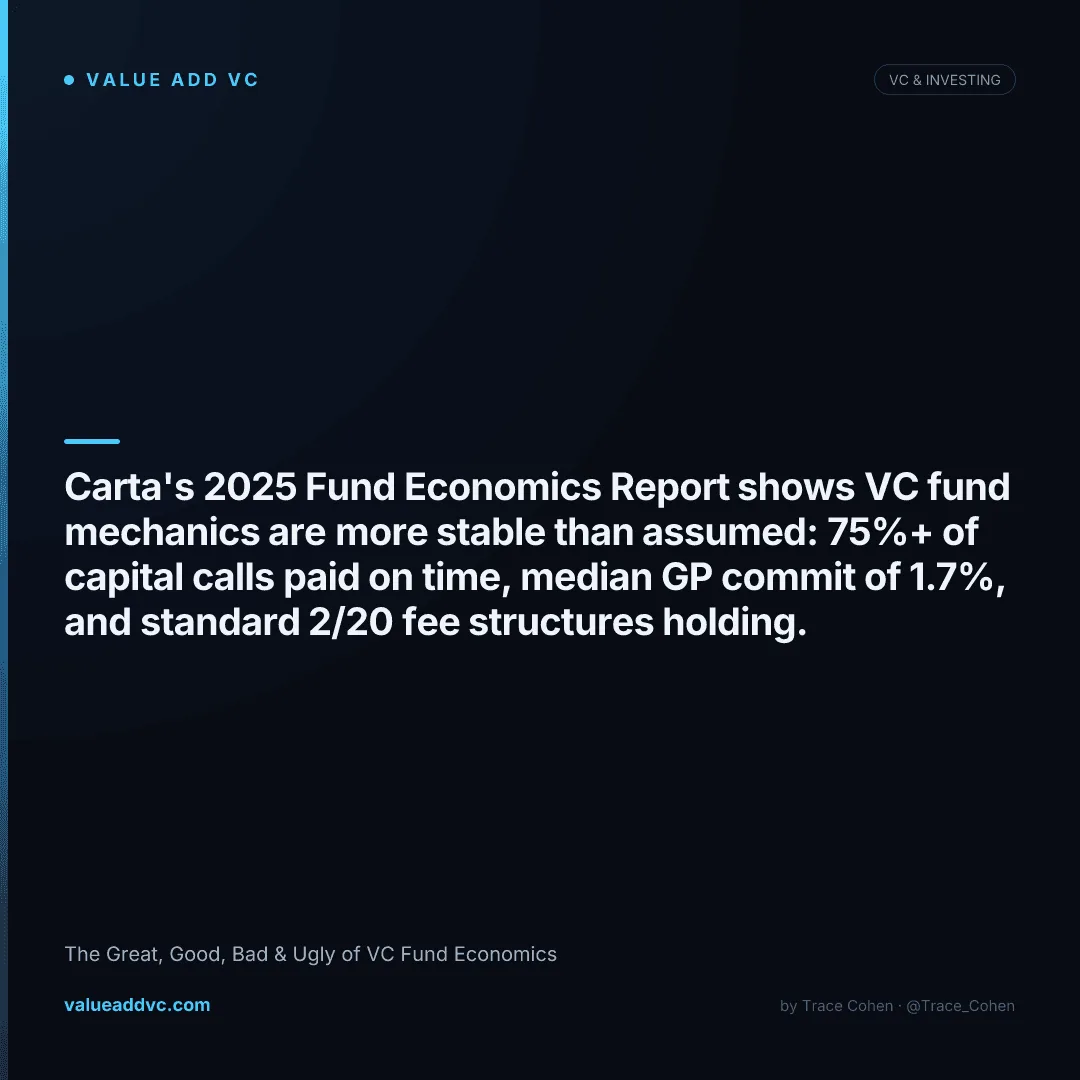
The venture industry loves stories. Carta's data replaces them with actual numbers — across thousands of vehicles, vintages, and structures.
Once you break the findings apart, a clear hierarchy emerges. Some fundamentals are genuinely strong. Some trends are directionally encouraging. Some weaknesses require more discipline. And some uncomfortable truths are simply part of the structure of venture.
⭐ The Great
The core machinery of venture is more stable and aligned than people assume.
Despite the market reset and a tougher fundraising environment, the foundations of venture capital — LP reliability, GP alignment, and operational structure — remain remarkably strong.
- •75%+ of capital calls paid on time, even for 2022–2024 vintages
- •Median GP commitment: 1.7% for VC, 2.55% for PE
- •Smaller funds (<$25M) call capital faster and more consistently
- •$100M+ funds spend only ~1% of fund size on operations
- •Infrastructure is modernizing: more third-party admin, automated calls, standardized reporting
👍 The Good
Structural shifts are reshaping how funds get built — not breaking them.
These trends don't break anything, but they do change the fundraising dynamics, governance structure, and day-to-day management of funds. They represent the new normal emerging after 2020–2021.
- •Median LP count: 23 LPs per 2025 fund (down from ~50)
- •Median anchor LP now contributes 22%+ of the fund
- •40% of anchor LPs in $1M–$10M funds are individuals
- •Fee structures remain stable at 2% fees / 20% carry
- •Post-2020 vintages show more uniform deployment pacing
😐 The Bad
Certain vintages, cost structures, and pacing patterns pose real performance risks.
These are growing pains — issues that don't break the model, but can drag down a fund's ability to produce strong DPI or maintain healthy pacing.
- •2022 vintage deployment: only 67% deployed after four years (vs ~80% historically)
- •$10M funds lose 3.4% to overhead — a real DPI drag
- •Funds >$250M show slower capital call velocity due to co-invest complexity
- •Anchor concentration >22% of fund size = structural fundraising risk
💀 The Ugly
The truths the industry avoids — but the data makes impossible to ignore.
These are the harsh realities that reveal how hard it is to run a small fund, how costly the early years are, and how power dynamics have shifted toward anchors.
- •Emerging managers (<$50M) often spend 5–7% of the fund on early-year ops
- •Early fee drag leads many young funds to start at -20% to -30% TVPI before markups
- •2021–2023 vintages face the highest structural risk since the post-dot-com era
- •LP concentration gives anchors disproportionate influence on governance and economics
- •If an anchor walks, the fund may collapse
Venture isn't fragile. It's just more transparent now.
The managers who internalize these dynamics will outperform. The LPs who underwrite based on data will build healthier portfolios.
Explore fund performance data on the VC Fund Performance Dashboard and Fund Benchmarking tools at Value Add VC. Originally published in the Trace Cohen newsletter.
Latest from the Pulse
Get VC data most people never see
— free to subscribe
Trace's notes on venture, AI and startups, a few times a week. Join 5,000+ subscribers. No spam.
No spam, unsubscribe anytime. Sent via Substack · Privacy · or subscribe on Substack ↗