VC
Value Add VC
โšกHomePulseโšกHelpful Apps๐Ÿ“Blog
Home/Blog/Bay Area AI Investment Concentration: 80% of US VC Dollars in Q1 2026, Up From 55%
Market & TrendsJuly 8, 2026ยท10 min readยท

Bay Area AI Investment Concentration: 80% of US VC Dollars in Q1 2026, Up From 55%

OpenAI's $122 billion round alone equaled 45% of all US venture dollars in Q1 2026, pushing Bay Area concentration to its highest level in at least twelve years while New York fell to a record-low 4% share.

TC
Trace Cohen
Co-Founder & GP at Six Point Ventures ยท 3x founder (BrandYourself, Launch.it, SPOT) ยท 65+ investments ยท Based in Boca Raton, FL
@Trace_Cohenยทt@nyvp.comยทSouth Florida Advisory
65+Investments3xFounder$200M+Funds Tracked
ShareXLinkedInEmailQuote card

Quick Answer

Bay Area startups captured more than 80% of all US venture dollars in Q1 2026, up from 55% for full-year 2025, largely because OpenAI's $122 billion round alone equaled 45% of nationwide VC. AI now makes up 81% of Bay Area investment, up 11 points from 2024, while New York's share fell to just 4%.

More than 80% of all US venture capital dollars went to Bay Area startups in Q1 2026, up from 55% for full-year 2025 โ€” and OpenAI's single $122 billion round accounted for 45% of the entire nationwide total on its own.

That's not a typo, and it's not a one-quarter blip driven by a rounding error. It's the most concentrated the US venture market has been in at least twelve years, and it's happening because AI's biggest rounds keep landing in the same six-mile radius between San Francisco and Menlo Park. Here's the actual concentration data, why it's getting more extreme instead of less, and what it means if your startup isn't based there.

80%+
Bay Area Share, Q1 2026
55%
Bay Area Share, FY 2025
81%
AI Share of Bay Area VC
4%
New York's Q1 2026 Share

Bay area ai investment concentration: how dominant is the region in 2026?

Bay Area startups captured more than 80% of all US venture dollars in Q1 2026, with the San Francisco metro area alone accounting for nearly two-thirds of the national total, according to PitchBook-NVCA's Venture Monitor. That's up sharply from a 55% share for the Bay Area across all of 2025, and it's the highest concentration reading for any quarter since at least 2014.

The jump isn't broad-based โ€” it's driven almost entirely by one deal. OpenAI's $122 billion Q1 2026 round, on its own, equaled 45% of every venture dollar invested in a US startup that quarter. Strip that single round out and Bay Area concentration looks a lot closer to its 2025 baseline, which is itself already historically elevated versus the 2015-2020 period when the region typically held 40-45% of national VC dollars.

US venture capital share by region, 2025 vs Q1 2026

RegionFY 2025 ShareQ1 2026 Share
Bay Area (SF + San Jose metros)55%80%+
San Francisco metro alone~40%~66%
California (statewide)60-64%n/a (not yet reported)
New York metro~10-12%4%
Rest of US, combined~28-30%~16%
National VC total (all deals)$191.2B (CA share basis)$297B (Q1 total)

Figures blended from PitchBook-NVCA Q1 2026 Venture Monitor, San Francisco Examiner reporting on Q1 2026 regional data, and NVCA's 2026 Yearbook for full-year 2025 California and national totals. California/Bay Area figures use overlapping but distinct geographic definitions across sources; treat percentages as directional rather than exactly additive.

Why Bay Area AI investment concentration keeps rising

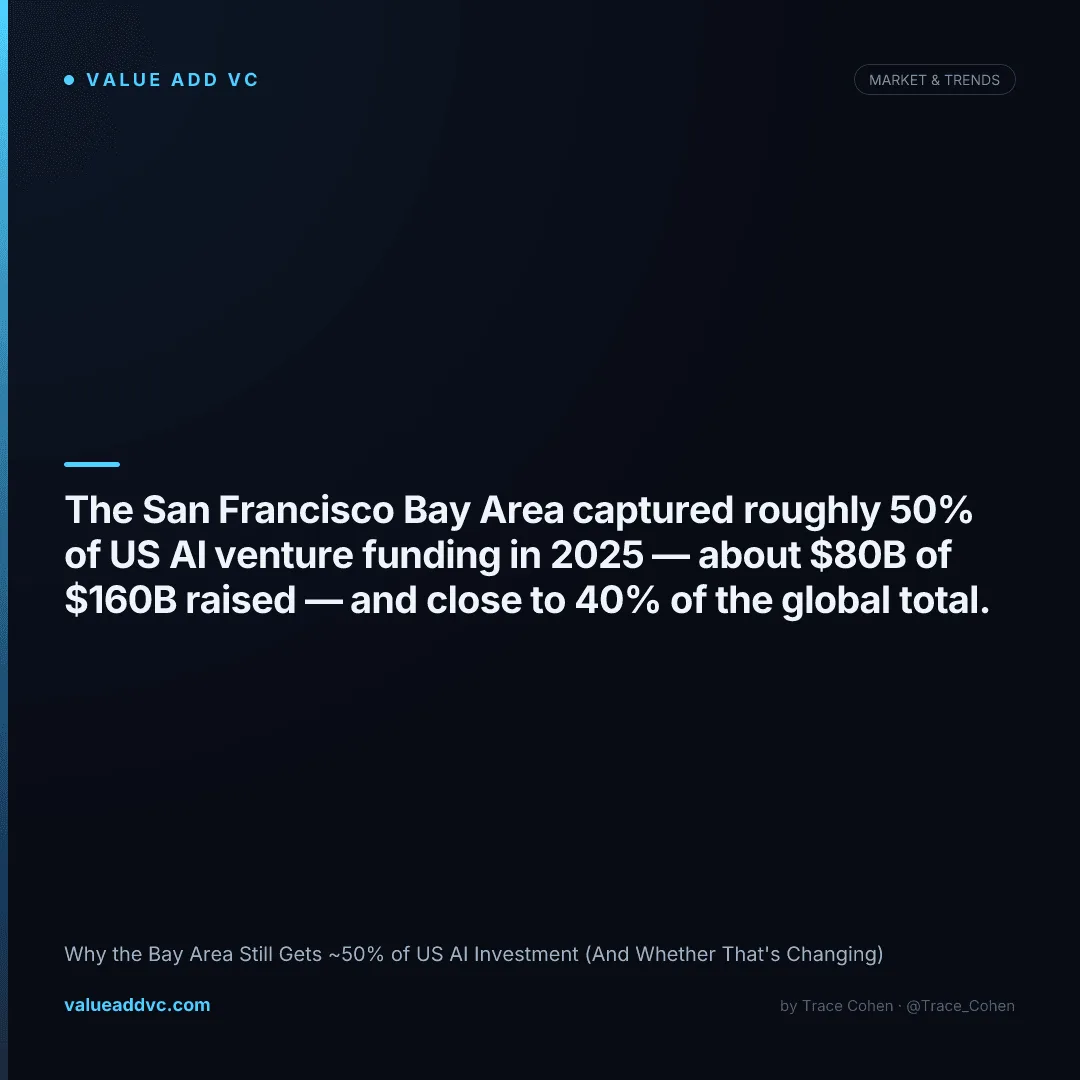
Three forces are compounding at once. First, AI's own share of Bay Area startup capital has climbed to 81% in 2025, up 11 percentage points from 70% in 2024 โ€” meaning the region's overall investment base has itself become an AI bet, not just an AI-heavy one. Second, the handful of companies capable of absorbing $10 billion-plus rounds โ€” OpenAI, Anthropic, xAI, Databricks โ€” are all Bay Area-headquartered, so mega-rounds mechanically inflate the region's dollar share far more than they inflate deal count. Third, at the global level the Bay Area captured roughly 60% of all AI venture funding in 2025, about $126 billion, despite holding only 22% of global AI deal volume โ€” a sign that capital is chasing a small number of large, high-conviction bets rather than spreading across geographies.

For context on how much of that capital is flowing into compute and infrastructure rather than headcount, see our AI valuations dashboard.

Is Bay Area AI investment concentration actually changing?

Not in the direction most founders outside California would hope for. Every available data point โ€” quarterly share, AI's percentage of local capital, New York's declining share โ€” points toward more concentration, not less, through the first half of 2026. The one caveat is that dollar-share concentration is more extreme than deal-count concentration: a small number of mega-rounds skews the dollar figure heavily, so if you're counting the number of individual financings rather than total dollars, non-Bay-Area regions look meaningfully less shut out than the headline 80% figure suggests.

The more durable floor is the California statewide number: 60-64% of all US venture capital in full-year 2025, well above the state's historical 40-45% share from 2015-2020. Even if the OpenAI-style mega-rounds slow down, there's little in the current data suggesting concentration reverts anywhere close to pre-AI-boom levels.

What Bay Area AI investment concentration means for founders elsewhere

If you're building outside the Bay Area, the practical read isn't "don't bother" โ€” it's that your fundraising strategy needs to account for a national VC market where 80 cents of every dollar just went to one metro area. That means leaning harder on regional and sector-specific funds who explicitly seek non-Bay-Area deal flow as a differentiator, building relationships with the growing number of Bay Area funds now actively sourcing outside their home turf precisely because local valuations have gotten so competitive, and being realistic that mega-round-scale outcomes remain heavily concentrated among companies with Bay Area gravity. Track how funding patterns are shifting across sectors on our VC performance dashboard.

For LPs, the concentration data is also a portfolio construction signal: a fund with zero Bay Area exposure in 2026 is structurally betting against where roughly four out of every five national VC dollars are currently landing, which is a real and intentional diversification choice rather than an accident of deal flow.

How mega-rounds distort the Bay Area concentration number

It's worth being precise about what's actually driving the Q1 2026 spike, because the 80%+ figure is easy to misread as "the Bay Area now wins 80% of individual funding rounds." It doesn't. A handful of companies โ€” OpenAI, Anthropic, xAI, and Databricks among them โ€” are absorbing check sizes that simply don't exist anywhere else in the venture market, and because those checks are denominated in the tens of billions, a single deal can move the national percentage by double digits in one quarter. OpenAI's $122 billion round is the extreme case: one company, one financing event, and 45 cents of every national VC dollar for the quarter.

That matters for how founders should read this data. If you're raising a $3-15 million seed or Series A outside the Bay Area, the 80% headline number is not really describing your market โ€” it's describing a market for frontier AI labs and infrastructure companies that happens to be dominated by five or six Bay Area-headquartered names. Strip the handful of $1 billion-plus rounds out of the national total and regional concentration drops meaningfully closer to the 55% full-year 2025 baseline, which is itself still historically elevated but far less of an outlier.

What Bay Area concentration looked like before the AI boom

Context helps calibrate how unusual 2026 actually is. Through most of the 2015-2020 cycle, the Bay Area typically captured 40-45% of national VC dollars โ€” dominant, but with real competition from New York, Boston, and Los Angeles, each holding double-digit shares in most years. New York alone regularly captured 10-15% of national VC dollars in that period, driven by fintech, adtech, and enterprise SaaS rounds that didn't require Bay Area-specific infrastructure or talent density. That New York share falling to just 4% in Q1 2026 โ€” the lowest in at least 12 years per PitchBook-NVCA โ€” is arguably the more striking data point than the Bay Area's rise, because it shows regional diversification actively reversing rather than simply stalling.

The mechanism is straightforward: New York's strongest sectors historically โ€” fintech and enterprise software โ€” haven't produced anything close to a $10 billion-plus mega-round in 2026, while Bay Area AI labs have produced several. When the denominator (total national VC dollars) balloons because of a handful of enormous rounds concentrated in one region, every other region's percentage share mechanically compresses even if its own dollar totals are flat or growing in absolute terms.

Which non-Bay-Area cities are still capturing real AI capital

Concentration isn't total exclusion. Even inside the current 80%-plus Bay Area dollar share, a second tier of cities is still landing meaningful AI-adjacent rounds โ€” Boston on the biotech-AI crossover, Austin on hardware and robotics, Seattle on cloud infrastructure tied to Amazon and Microsoft's ecosystems, and Los Angeles on applied AI in media and defense tech. None of these come close to Bay Area dollar volume, but deal count in those metros has held up better than the dollar-share numbers suggest, because the mega-rounds skewing the national total aren't being raised there in the first place. For a broader look at where defense-adjacent AI capital specifically is landing, see our defense tech dashboard.

The practical takeaway for a founder evaluating where to build: location still matters far less for a $2-5 million seed round than it does for a company trying to raise $500 million or more, since investors writing nine-figure-plus checks are disproportionately clustered around a small set of Bay Area firms with the capital base and conviction to write them. Below that threshold, the concentration data is real but less deterministic than the headline 80% number implies.

Bottom line

Bay Area AI investment concentration hit its highest level in at least twelve years in Q1 2026, with the region capturing over 80% of national VC dollars versus 55% for full-year 2025, powered by OpenAI's $122 billion round alone equaling 45% of the nationwide total. AI now makes up 81% of all Bay Area startup capital, New York's share has fallen to a record-low 4%, and every available trend line points toward more concentration ahead, not less โ€” even as deal-count data suggests the picture is somewhat less extreme than the dollar figures alone imply.

Get VC data most people never see โ€” free.

Weekly benchmarks, valuations, and fund data. No spam, unsubscribe anytime.

ShareXLinkedInEmailQuote card

Frequently Asked Questions

What percentage of AI investment goes to the Bay Area?

The Bay Area captured roughly 60% of global AI venture funding in 2025 โ€” about $126 billion โ€” despite accounting for only 22% of global AI deal count, according to industry tracking cited by The AI Economy. Within the Bay Area itself, AI now makes up 81% of all local startup investment, up 11 percentage points from 70% in 2024.

Why did Bay Area VC concentration rise so much in Q1 2026?

OpenAI's $122 billion Q1 2026 round, disclosed by PitchBook-NVCA, alone equaled 45% of all US venture dollars invested that quarter. Because OpenAI is Bay Area-headquartered, that single deal pushed the region's share of national VC dollars above 80%, with the San Francisco metro area alone accounting for nearly two-thirds of the total.

Is Bay Area AI investment concentration increasing or decreasing?

It's increasing on the dollar-share metric: the Bay Area's share of national VC dollars rose from 55% for full-year 2025 to over 80% in Q1 2026, the highest quarterly reading since at least 2014. Deal-count concentration is less extreme, since mega-rounds like OpenAI's skew dollar totals far more than they skew the number of individual financings.

How does New York's VC share compare to the Bay Area in 2026?

New York, historically the number two US venture hub, fell to just 4% of national VC dollars in Q1 2026, its smallest share in at least 12 years, per PitchBook-NVCA's Venture Monitor. That's down from a more typical 10-15% range New York held in prior cycles, illustrating how thoroughly AI mega-rounds have reconcentrated capital in Northern California.

Will Bay Area AI investment concentration ever come back down?

Likely somewhat, once the current wave of $10B+ frontier-model rounds slows, since those single deals are what's inflating the dollar-share number past historical norms. Even excluding mega-rounds, California still captured roughly 60-64% of all US venture capital in full-year 2025 per NVCA data, suggesting a structural floor well above the Bay Area's historical 40-45% share from the 2015-2020 period.

Keep Reading

The $1 Trillion AI Infrastructure Build: Data Centers, Power, and Cooling in 2026OpenAI Valuation 2026: How a $300B+ Company Justifies Its Price TagThe AI Startup Funding Surge of 2026: Which Sectors Are Getting the Most Capital

Explore 45+ free VC tools, dashboards, and recommended startup software.

Explore DashboardsHelpful Apps & Platforms

Trace Cohen is a serial founder, investor and data geek. Please feel free to reach out t@nyvp.com

VC
Value Add VC
Helpful AppsTwitterContact