
Pivoting is one of the most loaded words in startup culture. Everyone talks about it. Almost nobody knows when to actually do it.
Too early and you throw away real progress. Too late and you run out of money defending a position that was never going to work.
Founders navigate this decision well and poorly. Here's what separates them.
First: What Is a Pivot, Actually?
A pivot is not a minor product change. It's not updating your pricing. It's not adding a new feature. A real pivot is a fundamental change to one of the core assumptions your business is built on:
Customer segment
From SMBs to enterprises
Problem being solved
From productivity to compliance
Revenue model
From SaaS to marketplace
Technology layer
From UI layer to infrastructure
Channel
From direct sales to PLG
Geography
From US-first to international
Most “pivots” founders describe are actually just iterations. True pivots are rarer and scarier.
The Signals That It's Time
These aren't definitive rules. They're patterns that repeat across companies navigating this decision.
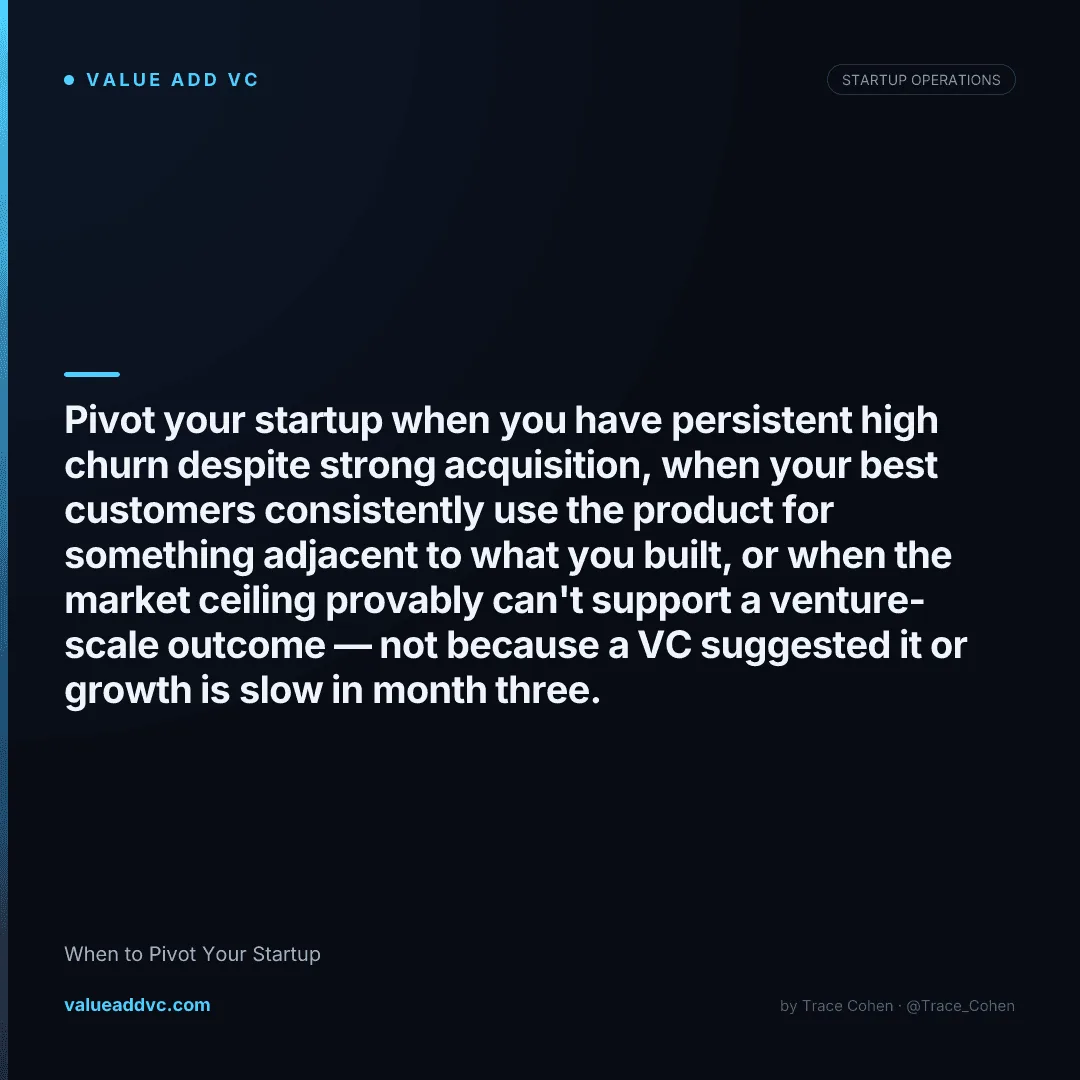
You're winning conversations but losing customers
Every demo goes great. People are excited. Then they don't buy, don't activate, or churn in week two. If your product is consistently failing at the moment of truth — not the pitch — there's a gap between the problem people say they have and the problem they actually have.
You're acquiring customers but they aren't staying
High churn is not a sales problem or a marketing problem. It is almost always a product-market fit problem. If you cannot retain customers past 60-90 days, you have not found the right problem to solve. More acquisition just increases the speed at which you learn this.
Your best customers are using the product differently than you built it
This is one of the most important pivot signals — and founders often miss it. When power users consistently repurpose your product for something adjacent to what you built, pay attention. Instagram started as a check-in app. Slack started as a game. The users found the real value before the founders did.
The market size doesn't support the outcome you need
You can have strong product-market fit in a market that will never produce a venture-scale business. If you've validated real demand but the ceiling is $10M ARR, that's a great lifestyle business — not a VC investment. The pivot may be to adjacent markets or a different segment, not a different product.
The competitive landscape has fundamentally shifted
If a platform you depend on adds your core feature, or a well-funded competitor launches with 10x your resources, staying the course is a choice. The question is whether the new landscape leaves room for your original thesis — or whether you need a new one.
The Signals That It's NOT Time
Pivoting is also a trap. These are the wrong reasons to change direction:
A VC told you to. Investors have their own pattern-matching biases. Listen, but don't blindly follow.
Sales are slow in month three. Early traction is almost always slower than founders expect. Slow is not dead.
A competitor launched something similar. Having a competitor validates the market. Fight for the customer, not away from the space.
You got bored. Startups are grinds. Boredom is not a product thesis.
You had a better idea. One great new idea doesn't mean the current direction is wrong. The grass always looks greener.
The Pivot-vs-Persevere Framework
Before making the call, answer these questions honestly:
Have you talked to at least 50 target customers about the problem? Not the product — the problem?
Are your best current customers genuinely delighted, or just willing to tolerate the product?
Is the core hypothesis of the business — the problem, the customer, the model — still intact?
Have you given the current direction enough runway to produce real signal, or are you reacting to noise?
If you pivot, what do you keep? What existing learning, technology, or relationships carry forward?
How to Pivot Without Losing Everything
The mechanics of a pivot matter as much as the decision itself.
Protect your team
Be transparent early. The worst pivots happen when founders try to hide the change until it's done. People who joined for your original mission need time to decide if they're in for the new one.
Preserve your best customers
Even when pivoting, your most engaged users often contain a signal about where you're going next. Don't abandon them. Bring them into the process if you can.
Pivot your story last
Update your internal thesis first. Then your product. Then your team. Then your investors. Then your public narrative. Pivoting your pitch before your product is just lying.
Give it a real timeline
A pivot isn't a flip of a switch. Set a 60-90 day proof window for the new direction. Define what success looks like at the end of it. If you can't define success, you're not pivoting — you're drifting.
The companies that pivoted best didn't abandon what they knew. They redirected it.
Know the difference between quitting and adapting.
The pivots that worked best were the ones that came from deep customer learning, not from investor pressure or competitive anxiety. Read more in the Value Add VC book.
Latest from the Pulse
Get VC data most people never see
— free to subscribe
Trace's notes on venture, AI and startups, a few times a week. Join 5,000+ subscribers. No spam.
No spam, unsubscribe anytime. Sent via Substack · Privacy · or subscribe on Substack ↗