
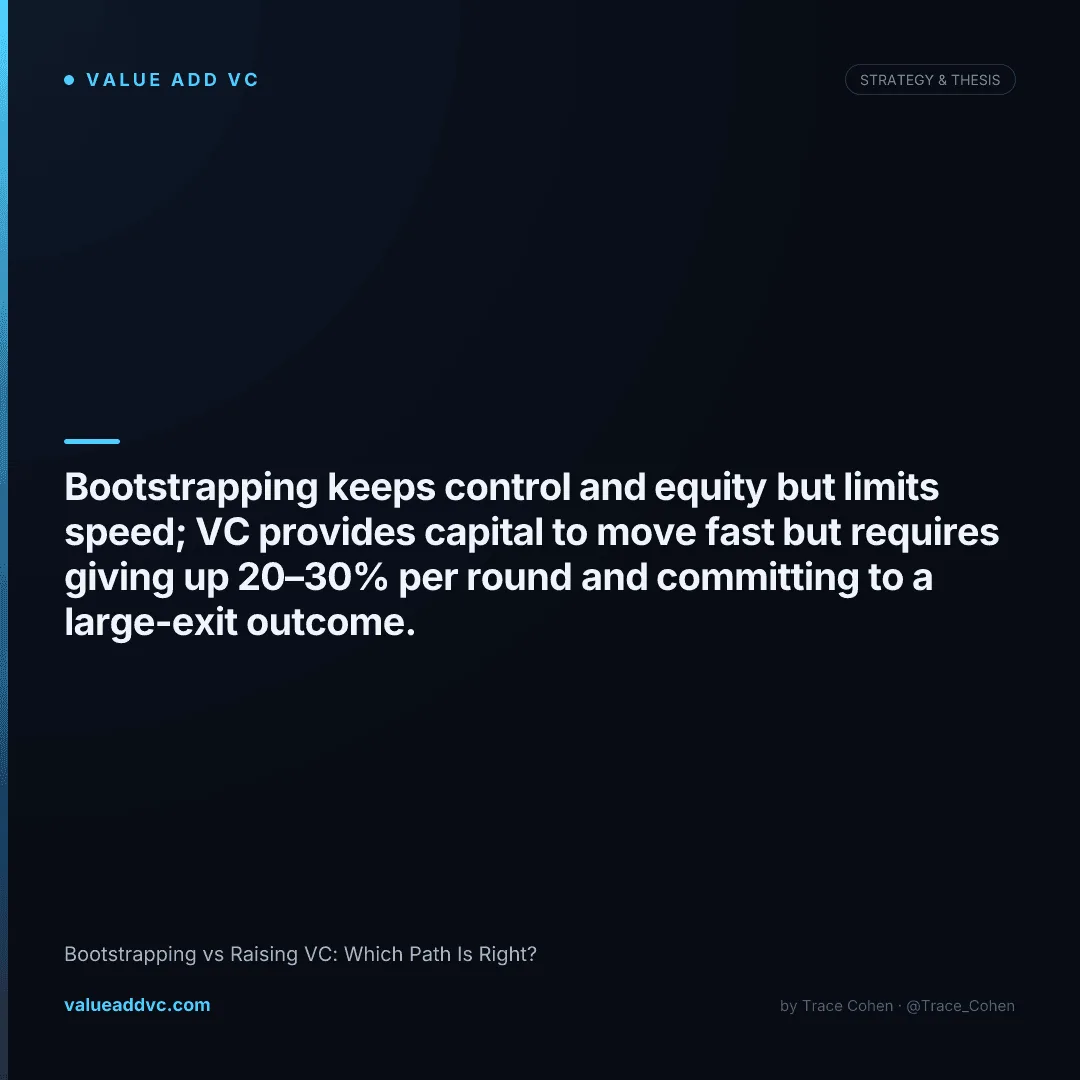
Most advice on this topic comes from one side of the fence. VCs tell you to raise. Bootstrappers tell you to stay lean. Neither is objective.
Here's the honest version.
What You're Actually Trading
The bootstrapping vs. VC decision isn't just about money. It's about what you're optimizing for — and what you're willing to give up.
Bootstrapping
You keep control
Every decision is yours. No board approval. No investor pressure on timing or direction.
You keep equity
A smaller outcome can still make you wealthy. $10M ARR bootstrapped often beats $100M ARR VC-funded in founder economics.
You move slower
Revenue constraints shape every hire, every product decision. That's discipline, but it's also a ceiling.
You have less room for error
Mistakes come out of your pocket. There's no buffer of investor capital between you and a bad quarter.
Venture Capital
You move fast
Capital lets you hire ahead of revenue, buy market position, and compress timelines that would otherwise take years.
You take on a partner
Good VCs open doors. Bad VCs create noise. You're picking a business partner for 7-10 years — not just taking a check.
You accept dilution
Seed through Series B, you're typically giving up 20-30% at each round, per Carta's dilution data. By the time you exit, founders often own 10-20% of what they built.
You lock in an outcome type
VC math requires big exits. A $20M acquisition is a rounding error for a fund. You are now on the path to $100M+ or bust.
When Bootstrapping Wins
Your market doesn't reward winner-take-all speed
If the winning move isn't to outspend competitors but to outlast them, capital efficiency is a competitive advantage, not a liability.
Your unit economics are strong from day one
If customers pay quickly, if CAC is low, and if you can fund growth from revenue — you don't need VC. You need customers.
You want flexibility in outcomes
Bootstrapped founders can sell for $5M and it's life-changing. VC-backed founders can sell for $30M and it's a bad return. Which math do you want to live inside?
Your business doesn't have a network-effect ceiling
Not every business needs to be a billion-dollar network effect business. Some of the best companies just solve hard problems for niche markets extremely well.
When VC Makes Sense
Speed is the moat
In markets where the first mover captures distribution — marketplace, social, infrastructure — capital buys the position that can't be replicated later.
The market is large and the window is open
If a massive market is shifting and you have 18-24 months to establish position before it closes, VC capital is fuel for a specific moment in time.
Your burn is pre-revenue by design
Deep tech, biotech, hardware, infrastructure — some businesses require capital before they can generate revenue. VC is the right instrument for that kind of R&D bet.
You want the network
The best VC firms bring introductions, talent pipelines, follow-on capital, and exit relationships that money alone can't buy. If those matter to your strategy, the dilution may be worth it.
The Middle Path
Bootstrapping to proof, then raising to scale.
The founders who negotiate the best deals are the ones who don't need the money. If you can reach $500K ARR bootstrapped, you raise from a position of strength — better terms, less dilution, more leverage.
This approach is increasingly common and often optimal. You validate the business on your own terms. You raise when you have leverage. You use the capital to accelerate something that's already working, not to find out if it can work.
The founders who get the worst deals are usually the ones who raised out of desperation rather than conviction.
The Question to Ask Yourself
What does success look like in 10 years — and does it require institutional capital to get there?
Am I raising because I need it, or because everyone else seems to be doing it?
Do I want to run a business, or build something to sell?
If I take VC money and my company sells for $40M in year 5, will I be happy with my outcome?
There is no universal right answer.
There's only the answer that fits the business you're building and the life you want to live.
This question sits at the core of the bootstrapping-versus-VC decision for founders everywhere. Explore the VC Fund Benchmarking tool or read the full Value Add VC book for more on how the math works out across different paths.
Latest from the Pulse
Get VC data most people never see
— free to subscribe
Trace's notes on venture, AI and startups, a few times a week. Join 5,000+ subscribers. No spam.
No spam, unsubscribe anytime. Sent via Substack · Privacy · or subscribe on Substack ↗