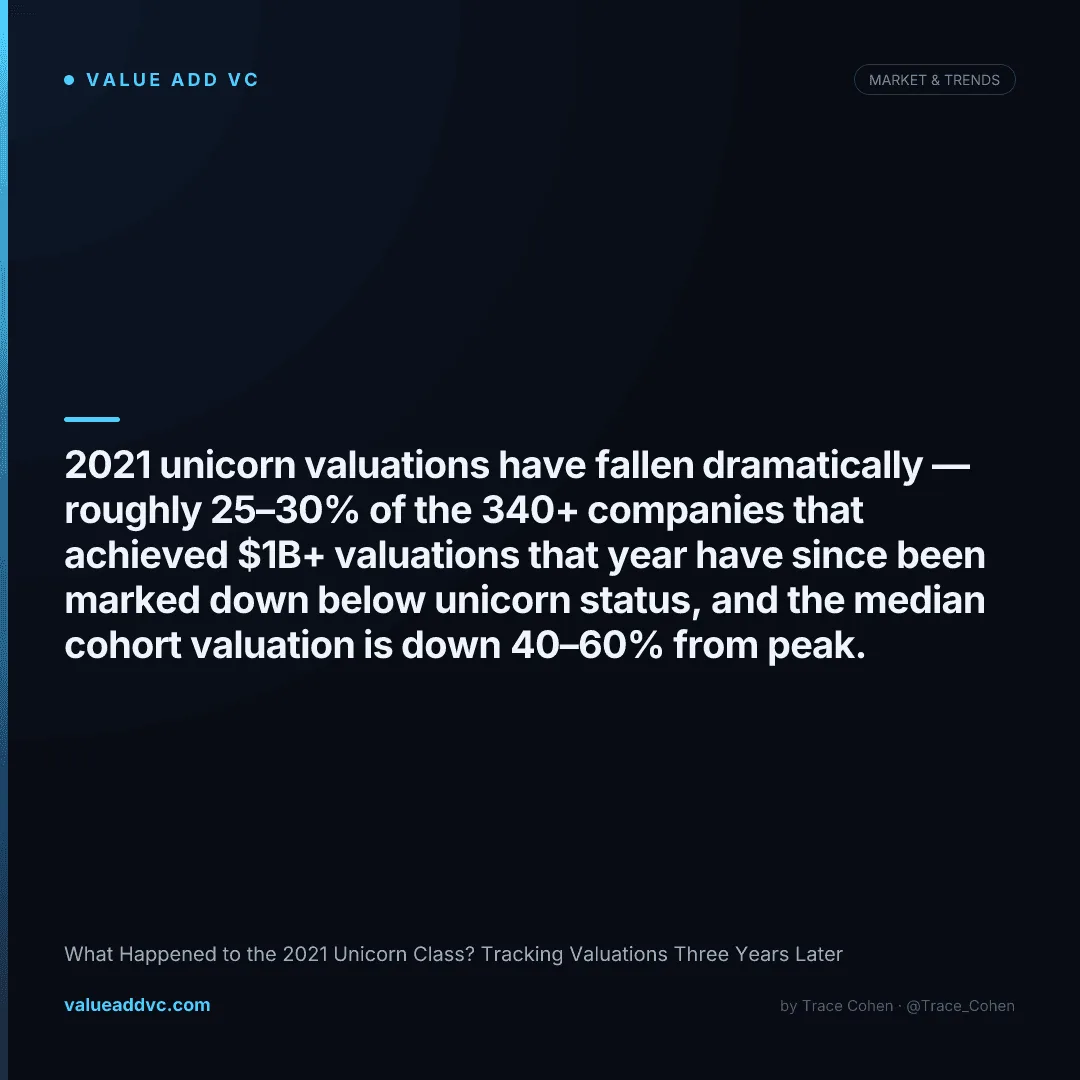
2021 was the greatest unicorn-minting machine in history. It was also a valuation bubble that has since corrected with no mercy.
340+ companies achieved $1B+ valuations in a single calendar year. By 2025, roughly 25–30% of that cohort has been marked down below unicorn status — and many of the rest are trading at steep discounts in secondary markets. The numbers are brutal, and founders and LPs need to understand exactly what happened. See which companies still hold the label on the live Unicorn tracker.
How 2021 Unicorn Valuations Got So Extreme
Three conditions aligned in 2021 that will not repeat together: near-zero interest rates (the Fed funds rate was 0–0.25%), pandemic-driven digital adoption that pulled 3–5 years of consumer behavior change into 18 months, and an unprecedented flood of crossover capital from Tiger Global, Coatue, D1, and SoftBank deploying at 50–100x ARR multiples.
Tiger Global alone participated in 335 deals in 2021 — averaging nearly one per day. SoftBank's Vision Fund 2 wrote checks measured in billions to companies with months of operating history. The median time from founding to unicorn status in the 2021 cohort was under 4 years. In prior vintages, it was 7–9 years.
I watched this from both the founder and investor side. The market had fully disconnected from fundamentals. Companies were getting $1B valuations on $10M in ARR — 100x multiples — at a time when public SaaS was trading at 30x forward revenue. When the Fed started hiking rates in March 2022, the math collapsed almost immediately, and the multiple compression that followed still hasn't fully reversed even with rate cuts now underway.
Where 2021 Unicorn Valuations Stand Today
Here is how the most high-profile members of the 2021 unicorn class have been repriced:
| Company | 2021 Peak Valuation | 2025 Status | Change |
|---|---|---|---|
| Klarna | $46B | ~$15B (post-IPO 2024) | −67% |
| Instacart | $39B | ~$10B (public) | −74% |
| Stripe | $95B | ~$70B (secondary) | −26% |
| Gopuff | $15B | Restructured / ~$1B | −93% |
| Checkout.com | $40B | ~$11B (internal mark) | −73% |
| Bolt (fintech) | $11B | Effectively zero | −100% |
| Fast (checkout) | $580M | Shut down 2022 | −100% |
| Hopin (events) | $7.8B | Sold for ~$15M | −100% |
Sources: CB Insights, PitchBook, public filings, secondary market data (2024–2025).
Which Sectors Got Hit Hardest
Not all of the 2021 cohort has collapsed equally. The worst-performing verticals were the ones most dependent on cheap capital, consumer behavior shifts, or near-zero interest rate environments:
- •BNPL and fintech lending — Klarna, Affirm, Sezzle, Zip all saw 60–90% valuation haircuts as rising rates crushed unit economics on consumer credit
- •On-demand delivery and quick commerce — Gopuff, Getir, Jokr, and others burned billions chasing 15-minute grocery delivery at unsustainable CAC
- •Crypto and Web3 — Dozens of 2021 unicorns in this category are now at zero following the FTX collapse and broader crypto winter
- •DTC and e-commerce — Companies like Glossier, Allbirds, and Warby Parker saw public or secondary valuations crater 70–90% as the D2C playbook stopped working post-iOS 14
- •Real estate tech — OpenDoor, Offerpad, and similar iBuyers were gutted by rising rates and inventory normalization
- •AI-native 2021 unicorns — The outliers. Companies like Scale AI and Cohere that pivoted hard to enterprise AI maintained or grew their valuations into 2024–2025
What the LP Portfolio Impact Looks Like
For LPs in 2021-vintage funds, this has been a painful cycle. Tiger Global's hedge fund lost approximately 52% in 2022 alone, and its VC-style crossover positions were marked down accordingly. SoftBank Vision Fund 2 reported a $21B investment loss for fiscal year 2022.
Traditional VC funds have fared better but not by as much as their reported TVPI suggests. The problem: many 2021-vintage VC funds still carry positions at or near peak marks because the companies haven't done down-rounds or liquidity events that would force a re-mark. On paper, TVPI looks acceptable. In reality, the DPI (actual cash returned) from these funds is near zero — and DPI is the metric that actually matters.
You can track real-time unicorn data — including current valuations, funding history, and geographic distribution — on the Unicorn Tracker dashboard at ValueAddVC.com. The gap between reported marks and secondary prices is often 30–50% for 2021-vintage positions.
The 2021 Survivors: What Separated Them
Some 2021 unicorns not only survived but thrived. The pattern is consistent across the ones that held or grew their valuations:
Real revenue, not GMV: Companies that were measuring actual SaaS revenue — not gross merchandise value, not adjusted revenue, not engagement metrics — had a foundation that could be valued conventionally. Stripe, despite being marked down from $95B, still generated estimated $3.7B in net revenue in 2023 and raised at a $70B secondary valuation in 2024.
Unit economics that worked at scale: The quick commerce and BNPL players had unit economics that required infinite growth to justify — though as our check-in on BNPL's post-2021 recovery shows, the survivors eventually fixed that math. The B2B SaaS players and infrastructure companies with 70%+ gross margins could weather a reset in multiples. The multiple compressed, but the business remained viable.
AI pivot timing: A handful of 2021 unicorns repositioned early enough to benefit from the generative AI wave. Scale AI (valued at $7.3B in 2021, then $14B in 2024) is the clearest example — their data labeling business became foundational infrastructure for every major AI lab.
The 2021 unicorn class is not a failure of venture capital — it is a masterclass in what happens when capital markets detach from fundamentals. The lesson for the next cycle: a billion-dollar valuation is only real when a billion-dollar buyer exists.
Track live unicorn valuations and funding data on the Unicorn Tracker at Value Add VC. Originally published in the Trace Cohen newsletter.
Latest from the Pulse
Get VC data most people never see
— 100% free
Weekly benchmarks, valuations, and fund data. Join 5,000+ investors. No spam.