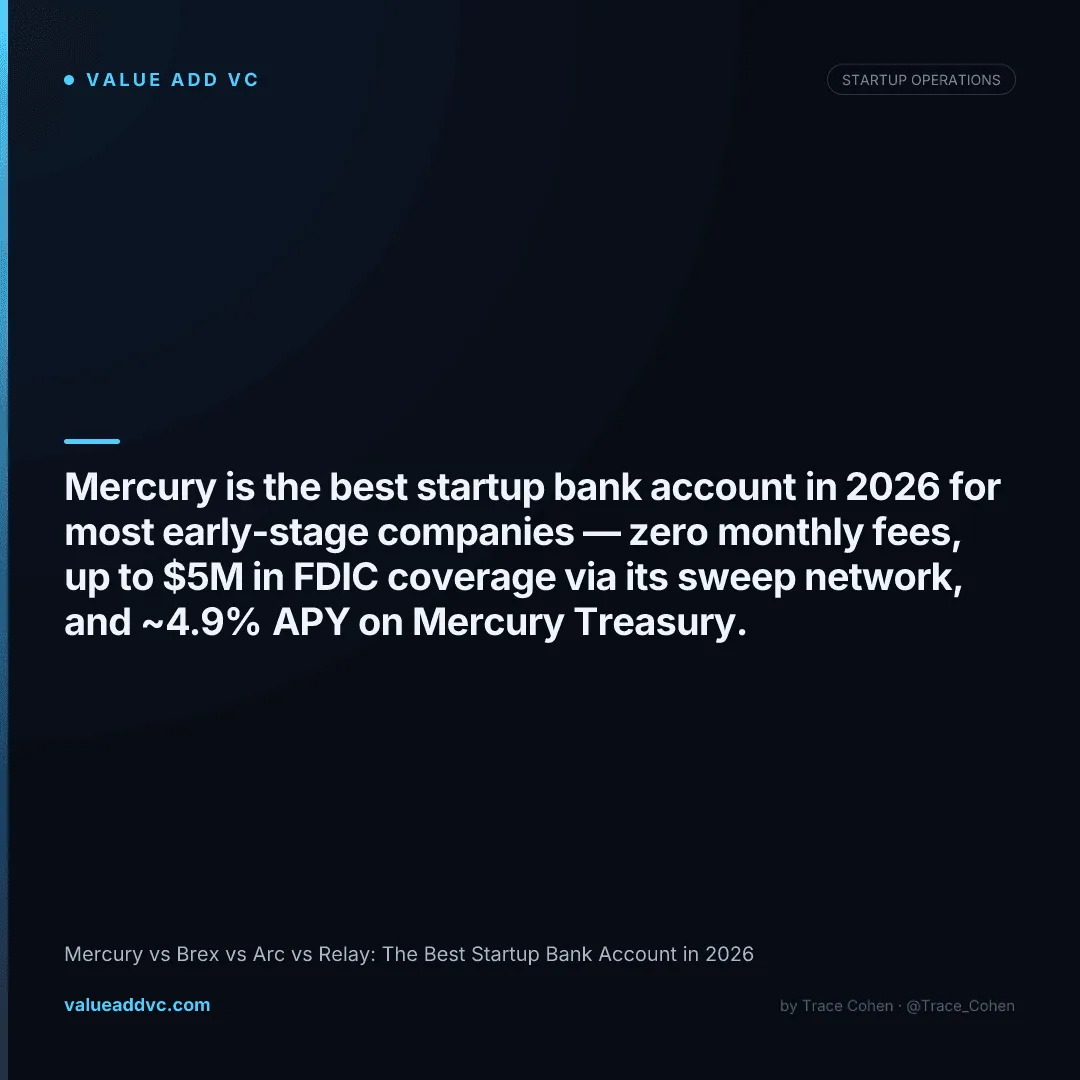
Most founders open a Mercury or Brex account on day one without comparing the actual differences — and that decision matters a lot more at $2M in the bank than it did at $20K.
Some links on this site may earn us a commission — this never affects rankings. See our editorial standards.
Six platforms now dominate venture-backed startup banking in 2026: Mercury, Brex, Meow, Rho, Arc, and Relay. Every one of them is free to open. The real differences are FDIC sweep coverage (which ranges from $3M to $125M), treasury yield on idle runway, whether a real corporate card program is attached, and how much finance-team work the software absorbs. After SVB, no founder should need convincing that where your runway sits — and how it is insured — is a survival question, not an ops detail.
Here is the ranked breakdown with verified September 2026 numbers. For the two-way version of the top matchup, see Mercury vs Brex in 2026.
What changed since our last update: Mercury is still waiting on its national bank charter — the OCC's conditional approval from April 28, 2026 still requires separate FDIC and Federal Reserve sign-off, and as of September 2026 Mercury remains in the bank-organization phase. Arc, meanwhile, confirmed its FDIC sweep coverage increase to $5.25M across a BNY Mellon-run network that includes Goldman Sachs, JPMorgan Chase, and Citibank.
The Best Startup Banks in 2026, Ranked
Startup Banks Compared: Fees, Coverage, Yield, and Cards
| # | Platform | Monthly Fee | Max FDIC Sweep | Treasury Yield (9/2026) | Corporate Card | Best For |
|---|---|---|---|---|---|---|
| 1 | Mercury | $0 | $5M | MMF via Treasury ($250K min) | IO card (modest) | Default for most startups |
| 2 | Brex | $0 / $12 per user (Premium) | $6M | ~3.35–3.7% (DGVXX) | Yes — flagship | Banking + cards + spend |
| 3 | Meow | $0 | Up to $125M | ~3.96–4.12% net; T-bills at 1bp/mo | Basic | Max coverage, big balances |
| 4 | Rho | $0 | $75M (savings) | Up to 4.59% net ($100K min) | Yes | Service + top yield |
| 5 | Arc | $0 | $5.25M | Up to 4.32% net (Enterprise) | No native card | Treasury + venture debt |
| 6 | Relay | $0 / $30 / $90 | $3M | 1.11–3.00% APY (savings, by plan) | Debit + charge cards | Budget controls |
Sources: published pricing and coverage pages at mercury.com, brex.com, meow.com, rho.co, joinarc.com, and relayfi.com, plus NerdWallet's 2026 reviews of Mercury, Brex, and Relay. Yields as of September 2026 and move with short-term rates; treasury products are SIPC-protected investments, not FDIC-insured deposits.
How We Ranked These
We weighted four factors: safety of funds — FDIC sweep coverage, partner-bank quality, and regulatory posture (35%); total cost including fees, wire pricing, and yield on idle cash (25%); product depth for a venture-backed company — cards, bill pay, sub-accounts, accounting integrations (25%); and fit signals from actual startup usage, including which platforms institutional investors expect to see (15%). Every figure comes from the providers' own published pages — Mercury's treasury and FDIC documentation, Brex's business account page, Rho's published treasury rates, Relay's pricing page, and the FDIC's deposit insurance rules — cross-checked against NerdWallet's 2026 reviews, as of September 2026. Sponsors and affiliate partners never influence rank or inclusion — see our editorial standards.
How to Choose by Stage
Pre-seed / Bootstrapped
Mercury
Free, fast to open, $5M sweep, and every investor you will ever meet already knows it. Nothing at this stage justifies more complexity.
Seed ($1M–$5M raised)
Mercury + a treasury layer
Keep operations on Mercury and put runway to work: Mercury Treasury from $250K, or Meow/Arc for T-bill exposure. At ~4% net, a $3M seed round throws off roughly $120K a year — real runway.
Series A+ (10+ employees)
Brex or Rho
Once card spend and headcount grow, the platform matters more than the account. Brex if you want the deepest spend automation; Rho if you value human service and its 4.5%+ treasury. Many teams keep Mercury alongside.
Large balances ($10M+)
Meow or Rho alongside your primary
At this size, insured coverage is the constraint. Meow's $125M FDIC ceiling and 1bp/mo T-bills, or Rho's $75M savings sweep, cover balances that Mercury's $5M cap cannot.
Wondering about Novo or Found? Both are solid for freelancers and small service businesses, but neither offers the multi-million-dollar sweep coverage or treasury products a funded startup needs — which is why they are not ranked here.
The Yield Math Nobody Talks About
A startup that raises $3M and leaves it in a standard checking account at 0.01% APY earns $300 a year. The same $3M in a treasury product netting 4% earns roughly $120,000 — more than a junior hire's fully loaded cost, generated by a form you fill out once. The spread between the best and worst cash setups in this ranking is worth more than every SaaS discount your company will ever negotiate, combined.
| Balance | Standard Checking (0.01%) | Meow (~4.0% net) | Rho Treasury (~4.57%) |
|---|---|---|---|
| $500K | $50/yr | $20,000/yr | $22,850/yr |
| $1M | $100/yr | $40,000/yr | $45,700/yr |
| $3M | $300/yr | $120,000/yr | $137,100/yr |
| $5M | $500/yr | $200,000/yr | $228,500/yr |
Illustrative annualized figures at September 2026 advertised net yields; rates are variable and not guaranteed. Treasury products are investments (SIPC-protected), not FDIC-insured deposits.
Every one of these accounts is free. What you are actually choosing is coverage, yield, and workflow.
Mercury for most. Brex or Rho when your team scales. Meow when your balance outgrows a $5M sweep.
Track startup financial benchmarks and burn rate data on the Startup Benchmarking Dashboard at Value Add VC. Originally published in the Trace Cohen newsletter. Full funding and business-model detail on the Mercury and Brex company profiles.
Latest from the Pulse
Get VC data most people never see
— free to subscribe
Trace's notes on venture, AI and startups, a few times a week. Join 5,000+ subscribers. No spam.
No spam, unsubscribe anytime. Sent via Substack · Privacy · or subscribe on Substack ↗