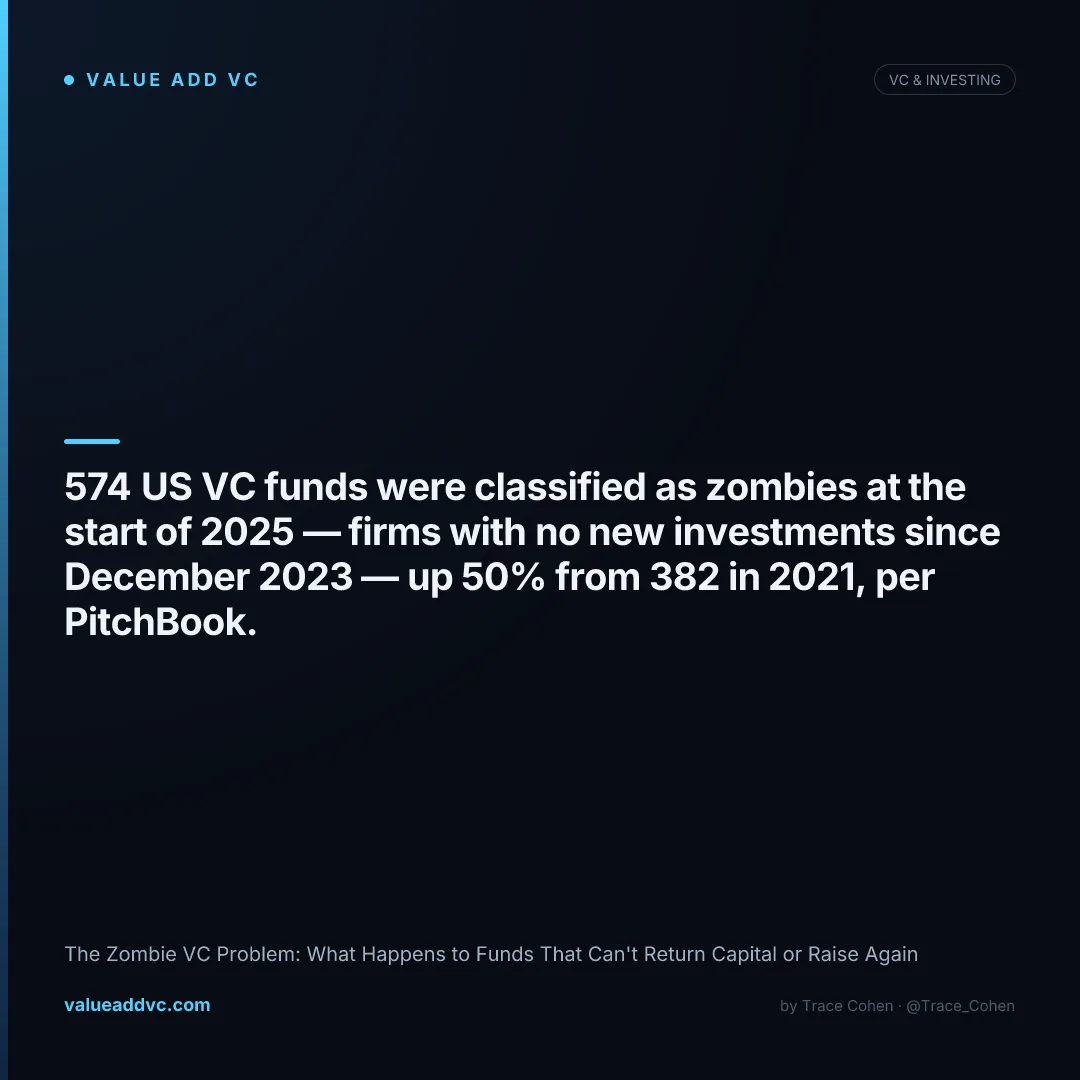
574 US venture funds were zombies at the start of 2025 — firms that raised money in the prior six years but hadn't made a new investment since December 2023 — up 50% from 382 at the end of 2021, per PitchBook. That's the short answer. The longer answer is more interesting.
A zombie fund doesn't announce itself. There's no press release, no wind-down notice. The GP keeps a website, keeps taking the 2% management fee, and keeps showing a markup-inflated TVPI on the quarterly report. What's missing is any actual cash back to LPs, any new checks written, or any real path to raising a Fund III. The fund is alive on paper and dead in practice — and 2026's liquidity drought is producing more of them than at any point since PitchBook started tracking the metric.
What counts as a zombie VC fund in 2026
A zombie VC fund is a firm that raised money within the prior six years but has made no new investments in over a year, per PitchBook. By that measure, 574 US firms qualified at the start of 2025, up 50% from 382 at the end of 2021 — still charging fees, but no longer deploying capital.
The trigger isn't one bad year; it's a GP that can no longer justify writing new checks because the last fund hasn't returned enough capital to convince LPs, or the partners themselves, that another deployment cycle makes sense.
The underlying driver is a distributions problem, not a deal-flow problem. Only 37% of 2019-vintage funds and 30% of 2020-vintage funds had made any distributions to LPs by Q1 2025, per Carta's fund performance data. Without DPI to show, a GP has nothing but paper markups to justify Fund III — and increasingly, LPs aren't buying it. You can track how DPI and TVPI compare across vintages on the VC Performance dashboard.
The zombie VC fund count by year
The zombie count and the collapse in unique investors are two sides of the same consolidation — fewer firms writing checks, and more of the firms still standing unable to deploy.
| Period | US zombie VC funds | Unique active investors | Funds with any LP distributions |
|---|---|---|---|
| End of 2021 | 382 | ~25,133 | n/a (pre-vintage) |
| 2019 vintage (by Q1 2025) | — | — | 37% |
| 2020 vintage (by Q1 2025) | — | — | 30% |
| Start of 2025 | 574 | ~11,425 | — |
| 3-year change | +50% | -54% | — |
Zombie fund counts and unique investor figures per PitchBook, cited in PitchBook News and LinkedIn Pulse analysis, 2021-2025. Distribution rates per Carta's VC Fund Performance Q1 2025 report. Dashes indicate the metric wasn't reported for that period in the same dataset.
Why VC funds can't return capital or raise again
Three mechanics turn a slow fund into a dead one, and they compound on each other.
The exit market stayed shut for years
IPO and M&A volume stayed depressed through 2022-2024, leaving GPs holding paper markups with no realized cash to distribute.
IRR decays the longer a company is held
Bain's 2026 Private Equity Outlook found IRR stagnates around year seven of a hold and declines after — every extra year without an exit makes the fund's numbers worse, not better.
No DPI means no Fund III
LPs increasingly underwrite re-ups on realized DPI, not TVPI. A GP with 37% distribution coverage on a 2019 fund has almost nothing concrete to show.
Key-person and time drift
As a fund ages without new deployments, partners leave, deal teams shrink, and the firm loses the operating muscle needed to source and win new deals even if capital appeared.
None of this is really about a single bad market year. It's a slow bleed — a fund that missed its exit window in 2022-2023 is now three years further into a hold period where IRR mechanically erodes every quarter it doesn't distribute. Benchmark a fund's actual TVPI and DPI against vintage-year peers on Benchmarking before assuming paper markups mean the fund is healthy.
What LPs can actually do about a zombie VC fund
LPs have real levers here — they're just rarely pulled because forcing the issue crystallizes a loss the LP would rather defer.
Tools LPs actually have
- ✓ LP advisory committee approval required for term extensions
- ✓ Key-person clauses that can suspend new investment authority
- ✓ No-fault divorce provisions to remove a GP with a supermajority vote
- ✓ Secondary sale of the LP stake to exit the fund early
Why they rarely get used
- ✕ Forcing liquidation crystallizes losses LPs would rather defer
- ✕ Coordinating a supermajority of LPs is slow and contentious
- ✕ Secondary sales on zombie stakes trade at steep discounts
- ✕ Most LPAs weren't written with today's liquidity drought in mind
The more common outcome is quiet attrition — a GP stops marketing a new fund, the team shrinks to one or two partners winding down the existing portfolio, and LPs simply write the position down over several years rather than force a fight. Compare that against how Funds tracks GP activity and fundraising status across the market.
A zombie fund isn't a failed fund on paper.
It's a fund that stopped fighting for exits — and with 574 of them now on the books, LPs need to start asking for DPI, not TVPI.
Track fund distributions, DPI, and GP activity on the VC Performance dashboard at Value Add VC. Originally published in the Trace Cohen newsletter.
Latest from the Pulse
Get VC data most people never see
— 100% free
Weekly benchmarks, valuations, and fund data. Join 5,000+ investors. No spam.