The pitch was great. The team shipped product. Customers signed contracts. But two years later, the company has $3M ARR, growth has slowed to 18% year-over-year, the last round valued it at $40M post-money, and no acquirer would pay that number.
The founder can't raise a new round at the same terms. The investors can't write down the position without triggering LP questions. Nobody wants to pull the plug. This is a zombie startup — and there are thousands of them right now.
What Defines a Zombie Startup
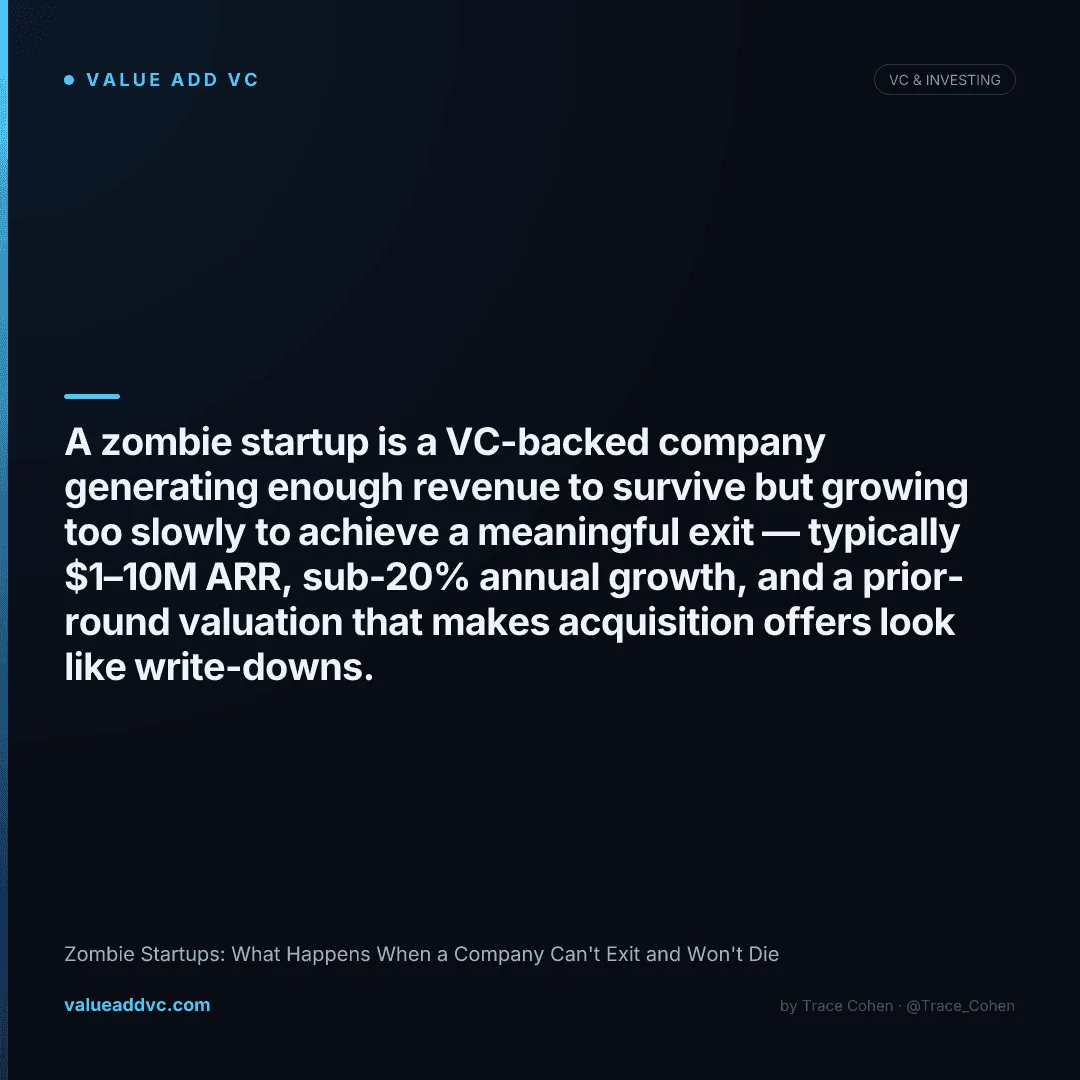
The term gets thrown around loosely, but the pattern is specific. A zombie startup has all of these characteristics:
ARR between $1M–$10M
Growing at less than 20% year-over-year — below the threshold for a credible next round
Inflated prior-round valuation
A post-money valuation that makes any realistic acquisition price look like a write-down for later investors
No clear path to exit
Growth rate is insufficient for an IPO; no strategic acquirer will pay the last-round price
Cash-flow neutral or slightly positive
The company can survive indefinitely — but isn't growing toward venture-scale returns
Held at cost or minimal markdown in the fund
The VC still reports this at the original entry price, even though a market sale would be 50–80% lower
The 2021 vintage produced more zombie startups than any cohort in modern VC history. When interest rates were near zero and SaaS multiples were 15–20x ARR, a company with $5M ARR could raise at a $50–75M post-money valuation. Those same multiples now sit at 4–6x ARR — meaning the identical company is worth $20–30M. Investors won't approve a sale at a 50–60% discount to their cost basis unless they absolutely have to.
The Scale of the Zombie Startup Problem
This isn't a niche problem. Estimates from Carta, Dealroom, and CB Insights suggest roughly 30–40% of all VC-backed startups eventually become zombies — companies that neither fail cleanly nor exit successfully.
30–40%
of VC-backed startups that become zombies
Carta / CB Insights est.
5,000+
US startups from 2019–2022 with no follow-on, exit, or confirmed shutdown
PitchBook 2025
$600B+
in global VC deployed at inflated valuations in 2020–2022
KPMG Venture Pulse
The most affected cohort is the 2020–2022 vintage, when over $600B in global VC was deployed at historically elevated multiples. Many of those companies raised at 15–30x ARR during the peak. When compression hit in 2022–2023, they became structurally unacquirable at their last-round price — and have been drifting since.
What the Zombie Startup Does to a VC Fund
For a VC fund, a zombie startup is a capital trap. The mechanics are brutal and compound over time:
Unrealized positions that LPs distrust
Every quarter the fund reports a carrying value that no secondary buyer would actually pay. LPs increasingly ask for write-downs or evidence of exit timelines.
GP attention is consumed
Zombie portfolio companies show up on every board agenda. They generate more work than the winners — constant bridge discussions, strategic pivots that go nowhere, and founder management.
Follow-on capital gets deployed poorly
Some GPs continue funding zombie companies with small bridges to avoid the write-down conversation. This destroys additional capital that should go to the portfolio winners.
Fund lifecycle gets extended
A 10-year fund with zombie exposure often extends to 12–13 years. LPs hate this — it delays return of capital and complicates their own allocation planning.
Next fund becomes harder to raise
DPI — actual distributions to LPs — is what matters when raising Fund III or IV. A portfolio full of zombies means low DPI, which means a much harder fundraise from institutional LPs.
Continuation funds as a workaround
Some GPs roll zombie positions into a new continuation vehicle, effectively kicking the can. This works once. It destroys trust with LPs if used as a regular mechanism.
I've seen GPs accept 0.3–0.5x on cost in secondary transactions just to clear a zombie position and move on. That's painful. But it's often the right call when the alternative is watching the position deteriorate for another three years while the team slowly disperses. Track the real data on VC fund performance on the VC & PE Performance dashboard.
The Four Real Exit Paths for a Zombie Startup
There are exactly four outcomes that actually happen for zombie startups. Recovery to unicorn is not on the list for 99% of companies.
Acqui-hire
The team is valuable even when the product isn't. Big tech and late-stage growth companies regularly pay $1–3M per engineer in acqui-hire structures. For a 20-person team, that's $20–60M total — often enough to return capital to seed and Series A investors, rarely enough to make whole the Series B+ holders.
Strategic acquisition for the customer base
A larger player in the same vertical buys the company at 1–2x ARR to acquire the customer relationships and contracts. These deals almost never return late-round VC money but often clear early investors and give founders a soft landing with earnout structures.
Secondary sale of VC positions
Investors sell their shares on platforms like Forge, Carta Secondary, or directly to secondary funds at 50–90% discounts to the last primary round price. This crystallizes the loss but clears the GP's position and removes the zombie from the reported portfolio. Secondary pricing for zombie startups has been brutal: typical bids in 2024–2025 were 15–30 cents on the dollar for 2021-vintage companies.
Quiet wind-down
More common than anyone publicly admits. The founder negotiates a soft landing — a few months of managed runway paid by the investors, IP placed in a shelf company, and a mutually agreed narrative about "winding down to explore new opportunities." Sometimes customers are transitioned to a competitor. Sometimes the product just goes dark.
What Founders Should Actually Do
If you're running a zombie company and you know it, stop pretending otherwise. The best founders I've seen navigate this situation share a few common behaviors:
Have the honest conversation with the board early — not after another year of bridge rounds that accomplish nothing
Explore acqui-hire options while the team is still intact, motivated, and the relevant talent market is aware of your name
Negotiate founder liquidity into any deal structure — you've spent years on this and you deserve something for it
Don't raise more primary capital to extend the status quo unless there is a genuine change in the business model or a new market thesis
Talk to secondary buyers early to understand what your investors' positions would actually clear at — this forces a realistic conversation about alternatives
Protect your reputation above all else — how you handle the wind-down or sale will define your next company's fundraise
The VC ecosystem doesn't have a good mechanism for zombie exits. It's not glamorous, it doesn't make the highlight reel, and the incentives often favor delay over resolution. But clean endings preserve founder reputation, return something to investors, and let everyone move on to the next thing. The founders who handle this well raise their next round faster than those who string it out.
The zombie startup problem is a $50B+ trapped capital problem.
The investors who get ahead of it — marking down early, clearing positions via secondary, and facilitating acqui-hires — will have the DPI to raise their next fund.
The ones who wait will be the reason LP confidence in venture erodes further. The math doesn't improve with time.
Track VC fund performance and DPI benchmarks on the VC & PE Performance dashboard at Value Add VC. Originally published in the Trace Cohen newsletter.
Latest from the Pulse
Get VC data most people never see
— 100% free
Weekly benchmarks, valuations, and fund data. Join 5,000+ investors. No spam.