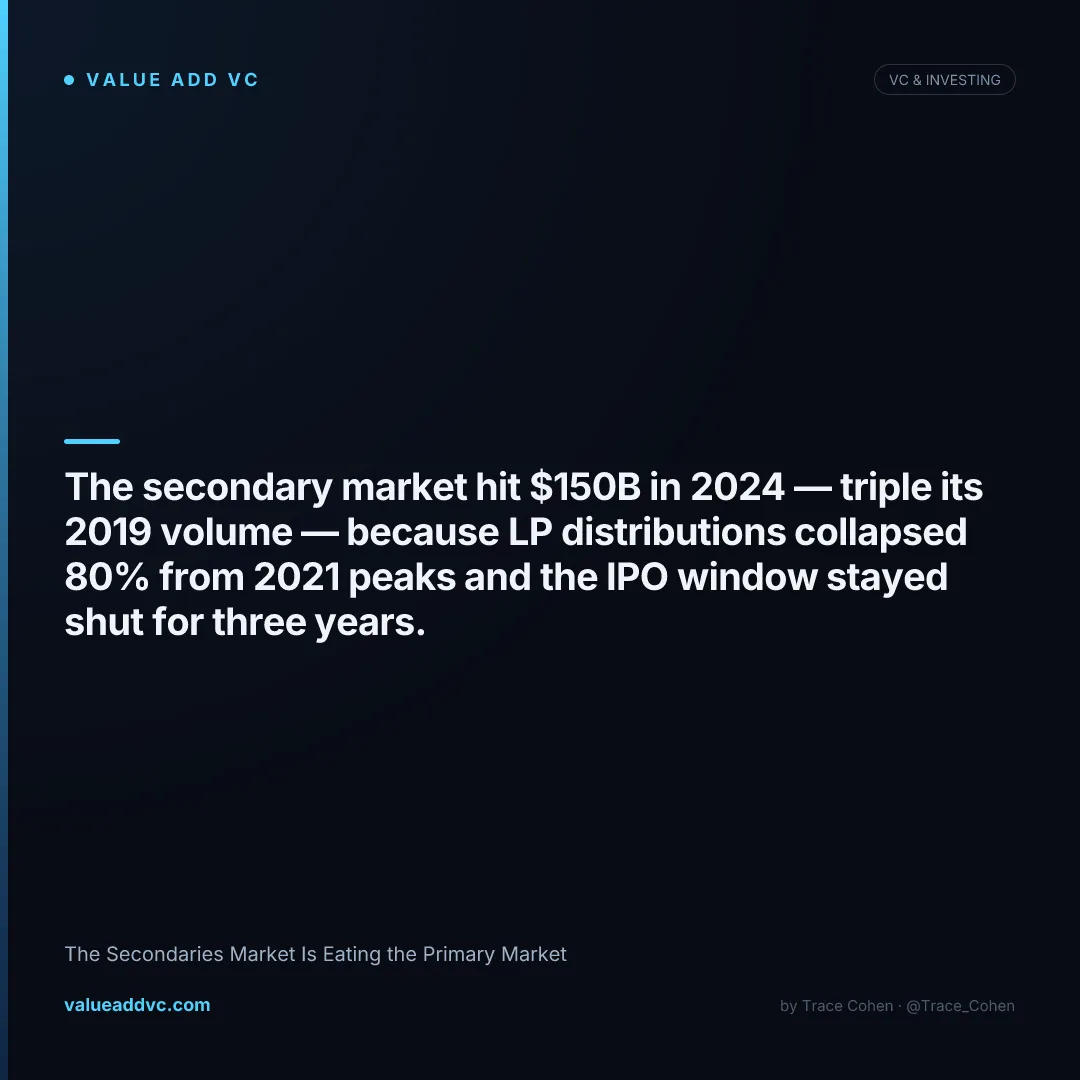
The secondary market hit $150B in 2024. Five years ago it was $50B. It is not a niche corner of venture capital anymore — it is where prices are actually set.
While everyone argues about primary valuations and what multiples are "fair" for AI companies, the secondary market has quietly become the only venue in private markets with real price discovery. Every other number is a self-reported quarterly mark.
Why the Secondary Market Tripled in Five Years
Three structural forces accelerated simultaneously and created a secondary market that now rivals primary fund activity in scale.
First, LP distributions collapsed. The industry returned $220B to LPs in 2021. By 2024, that number was under $60B — an 80%+ decline driven by a closed IPO window, nearly no M&A activity at meaningful valuations, and GPs holding assets far beyond their original timelines. LPs in 2018-2022 vintage funds have DPI averaging below 0.3x. They needed a way out, and the secondary market is the only door open.
Second, hold times extended dramatically. The median time from first institutional funding to exit stretched from 7 years in 2015 to over 11 years by 2024. Fund after fund ran past its 10-year life with no exit in sight. LPs can't legally stay in indefinitely — secondaries became the structural release valve.
Third, GP-led secondaries emerged as a legitimate asset class. Rather than forcing portfolio companies into bad exits, GPs began rolling winners into continuation funds — giving LPs the choice to cash out or stay in. GP-led deals grew from 30% of secondary volume in 2019 to over 55% by 2024. The biggest dedicated buyers — Lexington Partners ($22B+ in AUM), HarbourVest, Blackstone Strategic Partners, Coller Capital — now run dedicated strategies with $10-22B in dry powder each.
The Signals Hidden in Secondary Pricing
I've been watching secondary pricing data closely because it tells you something no quarterly mark ever will: what a motivated, informed seller will actually accept from a skeptical buyer under no obligation to purchase.
In 2024, 2021-vintage fund positions were broadly trading at 60-75 cents on the dollar. That's not distress selling — that's the market correcting the 2021 markup cycle. The private book values that funds are still reporting are simply not what the secondary market is clearing at. Secondary prices lead formal write-downs by 6-12 months, consistently.
For high-quality assets — top AI companies, vertical software leaders with strong NRR — some secondaries are clearing at a premium to last round. Platforms like Forge, Nasdaq Private Market, and Zanbato now create continuous price signals for late-stage private companies that previously had no public price reference. This is new, and it matters for how everyone — founders, employees, and investors — should think about their paper holdings.
What This Changes for Every Market Participant
- •LPs: Secondary is no longer the nuclear option. Selling fund stakes at a 20-25% discount buys capital recycling that outperforms sitting on a flat carry pool for five more years. Top endowments now run active secondary programs as a core part of their alternatives strategy, not a fallback.
- •GPs: Continuation funds give you optionality, but they create real conflicts. You're effectively setting the price while advising both the seller (old fund LPs) and the buyer (continuation fund LPs). Expect more LP scrutiny and regulatory attention on GP-led deal structures through 2026 and beyond.
- •Founders: Secondary tender offers let early employees and angels convert paper to cash. But unmanaged secondary sales — especially when early institutional investors exit — send a loud signal to the market. Founders need to treat their secondary market as actively as their primary fundraising process.
- •Secondary buyers: This is arguably the best risk-adjusted return in private markets right now. You buy assets with years of de-risking behind them, at discounts to book, with a shorter J-curve. Dedicated secondary funds raised over $80B in new capital in 2024 alone — the smart money has already voted.
- •Emerging managers and angels: Secondary is becoming a legitimate entry point for smaller check writers. AngelList, Yardstick, and Forge now enable sub-$250K secondary positions in late-stage companies. The market is democratizing whether large institutions want it to or not.
The primary market sets the narrative. The secondary market sets the price. In venture capital right now, the secondary market is winning.
Stay current with VC and startup trends at Value Add VC. Originally published in the Trace Cohen newsletter.
Latest from the Pulse
Get VC data most people never see
— 100% free
Weekly benchmarks, valuations, and fund data. Join 5,000+ investors. No spam.