
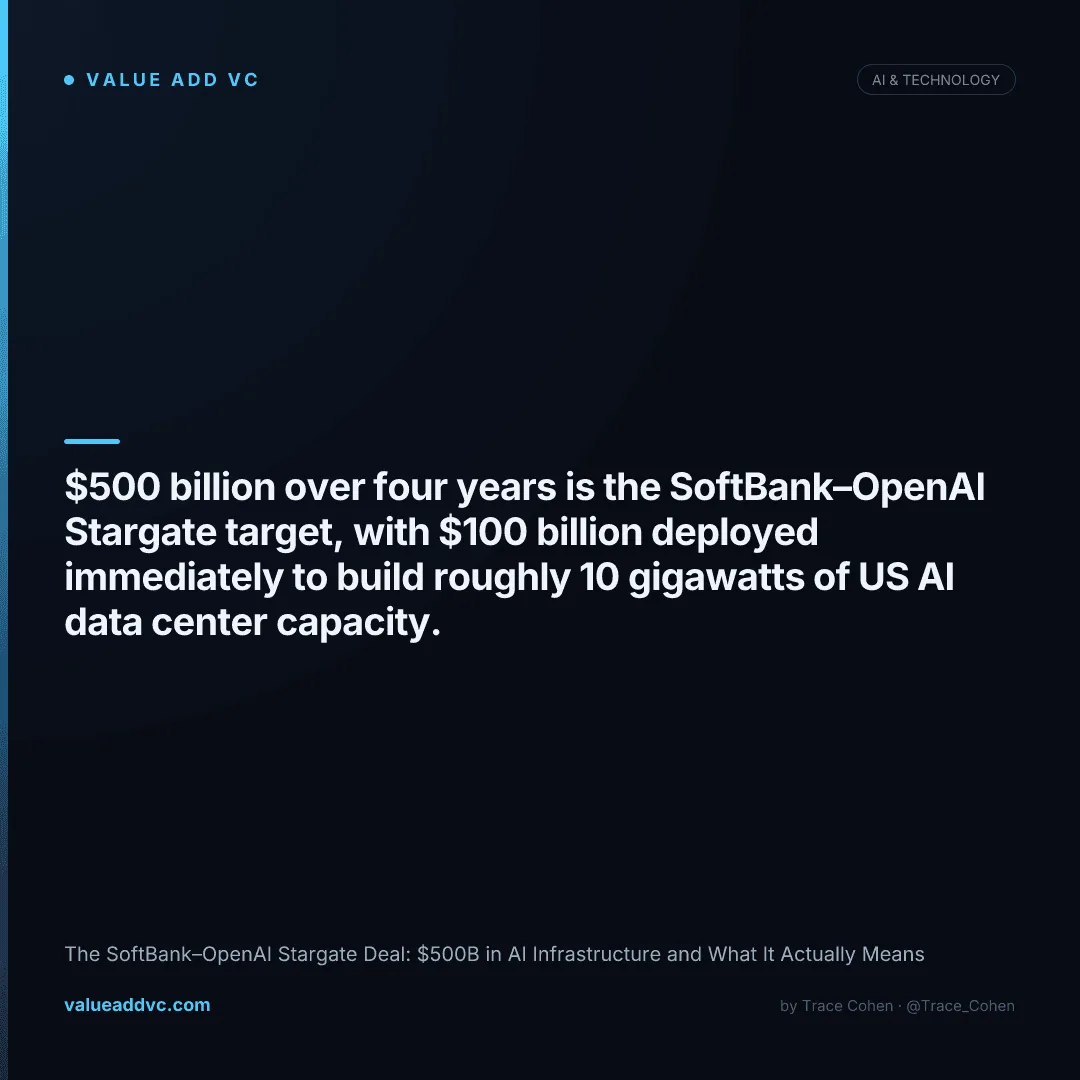
Stargate commits up to $500 billion over four years to build roughly 10 gigawatts of US AI data centers — but only $100 billion is actually funded, and most of the rest is debt that doesn't exist yet.
That gap between the headline number and the wired number is the entire story. The $500B figure got the White House podium and the press cycle. The structure underneath it — who owns what, who borrows what, and what has to go right — is where you actually learn whether this is the biggest infrastructure bet in history or the biggest press release.
What the SoftBank OpenAI Stargate deal actually is
The SoftBank OpenAI Stargate deal is a joint venture announced in January 2025 that targets up to $500 billion of investment over four years to build AI data center infrastructure across the United States. SoftBank and OpenAI each anchored the initial roughly $18 billion of equity, Oracle and Abu Dhabi's MGX added about $7 billion each, and an initial $100 billion is being deployed now. SoftBank carries financial responsibility; OpenAI carries operational responsibility.
Who is in the Stargate deal — and what each party brings
Stargate is a four-party venture where each backer covers a different gap. None could do it alone, which is exactly why it's a consortium rather than a single balance sheet.
| Party | Role | Initial equity | What they bring |
|---|---|---|---|
| SoftBank | Lead financier | ~$18B | Capital, debt arrangement, Masayoshi Son's risk appetite |
| OpenAI | Operator / tenant | ~$18B | Demand — the compute is for its models |
| Oracle | Cloud / build partner | ~$7B | Data center construction and OCI integration |
| MGX (Abu Dhabi) | Sovereign equity | ~$7B | Patient capital from a $100B+ AI fund |
| Nvidia | Tech partner | Supplier | GPUs — the single largest hardware line item |
| Microsoft / Arm | Tech partners | Supplier | Cloud, networking, chip architecture |
The tell is that OpenAI is both an equity owner and the customer. Stargate isn't building speculative capacity for an open market — it's building captive capacity for one tenant whose own revenue is still ramping. That's the core circularity critics keep pointing at.
What the Stargate $500 billion actually builds
Strip away the abstraction and $500 billion buys physical things: land, concrete, GPUs, transformers, and water. AI data centers cost roughly $40–50 billion per gigawatt all-in, so 10 gigawatts is exactly the order of magnitude the headline implies.
10 GW
Target compute capacity — enough to power millions of homes
$40–50B
All-in cost per gigawatt of AI data center
1M+ sq ft
Flagship Abilene, Texas campus footprint
~100,000
Construction and operations jobs claimed by the venture
$100B
Capital being deployed in the immediate first phase
60–70%
Share of all-in cost that is Nvidia GPUs and networking
The flagship is already rising in Abilene, Texas, built with Oracle and Crusoe. Additional sites have been scouted across roughly a dozen states, with power — not money — emerging as the binding constraint. A single 1GW campus draws as much electricity as a mid-sized city, which is why Stargate's timeline is now effectively a grid-interconnection timeline.
How Stargate compares to hyperscaler AI capex
The cleanest way to size Stargate is against what the public hyperscalers are spending. The difference isn't just scale — it's funding source. Microsoft and Google spend from operating cash flow; Stargate spends from a financing structure that mostly still has to be raised.
| Entity | AI infra commitment | Time frame | Funded by |
|---|---|---|---|
| Stargate | Up to $500B | 4 years (2025–2029) | JV equity + project debt |
| Microsoft | ~$80B (FY25) | 1 year | Operating cash flow |
| Amazon (AWS) | ~$80B (2025) | 1 year | Operating cash flow |
| ~$75B (2025) | 1 year | Operating cash flow | |
| Meta | ~$65B (2025) | 1 year | Operating cash flow |
| Big Four combined | ~$300B (2025) | 1 year | Operating cash flow |
Spread over four years, Stargate's $500B is about $125B a year — comparable to a single hyperscaler's annual run-rate, not a wild outlier. The difference is that Microsoft can absorb a demand miss because the capex is a fraction of a $250B+ revenue base. Stargate is a standalone vehicle. If demand stalls, there's no parent company quietly carrying the depreciation. You can track the full hyperscaler picture on the AI Spending dashboard.
Where the Stargate deal could break
Within days of the announcement, Elon Musk posted that "they don't actually have the money," noting SoftBank held closer to $30 billion in cash than the hundreds of billions implied. He's directionally right about the cash, and directionally wrong about how infrastructure gets financed — which is the whole nuance.
The Real Risks
- ✕ Only $100B of the $500B is committed today
- ✕ OpenAI is both owner and sole tenant — circular demand
- ✕ Power interconnection can add 2–4 years per site
- ✕ SoftBank's ~$30B cash means heavy reliance on debt
- ✕ A GPU price or architecture shift strands assets fast
Why It Could Work
- ✓ Infra is normally 70%+ debt-financed anyway
- ✓ Signed compute contracts make bankable collateral
- ✓ MGX brings genuinely patient sovereign capital
- ✓ Oracle gives real construction and cloud capability
- ✓ Phased build means capital follows proven demand
The honest read: $500B is a ceiling, not a commitment. Large infrastructure has always been built on debt secured against long-term offtake contracts — that's how toll roads, power plants, and fiber networks got financed. If OpenAI keeps signing multi-year compute commitments, lenders will fund the buildout against those contracts. If OpenAI's revenue ramp stalls, the debt doesn't materialize and the $500B quietly becomes $150B. The number floats on demand. That circularity is also why it mattered when Nvidia later pulled back the scale of financial support it had been extending to OpenAI — the same interlocking-capital dynamic that built Stargate is what makes any single partner stepping back so consequential.
What Stargate means for founders and investors
You don't need to handicap whether SoftBank wires the full $500B to read the signal. Three things are true regardless of how the financing lands.
Compute is now a sovereign-scale asset class
When governments and sovereign funds co-sign a data center venture, AI infrastructure has crossed from corporate capex into national strategy. Picks-and-shovels — power, cooling, networking, land — is where a lot of durable value accrues.
The bottleneck moved from chips to electrons
Stargate's gating factor is grid interconnection, not GPUs. Energy generation, transmission, and on-site power are now the constraint and the opportunity. Watch nuclear, gas turbines, and behind-the-meter generation.
Concentration risk is the quiet story
A handful of players — OpenAI, Nvidia, SoftBank, a few hyperscalers — increasingly fund each other in a loop. That's great while demand compounds and ugly if it ever inverts. Position accordingly.
MGX's stake in Stargate is one entry in a much wider map — nearly every major government now has its own AI investment vehicle chasing the same compute buildout.
Stargate isn't a $500 billion check. It's a $100 billion down payment on a bet that AI demand keeps compounding fast enough to justify the other $400 billion.
The number is real. Whether it gets fully funded is a question about demand, not about SoftBank's bank balance.
Track AI infrastructure spending on the AI Spending Dashboard and model valuations on the AI Valuations tool at Value Add VC. Originally published in the Trace Cohen newsletter.
Latest from the Pulse
Get VC data most people never see
— free to subscribe
Trace's notes on venture, AI and startups, a few times a week. Join 5,000+ subscribers. No spam.
No spam, unsubscribe anytime. Sent via Substack · Privacy · or subscribe on Substack ↗