The MBA definition of a moat is a competitive advantage that is durable, hard to replicate, and compounds over time. In 2026, almost none of those words apply to software features anymore.
I have made 65+ investments across three funds. The single thing that has changed most radically in my underwriting over the last 18 months is how I think about defensibility. The playbooks I relied on from 2015 to 2023 — network effects, switching costs, scale economics, product depth — are still relevant, but they have shorter half-lives and require a harder standard of evidence. AI did not kill moats. It just compressed the time horizon within which they need to be proven.
Why the Old Moats Are Thinner Than You Think
In a pre-AI world, building a product with 200 features and 18 months of engineering depth gave you a real head start. A competitor needed a year of runway just to reach feature parity. That time buffer was the moat. It let you capture customers, build brand, and create switching costs before anyone could catch up.
That buffer is now measured in weeks, not months. GitHub Copilot, Cursor, Claude, and GPT-4 have made senior engineering capacity 3–5x more accessible. A team of 5 engineers using AI-assisted development can ship what a team of 20 shipped three years ago. The implication is uncomfortable: your feature roadmap is not a moat. It is a temporary gap.
12–18 months
Median time to feature parity (2021)
Pre-AI coding tools
60–90 days
Median time to feature parity (2026)
With AI-assisted dev
55%
Coding productivity gain (Stanford study)
Tasks per engineer per week, as of 2025 — latest available
The Second-Order Effect: Pricing Compression
Eroding feature moats are the first-order effect. The second-order effect — the one almost nobody is modeling — is what happens to pricing power when the entire industry levels up at once. When a two-person team can build what required a 20-person team three years ago, new entrants can undercut incumbents at 50–70% lower price points, not as a land-grab but as a structurally sound business model. AI-native competitors are entering mature vertical SaaS markets with gross margins above 80% at price points legacy players cannot match without destroying their own economics.
This is already visible in procurement behavior: enterprise buyers are now running RFPs with AI-native vendors explicitly included, specifically in categories where those alternatives exist. That was not happening 18 months ago. If your defensibility plan assumes you can hold price while a competitor with an AI-era cost structure undercuts you, you do not have a defensibility plan — you have a countdown.
What Actually Defends a Business in 2026
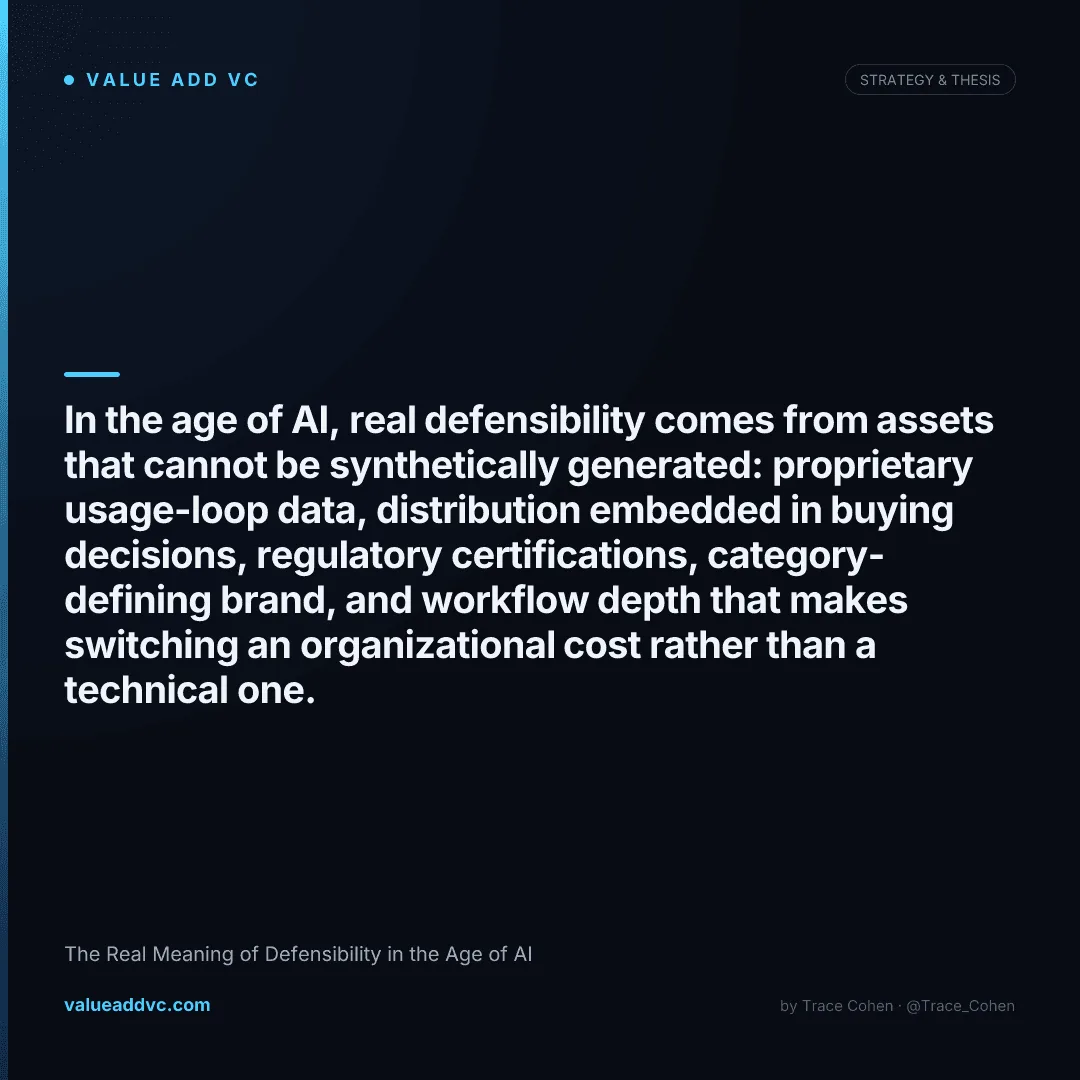
After re-underwriting a dozen portfolio companies through an AI lens, I have narrowed the real defensibility drivers to five categories. Every durable business I know has at least two of them. Most that are struggling have none.
1. Proprietary Data That Cannot Be Recreated
Not data you collected from public sources or licensed from third parties — data generated by your product's own usage loop. Veeva's clinical trial data. Palantir's mission-specific operational graphs. Toast's restaurant transaction history. This data is valuable not because it is large, but because it is irreplaceable. You cannot train a model on data that does not exist.
2. Distribution Locked Into a Buying Decision
Salesforce is worth $300B not because of its product quality — Hubspot is better on several dimensions — but because it is embedded in the procurement and approval workflows of 150,000 enterprise customers. Distribution that is woven into how decisions get made is harder to dislodge than any feature set.
3. Regulatory and Compliance Lock-In
HIPAA, SOC 2, FedRAMP, financial audit trails, FDA clearance — these are not bureaucratic hurdles. They are 12–24 month moats that keep faster competitors out of your market while you extend. The best founders in regulated industries treat compliance as a product feature, not an engineering tax.
4. Brand as the Default Choice
When a buyer does not have time to evaluate options, they pick the brand they trust. Stripe became the default payment infrastructure not by winning every head-to-head evaluation, but by becoming synonymous with the category. That kind of brand is built through consistent positioning over years — and it is almost impossible to replicate quickly.
5. Workflow Depth That Creates Genuine Switching Costs
There is a difference between a product that customers use and a product that customers' workflows are built around. When your system of record changes how a team structures their processes, language, and reviews, the cost of switching becomes organizational, not just technical. That is real stickiness.
The Data Moat Reality Check
Every founder I meet tells me their data is a moat. Most of them are wrong. There are three questions I ask to stress-test a data advantage:
- →Is it proprietary or just exclusive? Data you licensed can be licensed by someone else. Proprietary means it only exists because your product generated it.
- →Does more data make your product measurably better? If you cannot show a performance curve — more data → better outcomes for users — the moat is theoretical, not operational.
- →Can a foundation model trained on public data approximate your result? If yes, your proprietary data is not doing the work you think it is. The moat is thinner than your pitch deck suggests.
By this standard, maybe 10–15% of startups that claim a data moat actually have one. That is not cynicism. It is a useful filter. The ones that pass it are building something genuinely hard to copy.
What Founders Should Be Asking Every Quarter
Defensibility is not a checkbox you tick at founding and revisit at Series B. It is a dynamic question that needs to be answered every 90 days as the competitive landscape shifts. The companies I am most confident in are the ones where the founders have a crisp, evidence-backed answer to: What would it cost a well-funded competitor to take our best customer?
If the answer is "they would need to rebuild our product" — that is not a moat in 2026. If the answer is "they would need to re-earn two years of trust with a compliance team, re-train on data that only exists in our platform, and fight our brand in a market where we are the default" — that is a moat.
A useful frame for that quarterly review: track what is getting scarcer versus what is getting abundant. Defensibility lives on the scarce side of the ledger.
What gets scarcer
- • Judgment under uncertainty
- • Customer relationships
- • Proprietary data access
- • Domain expertise depth
What gets abundant
- • Code generation capacity
- • Content production at scale
- • Routine analysis and research
- • First-draft everything
Signs of Real Defensibility
- ✓ NRR above 120% from workflow expansion, not upsells
- ✓ Data flywheel that makes the product better with usage
- ✓ Compliance certifications competitors cannot shortcut
- ✓ Brand that generates inbound without paid acquisition
- ✓ Customers who reference your product in internal job descriptions
Signs of Fake Defensibility
- ✕ "We have 3 years of data" — with no performance curve to show
- ✕ Feature count as a proxy for switching cost
- ✕ Contract length confused with retention
- ✕ "First mover advantage" in a market where AI halves time-to-parity
- ✕ NPS scores as evidence of stickiness instead of love
The companies that will survive the next five years are not the ones with the best AI features.
They are the ones that own something AI cannot generate: trust, data, distribution, and the right to operate in a market their competitors have not earned.
Trace Cohen is a 3x founder and investor in 65+ startups. Follow the analysis at Value Add VC and subscribe to the weekly newsletter.
Latest from the Pulse
Get VC data most people never see
— free to subscribe
Trace's notes on venture, AI and startups, a few times a week. Join 5,000+ subscribers. No spam.