
95% of enterprise generative AI pilots never make it to production or show up on a P&L, per MIT's 2026 GenAI Divide research — yet AI-related capital investment now drives roughly 74% of all US GDP growth. That's the short answer. The longer answer is more interesting.
I sit on both sides of this gap every week. Portfolio companies show me internal dashboards where an AI coding agent or support copilot genuinely cuts a task's time by 30-50%. Then I read the same week's macro data and see a US economy where, strip out AI-related capex, real GDP growth is close to zero. Both things are true simultaneously, and reconciling them is the single most important open question in tech right now — not because it's academic, but because it determines whether the roughly $700B in 2026 hyperscaler AI capex is buying real economic output or just a very expensive, very well-funded pilot program.
What Is the AI Productivity Paradox in 2026?
The AI productivity paradox in 2026 is the widening gap between measurable task-level AI gains — 14% to 55% depending on the study and task — and the near-invisible effect AI has had so far on company-wide and national productivity statistics. Individual workers get faster at individual tasks; the organizations employing them don't get measurably faster overall, because the gains rarely survive the jump from one person's workflow to the whole company's output.
The MIT GenAI Divide: Why 95% of Pilots Fail
MIT's Project NANDA published the most cited data point in this entire debate: 95% of generative AI pilots inside large organizations fail to move past the experimental phase and never register a measurable profit-and-loss impact. RAND Corporation's separate research puts the broader AI project failure rate above 80% — roughly double the failure rate of conventional enterprise IT projects, which is itself a meaningful baseline given how notoriously bad enterprise software rollouts already are. The recurring failure pattern MIT researchers describe isn't a model-capability problem; it's what they call "POC purgatory" — a pilot that never graduates because success was never clearly defined, the underlying data infrastructure wasn't ready, the tool never got integrated into an actual workflow, and executive sponsorship faded once the initial budget line ran out.
The demand side backs this up. As of year-end 2025, 42% of firms said they still view AI technology as too immature to justify real investment, 36% said their workforce isn't trained to use it, and another 36% cited unresolved privacy concerns. Those aren't technology gaps — they're organizational readiness gaps, and they explain why the same foundation models producing 30-50% task-level speedups in a demo produce close to nothing at the balance-sheet level once you scale past the first few power users.
Why AI Capex Is Driving GDP Growth Even When Productivity Isn't Moving
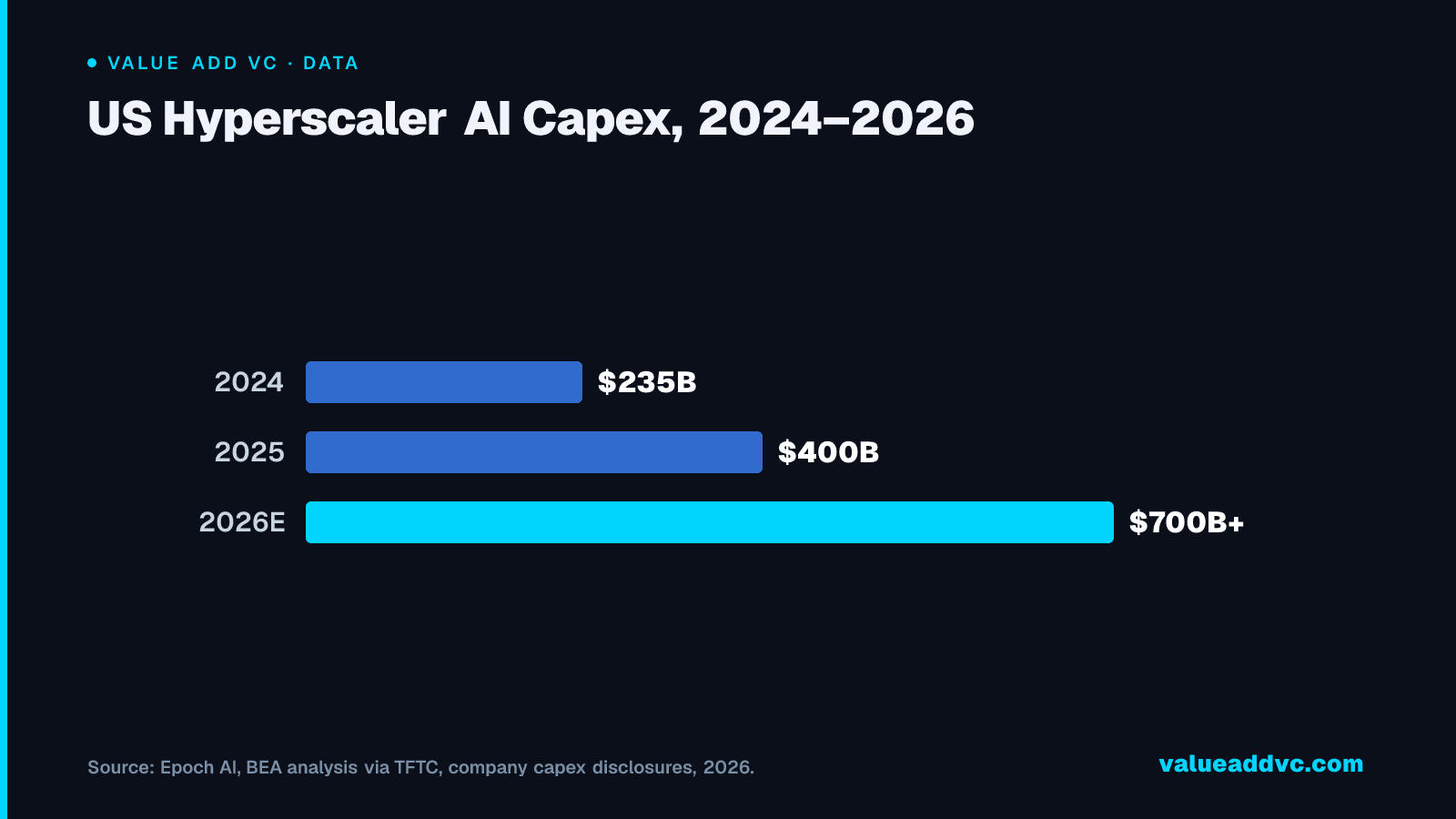
Here's the part of the paradox that gets less attention: AI investment is already showing up enormously in GDP, just not through productivity. US hyperscaler AI-related capex climbed from roughly $235B in 2024 to $400B in 2025, with 2026 estimates now running past $700B. That spending base is estimated at 1.2% to 1.5% of total US GDP — a share that matches or exceeds the late-1990s telecom and fiber buildout at its peak. In the BEA's third estimate of Q1 2026 GDP, AI-related investment accounted for roughly 74% of the quarter's 2.1% annualized growth rate, while consumer spending contribution nearly disappeared. Strip the AI capex line out entirely and US real GDP growth across 2024-2025 is close to flat.
US Hyperscaler AI Capex, 2024–2026
Capex nearly tripled in two years — but the spending is showing up as GDP growth through construction and chip purchases, not through measured productivity gains at the companies buying the compute.
Epoch AI, BEA analysis via TFTC, company capex disclosures, 2026.
Data
| Item | Value |
|---|---|
| 2024 | $235B |
| 2025 | $400B |
| 2026E | $700B+ |
That's the mechanism worth understanding: building a data center and buying GPUs counts as investment spending in GDP accounting the moment the check clears, regardless of whether the compute inside that data center ever produces a measurable productivity gain for the companies renting it. The Big Tech Q1 2026 earnings numbers tell the same story from the supply side — Google raised its 2025 capital budget to $92B and Meta now expects to spend around $100B in 2026, and nearly all of that capital is booked as investment long before the productivity case for it is proven out.
Task-Level Gains vs. Macro Productivity: Where the Gap Actually Lives
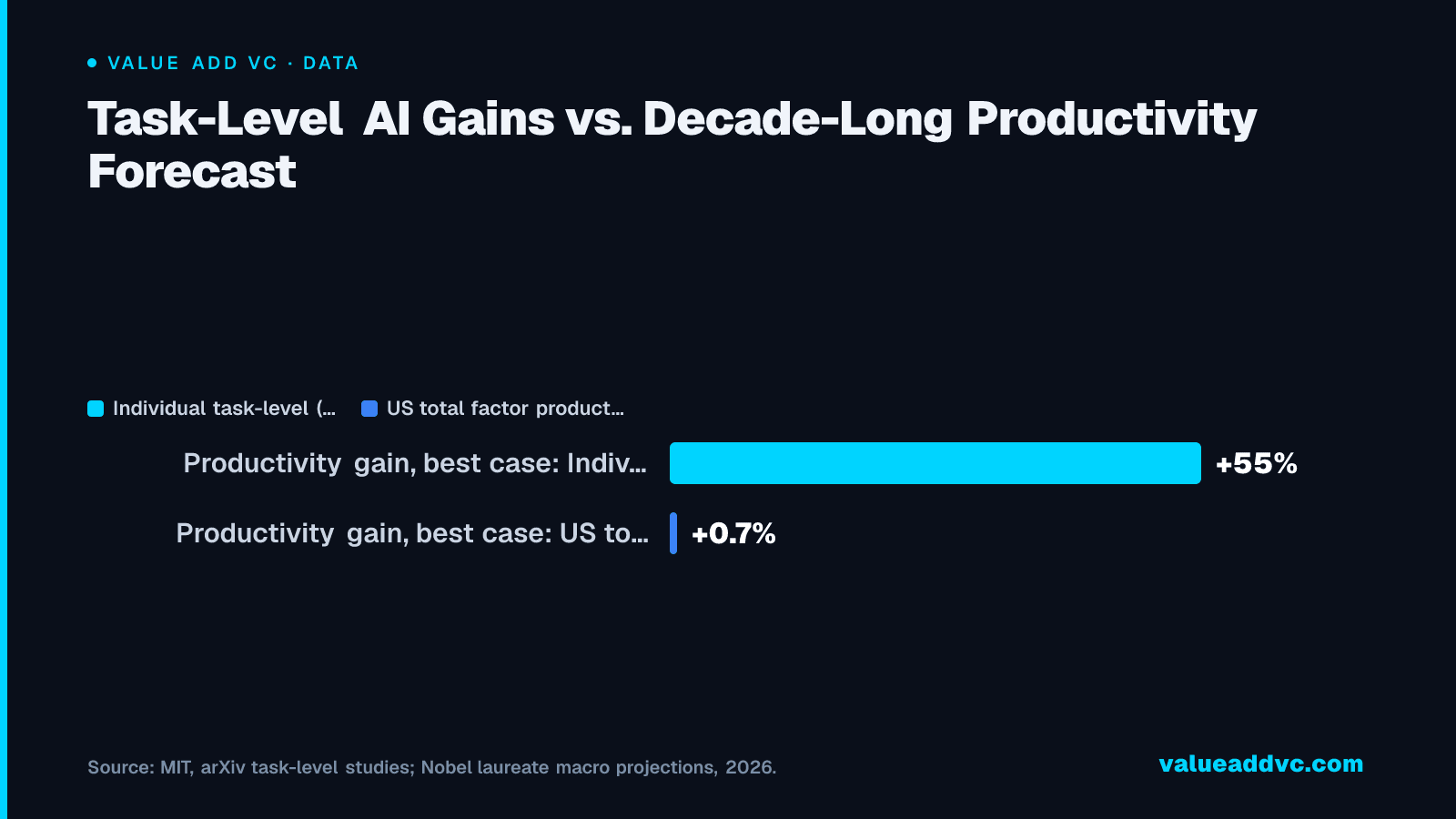
The clearest way to see the paradox is to put the two numbers next to each other: the best documented task-level AI productivity gains run as high as 55%, while at least one Nobel laureate economist studying AI's macro impact projects total factor productivity growth of only 0.5% to 0.7% over the entire next decade. That's not a rounding error — it's a roughly 100x gap between what AI does for an individual doing a single task and what shows up in national productivity statistics once that task is embedded back into a real organization with real coordination costs, approval chains, and legacy systems around it.
Task-Level AI Gains vs. Decade-Long Productivity Forecast
MIT, arXiv task-level studies; Nobel laureate macro projections, 2026.
Data
MIT Sloan's manufacturing research adds a further wrinkle: AI adoption doesn't just fail to help immediately, it often actively hurts first. Firms in MIT's sample saw an initial productivity decline of up to 60 percentage points after adopting AI tools, with recovery — when it happened at all — taking four or more years. Researchers call this the "AI adoption J-curve": a period where digital tools are misaligned with legacy processes because the company invested in the software but not in the data infrastructure, retraining, or workflow redesign that would let the software actually pay off.
Why Enterprise AI Investment Isn't Showing Up in Productivity Numbers
Pull together the 2026 survey data from MIT, RAND, BCG, and PwC and a consistent picture emerges: the failure isn't in what the models can do, it's in what organizations do with them.
| Metric | Figure | Source |
|---|---|---|
| GenAI pilots that never reach production | 95% | MIT Project NANDA, GenAI Divide report |
| Overall AI project failure rate | 80%+ | RAND Corporation |
| CEOs who report getting "nothing" from AI | 56% | PwC 2026 Global CEO Survey |
| Firms with meaningful financial value from AI | 26% | BCG AI at Scale, 1,800 execs |
| Firms citing AI as "too immature" to invest | 42% | Year-end 2025 enterprise survey |
| Firms citing workforce not trained on AI | 36% | Year-end 2025 enterprise survey |
| Firms citing unresolved privacy concerns | 36% | Year-end 2025 enterprise survey |
| Companies reporting significant GenAI ROI | 29% | 2026 enterprise ROI surveys |
| Companies reporting significant ROI from AI agents | 23% | 2026 enterprise ROI surveys |
Figures are 2026 estimates and survey results blended from MIT Project NANDA, RAND Corporation, PwC's 2026 Global CEO Survey, and Boston Consulting Group's AI at Scale survey. Methodology and sample sizes vary by source; see each organization's published report for full survey design.
What This Means for Founders and Investors
For anyone building or funding AI products right now, the paradox is actually good news if you read it correctly. A 95% pilot failure rate isn't a demand problem — enterprises are clearly still trying, given that $700B in 2026 capex — it's an implementation problem, and implementation problems are exactly what a well-built product or a well-run portfolio company can solve for a customer that a generic foundation-model subscription can't. The startups actually capturing durable revenue right now, the same ones I track across our SaaS valuations dashboard, tend to be the ones selling the workflow redesign and the data infrastructure alongside the model access, not just API wrapper access to GPT-5 or Claude on its own.
The other lesson is patience with the macro story. Prior general-purpose technologies — electrification, the PC, the internet — all showed the same lag between capital deployment and measurable productivity, typically running 10 to 20 years from first widespread adoption to visible aggregate gains. If AI follows even the faster end of that historical pattern, 2026's 95% pilot failure rate and near-zero underlying GDP growth (ex-AI capex) are exactly what you'd expect to see in year three or four of the buildout, not a signal that the technology doesn't work. The risk isn't that AI never pays off — it's that the current capex pace, running at 1.2-1.5% of GDP and concentrated in a handful of companies, isn't sustainable for the 10-plus years historical technology diffusion has taken, which puts real pressure on the timeline to start showing results.
I'd also push back on the framing that this is purely a technology-adoption story, because the 5% of pilots that do succeed share a pattern worth naming directly: they picked one narrow, high-frequency workflow, gave a single owner clear authority to redesign the process around the tool rather than bolt the tool onto the old process, and measured a specific output metric from week one instead of "AI usage" as a proxy for value. That's a much smaller ask than a company-wide AI transformation, and it's exactly the kind of scoped, metric-driven rollout that most of the 95% failure group skipped in favor of a broad pilot with no clear owner and no baseline to measure against. Funds and operators evaluating AI-native vendors should treat "can you show me the narrow workflow and the before/after metric" as a more useful diligence question in 2026 than "what model do you use."
The Bottom Line
95% of enterprise generative AI pilots still fail to reach production in 2026, per MIT, even as AI-related capex now drives roughly 74% of US GDP growth and totals over $700B for the year. The paradox isn't a sign AI doesn't work — task-level gains up to 55% prove it does — it's a sign that most organizations haven't yet done the workflow redesign, data infrastructure investment, and retraining that history shows every prior general-purpose technology has needed before its productivity gains show up in the aggregate numbers. Whether that gap closes in two years or ten is now the single biggest variable in whether today's AI capex boom was rational or the most expensive pilot program in economic history.
Latest from the Pulse
Get VC data most people never see
— free to subscribe
Trace's notes on venture, AI and startups, a few times a week. Join 5,000+ subscribers. No spam.
No spam, unsubscribe anytime. Sent via Substack · Privacy · or subscribe on Substack ↗