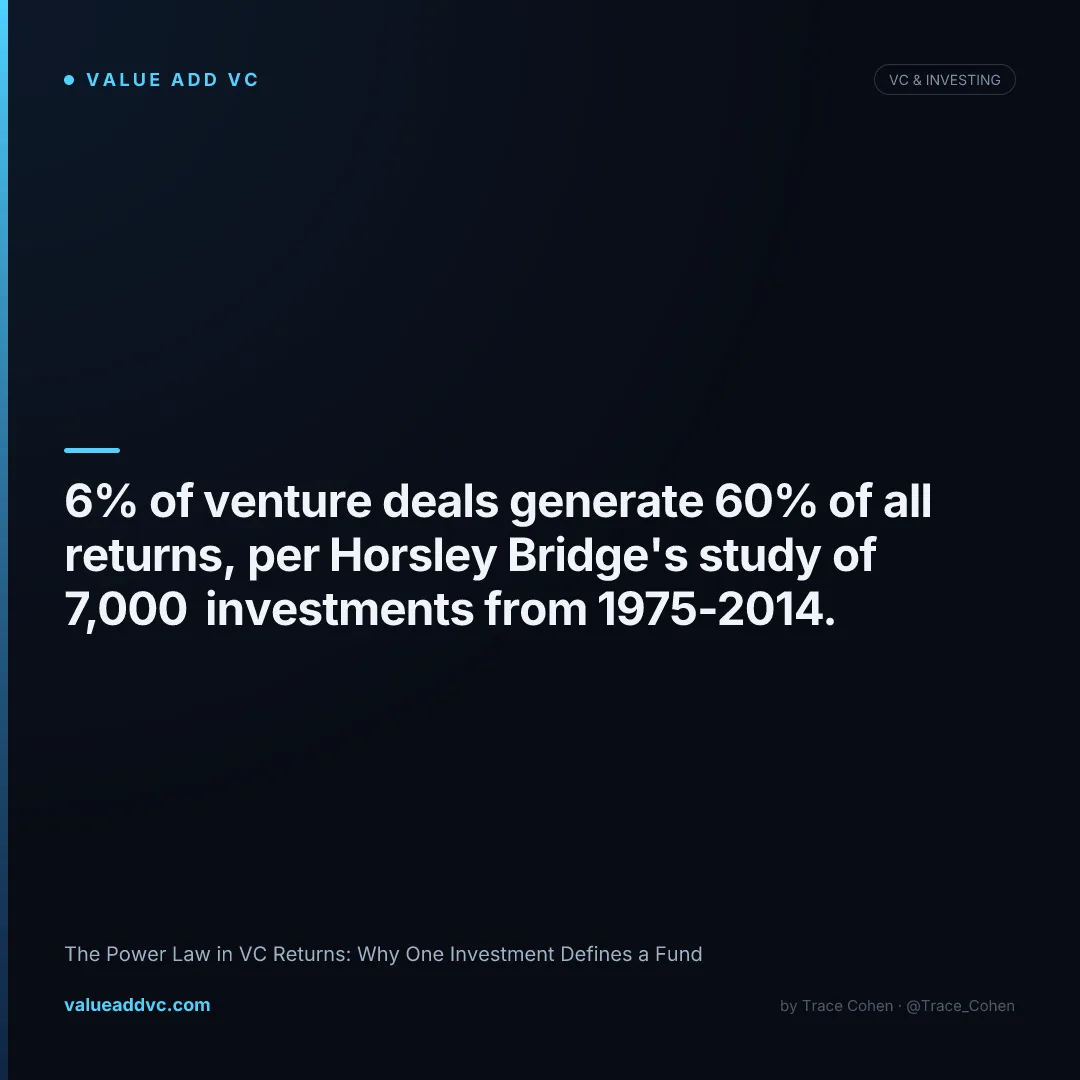
6% of venture deals generate 60% of all returns. That's the short answer, drawn from Horsley Bridge's study of 7,000 investments made between 1975 and 2014. The longer answer is that this single statistic explains almost every strange thing VCs do — the concentrated bets, the follow-on reserves, the willingness to lose on 65% of deals and still call the fund a success.
I've made 65+ investments across three companies and a handful of funds, and the power law is the one piece of math that never stops being uncomfortable. It means most of what a VC does in diligence — modeling, comparing, ranking — barely matters next to the binary question of whether you got into the one company that returns the fund. Here's what the data actually says about how concentrated venture returns really are, and what it means for how funds should be built.
What Is the Power Law in Venture Capital Returns?
The power law in venture capital returns describes a distribution where a tiny fraction of investments produce nearly all of a fund's value, while the majority contribute little or nothing. Horsley Bridge, a longtime LP across dozens of US venture funds, analyzed 7,000 of its own portfolio investments made from 1975 through 2014 and found that just 6% of those deals generated 60% of total returns — meaning a fund's success is decided by a small handful of positions, not its average deal.
This isn't a normal distribution with a fat tail — it's a fundamentally different shape. In a normal distribution, most outcomes cluster near the mean. In venture, the mean is almost meaningless because the distribution has no natural ceiling: a $50,000 seed check into a company that becomes a $100 billion outcome can return more than the rest of a 30-company fund combined. That asymmetry is why we built a dedicated VC Performance dashboard — median numbers alone hide the entire story.
The Data: How Concentrated Are VC Fund Returns, Really?
Two of the most-cited studies on venture return distribution come from Horsley Bridge and Correlation Ventures, and they agree on the shape even though they used different datasets. Correlation Ventures studied more than 21,000 financings from 2004-2013 and then expanded to over 27,000 from 2009-2018, and found that 65% of deals returned less than the capital invested. Only about 4% returned more than 10x, and a mere 0.4% — fewer than 1 in 200 investments — returned more than 50x. Those sub-1% outcomes are where the bulk of aggregate industry returns actually live.
Horsley Bridge's separate dataset shows the same pattern from a different angle: loss rates stay between 40-50% even for funds that ultimately returned 1x-5x overall, while the share of deals returning more than 10x jumps from about 20% in a fund's weakest cohort to 90% in its best-performing cohort. In other words, good funds and bad funds lose money on a similar number of deals — the difference is entirely in whether they caught the handful of massive winners.
Why the Power Law Means One Deal Can Define a Fund
Carta's data on 2,775 venture funds that closed between the start of 2017 and Q1 2026 — representing $119.3 billion in combined committed capital — puts a number on this at the fund level: in a typical fund with 20 to 30 portfolio companies, just 1 to 3 investments generate 50-80% of total fund returns. That's not an argument about a specific fund having bad luck; it's the structural norm across nearly $120 billion of tracked commitments.
The clearest real-world illustration is Founders Fund's investment in SpaceX. A relatively modest early check, made when SpaceX was an unproven rocket company that had failed three launches in a row, is now worth tens of billions of dollars on paper and has functioned as the anchor return across multiple Founders Fund vintages. We covered the mechanics of that specific bet in how Founders Fund bet on SpaceX — it's the power law made concrete: one position outperforming an entire multi-fund track record.
How the Power Law Changes VC Fund Strategy
If one or two deals decide the fund, three strategic conclusions follow, and they explain most of what looks irrational about how VCs behave from the outside.
| Power law implication | What it means in practice | Common mistake it corrects |
|---|---|---|
| Concentration beats diversification | A fund of 20-30 quality bets outperforms a fund of 80+ diluted ones | 'Spray and pray' seed strategies that cap position size to feel safer |
| Reserves matter more than deal count | Top funds hold back 40-50% of committed capital for follow-ons in winners | Deploying all capital on initial checks with no dry powder to double down |
| Losses are a feature, not a failure | A 65% loss rate is normal even in top-quartile funds | Judging a GP's skill by win rate instead of fund-level multiple |
| Ownership at entry compounds | Higher initial ownership in the eventual winner matters more than avoiding losers | Passing on a strong deal over price sensitivity, then missing the outlier |
| Fund size must match strategy | Mega-funds need bigger outcomes to move the needle, pricing them out of true power-law seed bets | Assuming a larger fund is strictly better than a smaller, more concentrated one |
| Time horizon has to be long | The biggest outcomes (SpaceX, Databricks-scale winners) take 10-15+ years to mature | Marking a fund's performance too early based on interim TVPI |
Framework built from Horsley Bridge (1975-2014), Correlation Ventures (2009-2018), and Carta VC Fund Performance data (2017-Q1 2026); interpretation reflects operator and LP-facing commentary, not a single source's conclusions.
Why Fund Size Interacts With the Power Law
The power law also explains why raising a bigger fund isn't automatically a better strategy, even though it looks that way from the LP fee-generation side. A $50 million seed fund can be made by a single $2 million check into a company that returns $200 million — a 4x on the whole fund from one position. A $1 billion fund needs an outcome roughly twenty times larger from a proportional check to have the same fund-level impact, which mechanically forces larger funds up the stack into later, larger, more competitively priced rounds where power-law dispersion is already compressed.
That's the tension every GP raising a bigger Fund II or Fund III runs into: the strategy that built the power-law track record — small, concentrated, early bets — doesn't scale linearly with fund size. A firm that outperformed on a $75 million Fund I by catching one seed-stage outlier often has to shift into growth-stage or larger check sizes for a $400 million Fund III, which changes the return profile entirely, even if the team and thesis haven't changed at all. LPs evaluating a GP's track record need to ask whether the power-law outcome that made the prior fund look great is even repeatable at the new fund size — the TVPI gap between mega and micro funds is a direct downstream effect of this same dynamic.
Reserve strategy is the other lever funds control directly. A fund that commits 50-60% of its initial capital to first checks and holds the remaining 40-50% for follow-ons can pour disproportionate capital into a winner once it's identified, buying additional ownership in the 6% of deals that will eventually produce 60% of returns. A fund that spends its reserves evenly, or runs out of dry powder because it over-deployed into breadth rather than depth, structurally caps its own upside regardless of how good its initial stock-picking was.
Do Top-Quartile Funds Beat the Power Law or Just Ride It Better?
Top-decile VC funds delivered net IRRs exceeding 20% in most vintages from 2017 to 2024 (2021 being the notable exception), according to Carta's dataset of 2,775 funds. Top-quartile funds more broadly benchmark at 3.0x+ TVPI, 25%+ net IRR, and 1.5x+ DPI by year seven, per blended Carta, PitchBook, and Cambridge Associates data — compared to a median fund that returns just 1.5x-1.8x TVPI and 12-15% net IRR, and a bottom-quartile fund stuck around 0.6x that may never return capital at all.
The mechanism behind that gap isn't that top funds pick winners more consistently across the board — their loss rates aren't dramatically lower. It's that they get more high-quality at-bats through proprietary dealflow, and critically, they have the reserves and conviction to concentrate follow-on capital into the winners once they identify them. That's the practical skill the power law rewards: not avoiding the 65% that lose, but correctly recognizing and doubling down on the 6% that will define the fund. We track these benchmarks in more depth, including how DPI lags TVPI across recent vintages, in our top-quartile VC returns breakdown, and you can pull the underlying benchmark tables on our VC & PE Performance dashboard.
The Bottom Line
The power law is the least intuitive and most important fact in venture capital: 6% of deals produce 60% of returns, 65% of deals lose money, and a typical fund's entire outcome rests on 1 to 3 positions out of 20 to 30. That's not a bug in how VC works — it's the entire operating model. Funds that internalize this concentrate capital, reserve aggressively for follow-ons, and judge themselves on fund-level multiple rather than batting average. Funds that don't — the ones diversifying to feel safe or marking success by win rate — are optimizing for the wrong statistic entirely.
6% of deals. 60% of returns. 65% of deals lose money entirely.
Venture isn't an averages business — it's a one-deal business.
Track VC fund benchmarks, TVPI/DPI by vintage, and top-quartile performance data on the VC Performance Dashboard and VC & PE Performance Dashboard at Value Add VC. Originally published in the Trace Cohen newsletter.
Latest from the Pulse
Get VC data most people never see
— 100% free
Weekly benchmarks, valuations, and fund data. Join 5,000+ investors. No spam.