Every six months someone declares cold outbound dead. Every six months the best B2B sales teams quietly keep booking meetings with it.
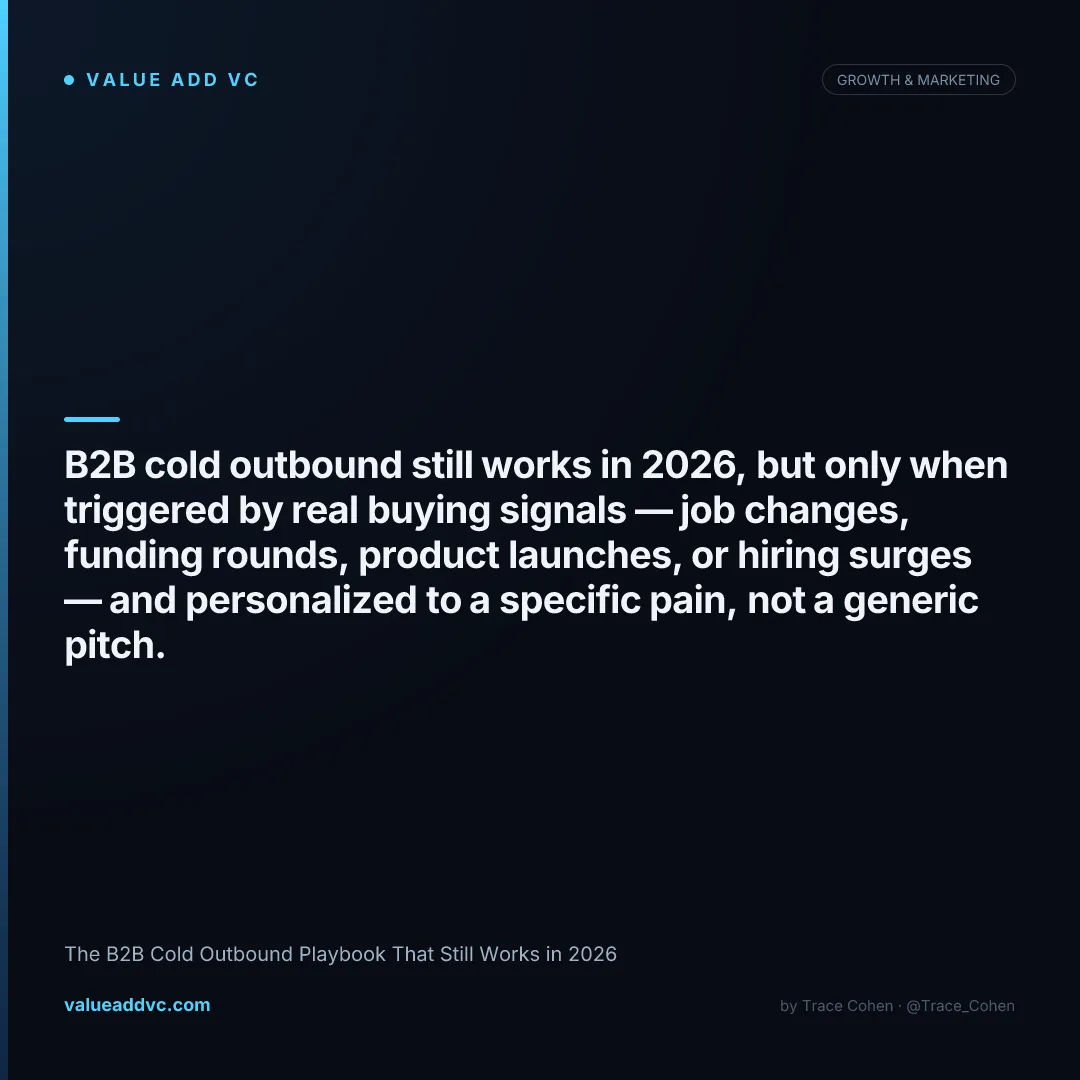
The reality: generic cold outbound died three years ago. Signal-triggered, hyper-personalized outbound is alive and working better than it ever has — because 90% of senders quit when the generic approach stopped working, reducing competition for the inbox of the people who matter.
According to Salesloft's 2025 benchmark report, the median cold email reply rate across 350 million tracked emails is 2.1%. The top quartile of senders — those using intent signals and personalization at the account level — average 9.4%. That 4.5x gap is entirely explained by the quality of the trigger and the specificity of the message, not the tool or the sequence length.
The Four Buying Signals That Actually Convert
Effective outbound starts before you write a single word. It starts with knowing why someone would buy right now — not hypothetically, but this week. The best signals are public, time-bound, and indicate an active decision window.
Funding Announcement
Fresh capital means new budget authority and pressure to deploy. A Series A company just committed to a growth plan — they need the stack to execute it.
Executive Hire
New VPs have 90 days to make an impression. They are actively evaluating vendors, replacing incumbents, and have no legacy bias toward existing tools.
Relevant Job Posting
A company posting for a Head of RevOps is signaling a problem your revenue tool solves. They are self-identifying their pain better than any intent data can.
Tech Stack Change
Migration events — switching CRMs, deploying a new data warehouse, dropping a competitor — create natural switching moments for adjacent tools.
The Anatomy of a Cold Email That Gets Replied To
Most cold emails fail in the first eight words. The subject line and opening sentence are doing 80% of the work. Here is the structure that consistently outperforms in 2026:
Subject Line
Reference the signal, not your product"Congrats on the Series B — quick question on your RevOps stack"
Congratulatory openers tied to a real event have 34% higher open rates than product-forward subjects (Outreach.io, 2025).
Opening Line
One specific observation, not a compliment"I saw you just posted for a Head of Demand Gen — that usually means pipeline visibility is about to become a board-level conversation."
Pattern-matched openers that reference observable behavior outperform generic compliments by 3.2x on reply rate.
The Pivot
Name the exact pain, not the feature set"Most teams at your stage are flying blind on which channels are actually converting to closed-won."
Pain-led pivots reduce the time to relevance. Feature pivots require the reader to do cognitive work you should be doing for them.
Social Proof
One specific result, one recognizable name"We helped [Similar Company] cut their CAC by 31% in 90 days."
Named proof points increase reply likelihood by 2.4x versus generic claims. Vague proof is worse than no proof.
CTA
One specific ask, low friction"Worth a 20-minute call this week or next?"
Binary yes/no CTAs outperform open-ended asks by 1.8x. Never ask for a demo in a cold first touch — it signals desperation.
Deliverability Is a Hard Prerequisite, Not an Afterthought
Google's February 2024 bulk sender rules fundamentally changed the deliverability landscape. Any domain sending more than 5,000 emails per day must authenticate with SPF, DKIM, and DMARC — or Gmail will silently filter or reject at scale. But even below that threshold, domain reputation has become the primary determinant of inbox placement.
Warm new domains for 45-60 days before scaling above 50 emails per day
Send from a subdomain (mail.yourcompany.com) to protect your root domain reputation
Keep bounce rates below 2% — anything higher trains ISPs to deprioritize your domain
Remove unresponsive contacts after two sequences, not five — list hygiene is a deliverability lever
Never include links or attachments in your first cold email — wait until reply to send assets
Rotate sending across 3-5 inboxes per domain with a max of 40-50 emails per inbox per day
The Sequence Structure That Books Meetings
Data from Apollo.io's 2025 outbound report across 4.2 million sequences shows that 78% of all replies come in the first three touchpoints. Beyond five, marginal reply rates drop below 0.3% — and the damage to deliverability from high-volume, low-reply sequences exceeds the upside from additional contacts.
Day 1
Email 1
Signal-triggered cold email with pain-led pivot and light social proof. Subject references the trigger event.
Day 3
LinkedIn Connection
Simple connection request with no message. Touchpoint diversity increases brand recognition and improves reply rates on subsequent emails by 18%.
Day 5
Email 2
Short follow-up adding one new piece of context — a relevant case study, a stat about their industry, or a question about the pain. Never just 'bumping this.'
Day 9
Email 3
The breakup email. Acknowledge they are likely busy, restate the core value prop in one sentence, and offer an easy exit. Paradoxically, these generate 30-40% of all sequence replies.
Day 14
LinkedIn DM (if connected)
Short DM if they accepted the connection request. Reference the emails briefly, ask if the timing is just off. No pitch — just a human check-in.
What AI Changed (and What It Didn't)
AI has democratized the production of mediocre cold email. Tools like Clay, Apollo, and Instantly now let anyone generate 10,000 personalized-sounding emails per day. The result: inboxes are flooded with AI-generated messages that pattern-match on surface signals — company name, job title, recent LinkedIn posts — while missing actual buying context.
What AI cannot do is identify genuine business pain from public signals. It cannot understand that a company posting for a Head of Revenue Operations at $40M ARR is facing a specific, predictable scaling problem. It cannot write a first line that shows you understand their business model well enough to name their risk.
The founders and sales teams winning in 2026 are using AI for research and drafting, but applying human judgment to signal interpretation and message framing. The bar for what reads as "genuinely personalized" has risen — which means those who clear it have less competition, not more.
Cold outbound in 2026 is not a volume game.
The teams winning are sending fewer emails to better-signaled prospects — and booking 5-10x more meetings as a result.
Trace Cohen is a 3x founder and has invested in 65+ startups. He writes about growth, fundraising, and the startup operating playbook at Value Add VC.
Latest from the Pulse
Get VC data most people never see
— 100% free
Weekly benchmarks, valuations, and fund data. Join 5,000+ investors. No spam.