OpenAI has deprecated or retired over 7 model versions since 2022. Anthropic has end-of-lifed Claude 1, Claude 2, and multiple Claude 3 variants. Google has deprecated Bard and multiple Gemini preview endpoints. Each deprecation forces every enterprise integration to migrate — with zero revenue upside.
This is not a theoretical risk. For regulated industries — financial services, healthcare, legal — it means restarting formal validation processes from scratch. For everyone else, it means prompt regression testing, API rewrites, and unplanned engineering sprints. The AI model release cycle is now the fastest-moving variable in enterprise software procurement, and most vendor evaluation frameworks weren't built to handle it.
How Fast the AI Model Release Cycle Actually Moves
Look at the timeline for any major lab and the pattern is unmistakable. This isn't annual software versioning. It's continuous deployment at the infrastructure layer — and enterprises are the ones absorbing the cost.
GPT-3 → 3.5 → 4 → 4 Turbo → 4o → o1 → o3 → o4-mini
Claude 1 → 2 → 2.1 → 3 Haiku/Sonnet/Opus → 3.5 → 4
Bard → Gemini 1.0 → 1.5 Flash/Pro → 2.0 → 2.5 Pro/Flash
Llama 1 → 2 → 3 → 3.1 → 3.2 → 3.3 → 4 Scout/Maverick
Note: This counts public-facing API releases only. Internal fine-tunes and system prompt changes happen more frequently and are rarely disclosed.
Why the Enterprise AI Model Release Cycle Creates Procurement Problems
Traditional enterprise software has annual major releases and 5-10 year lifecycle support windows. A company buying Salesforce in 2022 isn't worried that their API calls will stop working in 18 months. AI is structurally different — and enterprise procurement frameworks haven't caught up.
Validation restart in regulated industries
Financial services and healthcare require formal model validation before production. A new model version — even a minor patch — may invalidate prior sign-offs and restart a multi-month compliance process.
Prompt regression and output drift
A prompt tuned for GPT-4-turbo doesn't produce identical outputs on GPT-4. Enterprises running production AI on business-critical workflows discover regressions only after deployment.
Deprecation timeline misalignment
OpenAI's shortest model wind-down period has been ~6 months. Enterprise software contracts typically cover 3-year terms. The lifecycle mismatch means every enterprise will face at least one forced migration per contract cycle.
Procurement cycle lag
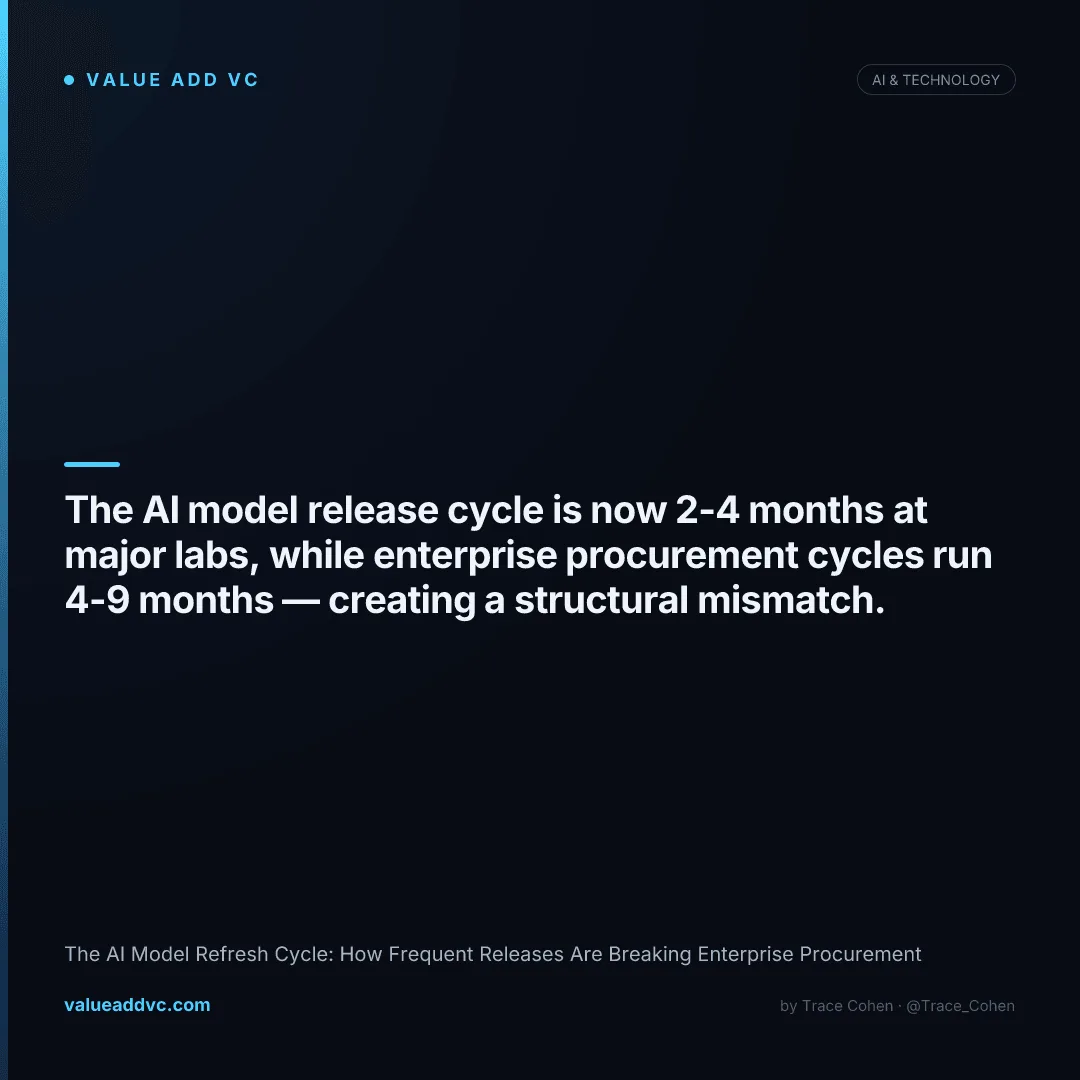
A typical Fortune 500 AI vendor evaluation runs 4-9 months: legal review, security assessment, pilot, procurement sign-off. By completion, a newer model is often already generally available — and the evaluation was done on the older one.
The Deprecation Cost Nobody Budgets For
When a model gets deprecated, the visible cost is the migration engineering sprint. The invisible cost is everything that breaks in production before someone notices.
Gartner estimates that unplanned AI system changes — including model deprecation-driven rewrites — add 15-25% to total enterprise AI implementation costs over a 3-year period. That doesn't appear in any initial ROI model. For a $2M enterprise AI deployment, that's $300-500K in unbudgeted rework.
| Deprecation event | Wind-down period | Migration complexity |
|---|---|---|
| GPT-3 text-davinci-003 | ~6 months | High — required full prompt rewrite for most apps |
| Claude 2.0 → 2.1 → 3 | ~3 months overlap | Medium — output format changes, context handling differences |
| GPT-3.5-turbo-0301 | ~8 months | Low — backward-compatible API, output drift only |
| Gemini 1.0 → 1.5 | ~6 months | Medium — tokenization changes, different safety filters |
| GPT-4-0314 | ~12 months | Low-medium — same architecture, minor output differences |
What Enterprise CTOs Are Actually Doing
The enterprises that are handling this well aren't solving the problem — they're abstracting away from it. The core playbook has three layers:
What This Means for AI Startups Selling to Enterprise
If you're building an AI product and selling to enterprises, model lifecycle management is now a sales conversation — not an engineering footnote. Enterprise buyers will ask: what happens when the underlying model changes? Do I have to revalidate? Who absorbs the migration cost?
The companies winning the largest enterprise contracts are those that can credibly answer: "We own the model lifecycle problem so you don't have to." That means model-agnostic architecture, tested migration paths, and contractual guarantees around output stability — even when the underlying model evolves.
Track the current AI valuation environment and enterprise AI adoption data on the AI Valuations dashboard and Enterprise AI Adoption tracker at Value Add VC.
The fastest-moving variable in enterprise AI is not which model is best today.
It's which vendor makes the model refresh cycle invisible — so you can build on top of AI without rebuilding everything every 6 months.
Monitor AI model and enterprise adoption trends on the AI Valuations Dashboard at Value Add VC. Originally published in the Trace Cohen newsletter.
Latest from the Pulse
Get VC data most people never see
— free to subscribe
Trace's notes on venture, AI and startups, a few times a week. Join 5,000+ subscribers. No spam.