
Trade policy used to be something startup founders could safely ignore. That era is over. The tariff landscape of 2025-2026 has fundamentally altered the cost structure, supply chain logistics, and strategic calculus for technology companies of every size. Whether you are building hardware, shipping software, or somewhere in between, tariffs are now a first-order concern that belongs in your board deck right next to burn rate and runway.
The Current Tariff Landscape (2025-2026)
The tariff environment has escalated dramatically over the past two years. What began as targeted levies on specific categories of Chinese goods has expanded into a broad-based regime of trade barriers affecting dozens of countries and hundreds of product categories. As of early 2026, the effective average tariff rate on imported goods to the United States sits at levels not seen since the 1930s.
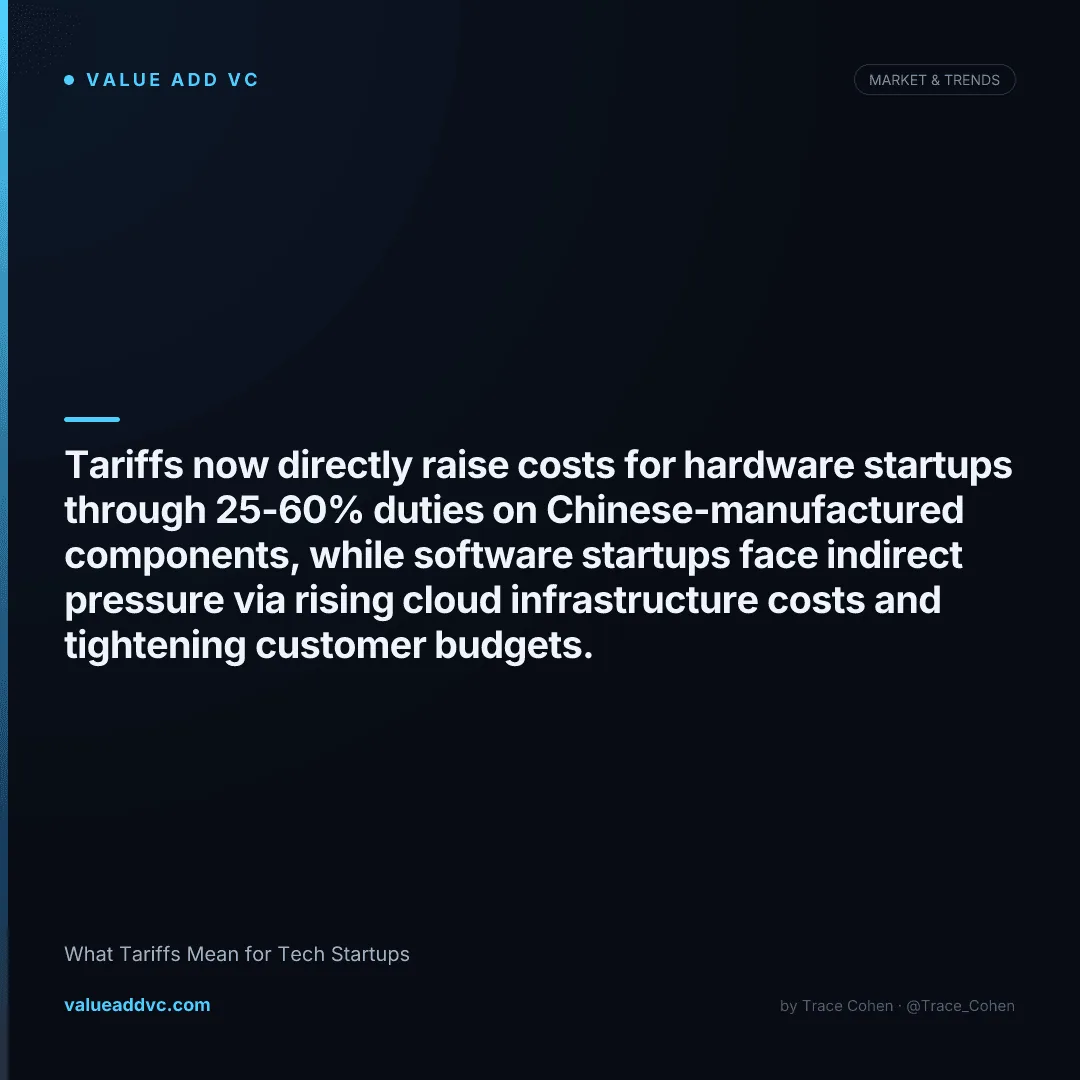
The most consequential tariffs for the tech sector include 25-60% duties on Chinese-manufactured electronics components, 10-25% tariffs on goods from Southeast Asian nations that were previously tariff-free or subject to minimal duties, and new reciprocal tariff frameworks with the European Union that affect software licensing and digital services. The semiconductor sector has its own overlay of export controls and import duties that create a complex web of compliance requirements.
What makes this environment particularly challenging for startups is the unpredictability. Tariff rates have changed multiple times, exemptions have been granted and then revoked, and new categories get added with little warning. This volatility makes it nearly impossible to build reliable 12-month financial models if your business touches physical goods in any meaningful way.
The geopolitical context matters too. This is not simply a U.S.-China story anymore. The tariff regime reflects a broader global trend toward economic nationalism, supply chain security, and the weaponization of trade policy. For founders, this means the trend is structural, not cyclical. Planning for tariffs is not about waiting out a political cycle; it is about adapting to a new permanent reality.
Direct Impact on Hardware Startups
Hardware startups are on the front lines of tariff pain. The math is brutal and straightforward: if your bill of materials includes components manufactured in tariff-affected countries, your cost of goods sold just went up by 15-50%, depending on the component and country of origin. For a pre-revenue startup with thin margins and limited pricing power, that can be existential.
Consider a robotics startup sourcing servo motors, PCBs, and chassis components from Shenzhen. Before tariffs, their landed cost per unit might have been $400. With current tariff rates, that same unit costs $520-$600 before they have added a single dollar of margin. If they were planning to sell at $799 with a 50% gross margin, that margin just collapsed to 25-35%. For a Series A company burning $300K per month, that margin compression can cut their runway by a third.
The challenges go beyond raw cost increases. Lead times have stretched as manufacturers scramble to reroute supply chains. Quality control becomes harder when you are working with new suppliers in unfamiliar geographies. Customs clearance is slower and more unpredictable, making just-in-time inventory management a fantasy. And the compliance burden of tracking country of origin, calculating tariff classifications, and filing the right paperwork adds overhead that startups are not staffed to handle.
Some hardware founders are responding by redesigning products to minimize tariff-affected components, but that takes time and engineering resources. Others are absorbing the cost increases and watching margins shrink. A few are passing costs to customers, but that only works if you have enough pricing power and your competitors face the same tariff exposure, which is not always the case if they manufacture domestically or in a tariff-exempt country.
Indirect Impact on Software Startups
Software founders might think they are immune to tariff effects. They are wrong. The indirect impacts are real, pervasive, and often harder to identify because they flow through second and third-order effects.
First, cloud infrastructure costs are rising. The major cloud providers run massive hardware operations, and they are not absorbing tariff-driven cost increases out of the goodness of their hearts. AWS, Google Cloud, and Azure have all adjusted pricing or reduced promotional credits over the past year. If you are a SaaS startup spending $50K per month on cloud infrastructure, a 10-15% increase in compute costs hits your unit economics directly. Multiply that across the thousands of SaaS companies in any given sector, and you start to see how tariffs ripple through the entire software economy.
Second, your customers are affected. If you sell software to manufacturing companies, logistics firms, retailers, or any business that deals in physical goods, their budgets are under pressure from tariff-related cost increases. Tighter customer budgets mean longer sales cycles, more aggressive negotiation on pricing, higher churn risk, and delayed expansion decisions. A B2B SaaS company selling to mid-market manufacturers may find that their customers are cutting discretionary software spend to offset tariff costs elsewhere in their business.
Third, the labor market is shifting. As companies restructure operations to adapt to tariffs, there are downstream effects on hiring patterns, office locations, and talent availability. Remote work policies, international hiring strategies, and compensation structures are all being reconsidered. Tools like Deel have become essential as startups explore hiring in new geographies to navigate both tariff exposure and talent access.
Supply Chain Shifts: Nearshoring and Friend-Shoring
The most significant structural response to the tariff regime is the massive reshuffling of global supply chains. Two terms have entered the startup vocabulary that barely existed five years ago: nearshoring and friend-shoring.
Nearshoring refers to moving manufacturing and sourcing closer to your primary market. For U.S.-based startups, this means Mexico, Central America, and increasingly, domestic manufacturing. Mexico has become the biggest beneficiary of the China tariff regime, with foreign direct investment in Mexican manufacturing facilities reaching record levels. For startups, nearshoring offers shorter supply chains, easier quality control, and tariff advantages under the USMCA trade agreement. The tradeoffs are higher labor costs, less mature supplier ecosystems in certain categories, and capacity constraints as everyone rushes to the same facilities.
Friend-shoring is the geopolitical cousin of nearshoring. It means sourcing from countries that are allied with or at least not adversarial to the U.S. In practice, this means shifting from China to India, Vietnam, Thailand, or Eastern Europe. The logic is both economic (lower tariff rates) and strategic (reducing dependence on a single geopolitical rival). India in particular has emerged as a major destination for electronics manufacturing, with Apple and its contract manufacturers leading the way. Startups are following, though the infrastructure and supplier maturity in India is still developing in many categories.
The challenge for startups is that supply chain restructuring takes time, capital, and expertise. Large companies can afford to send teams to evaluate new suppliers, negotiate long-term contracts, and manage the transition over 18-24 months. A 15-person startup does not have that luxury. This is creating a new category of service providers, logistics platforms, and procurement tools specifically designed to help smaller companies navigate the new supply chain reality.
How Startups Should Respond
The worst response to the tariff environment is to ignore it and hope it goes away. The second worst response is to panic and make hasty decisions. Here is a more measured framework for startup founders thinking about tariffs.
Audit your tariff exposure. Map every component, service, and cost in your supply chain back to its country of origin. Understand which tariff categories apply, what the current rates are, and what the worst-case scenario looks like if rates increase further. This is not a one-time exercise. Assign someone on your team to monitor tariff changes on at least a monthly basis.
Model scenarios, not just forecasts. Build financial models with at least three tariff scenarios: current rates, moderate escalation, and severe escalation. Understand what each scenario means for your unit economics, runway, and fundraising needs. Share these scenarios with your board and investors. The conversation about the real cost of starting a startup now has a tariff chapter.
Diversify your supply chain. Do not be single-sourced from any one country for critical components. This adds complexity and may increase costs in the short term, but it buys you resilience. Have at least one alternative supplier qualified and ready in a different tariff zone.
Explore tariff engineering. This is the practice of designing or classifying products in ways that minimize tariff exposure. It is perfectly legal and widely practiced by large companies. The specifics depend on your product category, but even small changes to product design, assembly location, or how a product is classified under the Harmonized Tariff Schedule can make a meaningful difference in duty rates.
Consider your pricing strategy. If tariffs are permanent, your pricing needs to reflect the new cost structure. Founders are often reluctant to raise prices, especially at early stages, but selling below cost is not a viable strategy. Be transparent with customers about why prices are changing. Most sophisticated buyers understand the tariff environment and will respect honest communication.
Opportunities in the Disruption
Tariffs are not all bad news for startups. In fact, some of the most interesting venture opportunities of 2026 are direct responses to the tariff environment.
Domestic manufacturing technology. As companies reshore production, there is massive demand for automation, robotics, and manufacturing software that makes domestic production cost-competitive. The defense tech sector is a particularly active buyer, given national security mandates to source domestically.
Supply chain visibility and compliance software. The complexity of managing tariffs, tracking country of origin, and ensuring compliance has created a booming market for supply chain technology. Startups building in this space are seeing strong demand from mid-market companies that can not afford the enterprise solutions from SAP or Oracle but desperately need tools to manage tariff complexity.
Cross-border hiring platforms. As companies restructure operations across geographies, the need for international hiring infrastructure is surging. Deel and similar platforms are enabling startups to hire talent in new regions without setting up legal entities, which is essential for companies exploring nearshoring or friend-shoring strategies.
Alternative material sourcing. Tariffs are accelerating the development of alternative materials and components that can be sourced domestically or from tariff-friendly countries. This includes everything from rare earth element substitutes to locally manufactured semiconductor packaging.
Trade finance and insurance. The uncertainty around tariffs has created demand for new financial products that help companies hedge against tariff risk, secure trade financing for restructured supply chains, and insure against sudden policy changes.
What Investors Are Watching
If you are raising capital in this environment, understand that sophisticated investors are now evaluating tariff risk as part of their diligence process. Here is what VCs are looking for, and what might give them pause. The broader state of VC funding in 2026 makes this scrutiny even more intense.
Supply chain resilience. Investors want to see that you have thought about tariff exposure and have a plan. A single-source dependency on a tariff-affected country is now a yellow flag in diligence. Founders who can demonstrate diversified sourcing, domestic alternatives, or tariff-engineered product designs will have an edge.
Margin trajectory under tariff scenarios. Investors are stress-testing financial models against tariff escalation scenarios. If your path to profitability depends on current tariff rates staying constant, that is a risk factor. Show that you can maintain viable unit economics even if tariffs increase by another 10-20 percentage points.
Competitive dynamics. Are your competitors more or less exposed to tariffs than you are? If a larger competitor manufactures domestically while you source from China, the tariff regime gives them a structural cost advantage that did not exist two years ago. Conversely, if you are the company with the domestic manufacturing edge, tariffs are actually widening your moat.
Policy monitoring capability. This may sound basic, but investors are looking for evidence that founders are tracking trade policy developments and incorporating them into strategic planning. A founder who is surprised by a tariff change that was telegraphed weeks in advance raises concerns about situational awareness and risk management.
Opportunity capture. The best founders are not just defending against tariff risks but finding opportunities in the disruption. Investors love to see that you have identified a way to turn the tariff environment into a competitive advantage, whether through supply chain innovation, new market positioning, or product design that specifically addresses tariff-driven pain points.
The Bottom Line
Tariffs are no longer an abstract policy debate happening in Washington. They are a material factor in the economics of building a technology company in 2026. The founders who will thrive in this environment are the ones who treat tariffs as a strategic variable to be managed, not an externality to be ignored. They will audit their exposure, diversify their supply chains, model multiple scenarios, and find opportunities in the disruption.
The good news is that startups have inherent advantages in adapting to change. You can pivot faster than large companies, redesign products without bureaucratic approval processes, and explore new suppliers and geographies with agility that Fortune 500 companies envy. The tariff regime is a headwind, but for the right founders building the right companies, it is also a once-in-a-generation opportunity to build something that matters.
The trade landscape will continue to evolve. New tariffs will be announced, exemptions will be negotiated, and the geopolitical context will shift. What will not change is the need for founders to be informed, strategic, and resilient. That has always been the job. Tariffs just raised the stakes.
Latest from the Pulse
Get VC data most people never see
— free to subscribe
Trace's notes on venture, AI and startups, a few times a week. Join 5,000+ subscribers. No spam.
No spam, unsubscribe anytime. Sent via Substack · Privacy · or subscribe on Substack ↗