
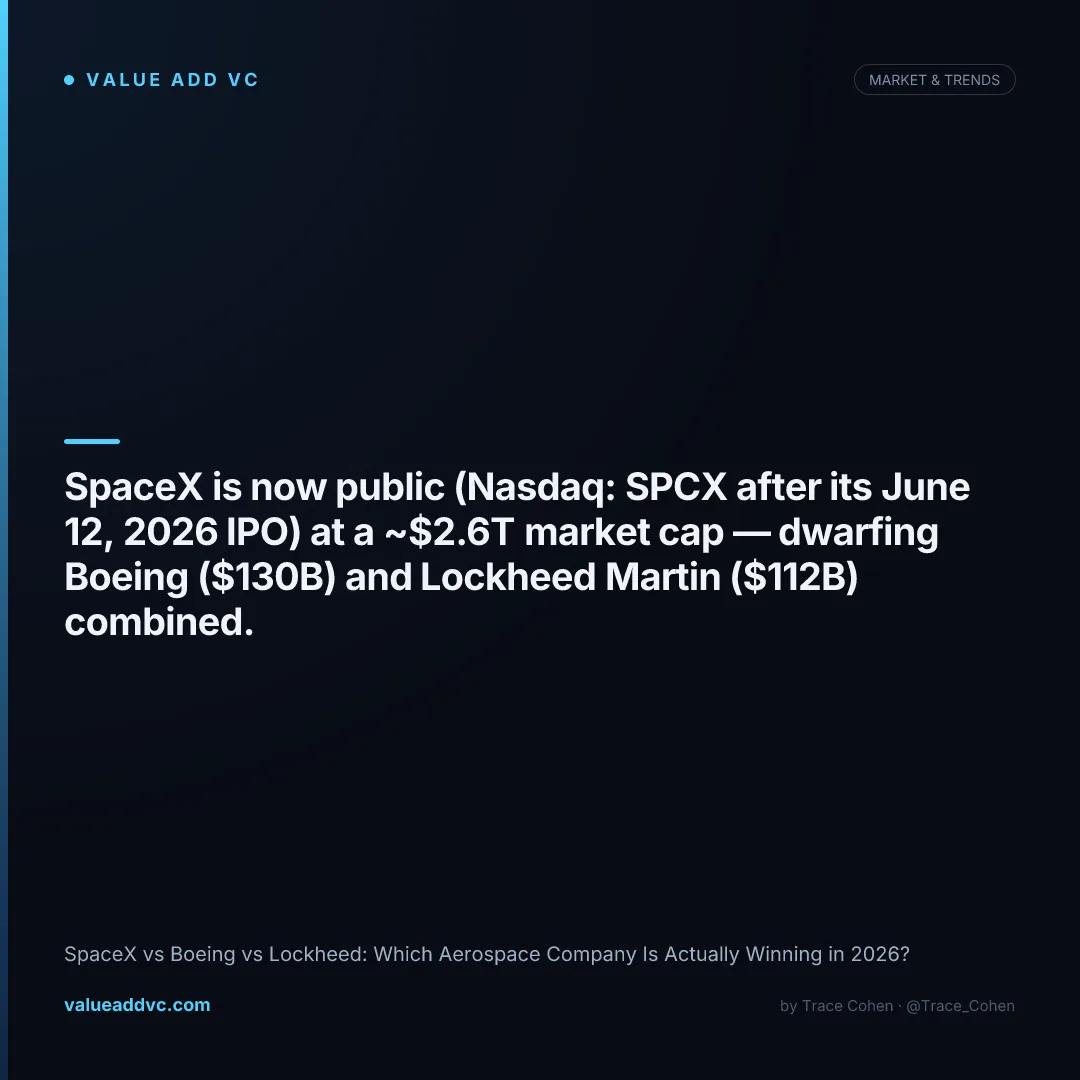
SpaceX's roughly $2T market cap in 2026 — set after its June 12 IPO as SPCX, the largest listing in history per CNBC — is about 7x Boeing (~$174B) and Lockheed Martin (~$113B) combined as of the June 24 close (Boeing at $220.25 × 788.3M shares per its Q1 10-Q; Lockheed at $491.64 × 230.6M shares per its Q1 10-Q), the most lopsided the aerospace scoreboard has ever been.
That's the short answer for anyone Googling "spacex vs boeing stock comparison" in 2026. The longer answer is more interesting: Boeing isn't losing because SpaceX is winning. Boeing is losing because Boeing is losing — and Lockheed is quietly running a 17% margin defense business that the market is barely noticing.
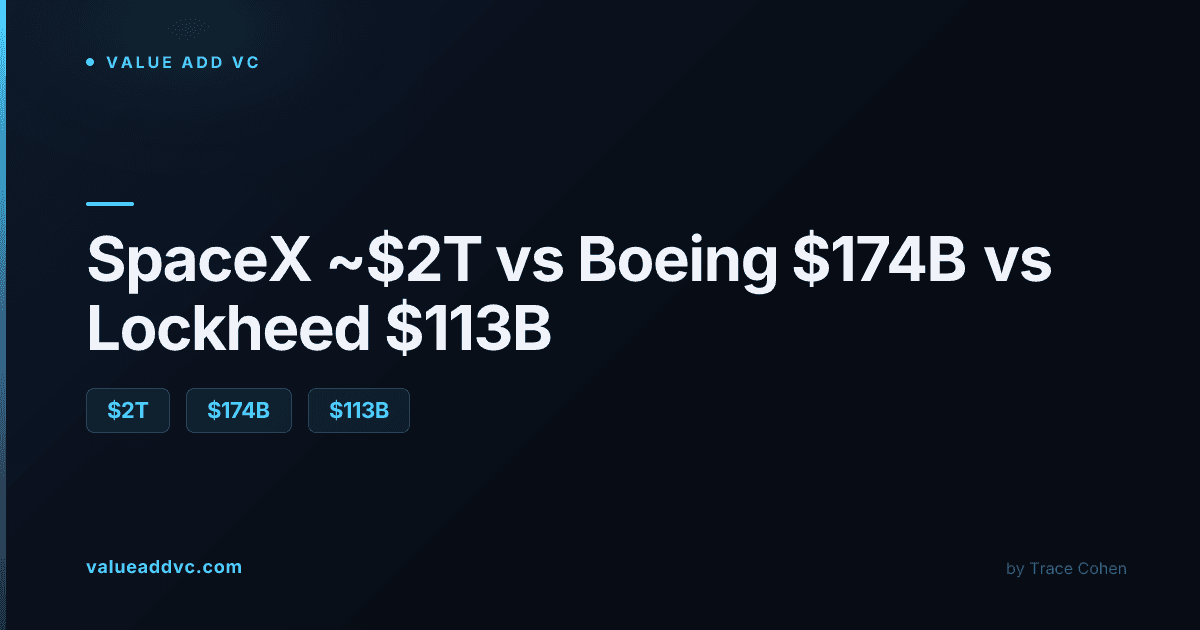
SpaceX vs Boeing vs Lockheed: Market Cap & 2024 Revenue
Sources: company 10-Ks; SpaceX market cap per CNBC (June 23, 2026).
SpaceX vs Boeing Stock Comparison: The 2026 Scoreboard
The clearest way to compare SpaceX, Boeing, and Lockheed Martin in 2026 is side by side on the metrics that actually drive equity value: revenue, growth rate, valuation, launch cadence, and operating margin. SpaceX wins on growth (~50% YoY) and launches (134 in 2024). Lockheed edged Boeing on 2024 revenue ($71.0B to Boeing's $66.5B, a 14% drop for Boeing that year) and runs with the highest operating discipline, while Boeing trails on margins.
| Metric (FY 2024 / mid-2026) | SpaceX | Boeing (BA) | Lockheed Martin (LMT) |
|---|---|---|---|
| Valuation / Market Cap | ~$2T (public, SPCX) | ~$174B | ~$113B |
| Share Price | Public, ~$154 (SPCX) | Public, ~$220/share | Public, ~$492/share |
| 2024 Revenue | ~$13.1B (est.) | $66.5B | $71.0B |
| Revenue YoY Growth | +47% | −14% | +5% |
| Operating Margin | Reinvested / break-even | −15.2% | 11.4% |
| 2024 Orbital Launches | 134 Falcon | 5 Vulcan + 3 Atlas (ULA) | Same ULA stake |
| Backlog | ~$11B Starlink + DoD | $521B | $173B (F-35 alone) |
| Long-term Debt | ~$5B | $57.7B | $19.6B |
| Headcount | ~14,000 | 172,000 | 122,000 |
| Dividend Yield | None (growth reinvest) | None (suspended 2020) | 2.8% |
Sources: company 10-Ks, SpaceX secondary tender filings, Forge Global, Hiive, ULA launch manifest, BryceTech 2024 orbital launch report.
Why SpaceX Is Winning the Aerospace Race in 2026
SpaceX captured ~83% of all global commercial launch revenue in 2024 — roughly $8.5B of an estimated $10.2B market. The Falcon 9 booster has now flown 23 times on the same vehicle (B1067 holds the record). Reuse economics took the per-kilogram cost to LEO from $54,500 on Shuttle in 2010 to roughly $1,520 on Falcon 9 in 2024 — a 36x cost collapse.
On top of that, Starlink hit 7,800 active satellites in orbit by mid-2026 and crossed 5 million subscribers globally. At an estimated $96 average monthly ARPU, that's a Starlink revenue run-rate near $5.8B/year — up from $1.4B in 2023. Direct-to-Cell partnerships with T-Mobile, Optus, Rogers, and KDDI add another revenue line that Boeing and Lockheed have no equivalent for.
Meanwhile, Starship achieved its first successful chopsticks catch in October 2024, completed orbital refueling demos in 2025, and was selected by NASA for the Artemis III lunar landing. The DoD's NSSL Phase 3 award gave SpaceX 60% of national security launches over the 2025–2034 window — and that's the contract that used to belong almost entirely to United Launch Alliance, the Boeing/Lockheed joint venture.
Boeing vs Lockheed vs SpaceX: Why Boeing Is the Loser in 2026
Boeing's 2024 was historically bad. The company posted a $11.83B net loss for the full year — its worst since the 2020 MAX grounding. Defense, Space & Security alone lost $5.4B on the year on fixed-price program charges across five programs: Starliner ($2.04B in cumulative charges), KC-46 tanker (over $7B since 2016), T-7A trainer, MQ-25 Stingray, and VC-25B Air Force One ($2.5B in losses).
The 53-day machinist strike in late 2024 took 33,000 workers offline and burned through roughly $5.5B in cash. Free cash flow for FY 2024 came in at negative $14.3B. The dividend was suspended in March 2020 and has not been restored. S&P downgraded BA to BBB- in 2024 — one notch above junk.
Starliner is the most visible symbol of the gap. Boeing's Commercial Crew contract was awarded in 2014 at the same time as SpaceX's Dragon. SpaceX has flown 13+ crewed missions to the ISS since 2020. Boeing's first crewed Starliner flight in June 2024 stranded two astronauts on ISS until February 2025 when SpaceX brought them home. Boeing has booked $2B+ in Starliner losses with no clear path to profitability on the program.
Lockheed Martin: The Quiet Compounder in the SpaceX vs Boeing Story
Lockheed's 2024 looked nothing like Boeing's. Revenue grew 5% to $71.0B, operating margin came in at 11.4%, and the company returned $6.8B to shareholders via buybacks ($3.7B) and dividends ($3.1B). The F-35 program alone has a $173B backlog stretching to 2049 and produced 110 aircraft in 2024.
Where SpaceX is eating launch, Lockheed is winning on missile defense and integrated air systems. THAAD, PAC-3, GMLRS, HIMARS munitions, and Long Range Hypersonic Weapon (Dark Eagle, declared operational Q4 2024) are growing 15–25% annually post-Ukraine. The Missiles & Fire Control segment grew 13% in 2024 — its fastest growth in 20 years.
The catch: Lockheed lost the Next Generation Air Dominance (NGAD) contract to Boeing in March 2025 (designated F-47), the first time Lockheed has lost a top fighter competition since the YF-23 in 1990. That said, the F-47 contract is fixed-price — exactly the structure that has been bleeding Boeing on every other program. Lockheed losing NGAD may end up being a blessing if Boeing repeats its fixed-price mistakes.
SpaceX vs Boeing vs Lockheed: Which Aerospace Stock to Actually Buy in 2026
The honest answer to "SpaceX vs Boeing vs Lockheed: which to buy?" comes down to time horizon — and all three are now directly buyable. SpaceX is public as of June 2026 (SPCX) and trades like any other stock; Boeing and Lockheed are the legacy primes. Each rewards a very different kind of investor.
SpaceX
For long-term growth
- • Best growth (~50% YoY)
- • Best launch share (~80% global)
- • Access: buy SPCX directly on Nasdaq
- • Risk: rich ~$2T cap, post-IPO volatility
Lockheed Martin (LMT)
For cash flow + dividend
- • 11.4% operating margin
- • 2.8% dividend yield, 22 years of raises
- • $173B F-35 backlog
- • Risk: NGAD loss, single-customer concentration
Boeing (BA)
For deep-value turnaround
- • Trades near 1.9x 2025 sales ($89.5B)
- • $521B backlog (largest)
- • Risk: $58B debt, no dividend, BBB- credit
- • Catalyst: 737 MAX rate to 38/month, NGAD win
How Investors Get SpaceX Exposure in 2026
Since the June 2026 IPO the simplest route is to buy SPCX directly. The pre-IPO fund vehicles still exist and now hold the public stock — but for most investors there's no longer a reason to pay a NAV premium for indirect access.
Buy SPCX directly (simplest)
Since June 12, 2026 SpaceX trades on Nasdaq as SPCX. Any brokerage, no accreditation, no premium — the cleanest exposure.
Robinhood Ventures I (RVI)
Closed-end fund with ~9% allocation to SpaceX, listed on NYSE, $0 minimum. Now holds SPCX shares but still often trades at a premium to NAV.
Destiny Tech100 (DXYZ)
Public fund with a large SpaceX weighting, ticker DXYZ on NYSE. Historically traded at steep premiums to NAV — most volatile of the bunch.
ARK Venture Fund (ARKVX)
$500 minimum, ~12% SpaceX exposure, 2.75% expense ratio. Quarterly liquidity windows only — now wraps public SPCX plus other private names.
Cathie Wood ARKK
Public ETF that holds ARKVX indirectly — a small, diluted sliver of SpaceX exposure.
For a deeper breakdown of every way to buy SpaceX, see the full guide to buying SpaceX stock (SPCX) or the live SpaceX IPO tracker.
What Could Change the SpaceX vs Boeing vs Lockheed Picture by 2027
Four catalysts could re-rate this trio over the next 18 months: a Starlink spin-off listing (now that the SpaceX parent is public), Boeing 737 MAX rate getting to 38/month sustained (last hit pre-MAX grounding), Lockheed F-35 sustainment contract renewal worth $250B+ across 2026–2030, and Starship achieving full reusability — which would collapse launch costs another 5–10x and finish ULA. Venture capital is already betting a credible independent challenger can emerge before that happens, with one fully reusable-rocket startup reaching a $10 billion valuation this year alone.
SpaceX's June 2026 IPO was already the largest single market-cap creation event in tech history — it priced at $1.77T (Aramco listed at $1.7T but was already government-owned), closed its first day at about $161 (~$2.1T), and closed at $192.50 on June 15 — about $2.5T on the 13.08B shares CNBC reported — before a three-day slide took it back near $2T, per CNBC. Even at the IPO price, SpaceX was worth more than Boeing, Lockheed, Northrop Grumman, General Dynamics, RTX, and L3Harris combined.
SpaceX has already won the future of aerospace — and now it's public.
The question for 2026 isn't how to access it — SPCX trades on Nasdaq — it's whether a ~$2T market cap leaves any upside left to buy.
Track SpaceX, Boeing, and Lockheed alongside every other major tech and defense IPO on the SpaceX IPO dashboard, the Tech IPO Pipeline, and the Defense Tech Map at Value Add VC. Originally published in the Trace Cohen newsletter.
Latest from the Pulse
Get VC data most people never see
— free to subscribe
Trace's notes on venture, AI and startups, a few times a week. Join 5,000+ subscribers. No spam.
No spam, unsubscribe anytime. Sent via Substack · Privacy · or subscribe on Substack ↗