
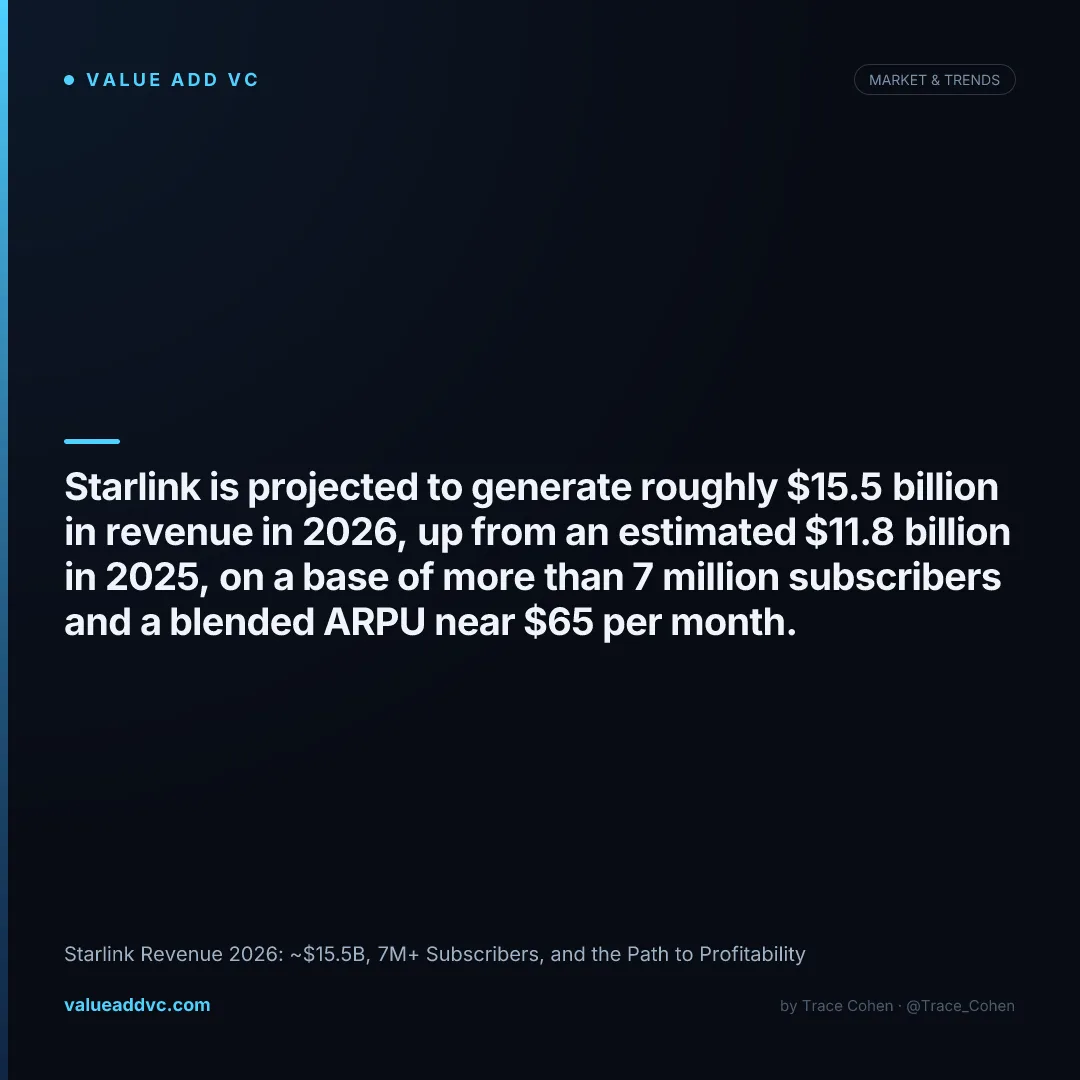
Starlink hit 12 million subscribers and $4.29 billion of quarterly connectivity revenue in Q2 2026 — a ~$17B annualized pace, up 66% year over year — after generating $11.4B in 2025 — 61% of everything SpaceX earned.
The interesting part isn't the topline. It's that Starlink crossed from a capital-incinerating moonshot into SpaceX's only profitable segment in about 24 months — and became the recurring-revenue engine that let SpaceX go public on June 12, 2026 at $1.77 trillion (Nasdaq: SPCX), the largest IPO in history. And yet the listing investors keep asking about — a standalone Starlink spinout — still hasn't happened. Launch is the headline; Starlink is the business model.
Starlink revenue in 2026: the audited numbers
For years these figures were analyst estimates from Quilty Space, Payload, and Bloomberg. The S-1 and SpaceX's first public earnings reports replaced them with audited data. Per the Q2 2026 earnings release (August 4, 2026), connectivity revenue was $4.29B for the quarter — $2.49B consumer (up 44%) and $1.81B enterprise and government (up 108%) — against consolidated SpaceX revenue of $7.81B, nearly double a year earlier, with a $47.5B backlog.
| Year | Starlink revenue | Subscribers | Reported ARPU/mo | Source |
|---|---|---|---|---|
| 2022 | ~$1.4B | ~1.0M | — | analyst est. |
| 2023 | ~$4.2B | ~2.3M | — | analyst est. |
| 2024 | $6.6B | ~4.6M | $91 | S-1 |
| 2025 | $11.4B | 6M (mid) → 10.3M (Q1 '26) | $81 | S-1 |
| Q2 2026 | $4.29B (quarter, ~$17B pace) | 12M | $66 | Q2 earnings |
Reported ARPU is consumer service revenue per subscriber, as SpaceX discloses it. Note the pattern: revenue keeps climbing while reported ARPU falls ($91 → $81 → $66). That's not a problem — it's the deliberate trade of price for volume in emerging markets, offset by high-ARPU enterprise and government verticals that now contribute ~42% of connectivity revenue.
Starlink ARPU, properly understood: $66 reported vs ~$120 all-in
The single biggest mistake people make reading Starlink revenue is mixing up two different ARPU numbers. SpaceX's reported monthly ARPU — $66 in Q2 2026, down 22% from $85 a year earlier — measures consumer service revenue per subscriber, and it's falling by design as cheaper emerging-market plans scale toward the 20M-subscriber year-end target. But a $30/month rural household and a $25,000/month container ship are both "subscribers," and the enterprise side is growing far faster. Divide total Q2 connectivity revenue ($4.29B) across the 12M base and you get roughly $120 per subscriber per month all-in — nearly double the consumer-only figure, because enterprise and government contracts contribute ~42% of revenue from a small fraction of accounts.
| Segment | Typical price/mo | Q2 2026 revenue | Role |
|---|---|---|---|
| Consumer (residential + roam) | $10–120 by market | $2.49B (+44% YoY) | Volume base; reported ARPU $66 |
| Enterprise & government | $250–$25,000+ | $1.81B (+108% YoY) | Maritime, aviation, defense, D2C wholesale |
Read the enterprise row again: it doubled year over year and now carries the margin. That concentration is why Starlink can keep cutting consumer prices in India, Africa, and Southeast Asia to win the next 50 million households without wrecking its economics — the verticals pay for the network. Direct-to-cell wholesale via carriers like T-Mobile adds capacity-based revenue with near-zero incremental capex per end user; I broke down why in this piece on Starlink Direct to Cell.
The path to profitability: already behind it, not ahead of it
Starlink turned free-cash-flow positive in 2024, and the S-1 showed it as SpaceX's only profitable segment — roughly $4.4B of operating income on $11.4B of 2025 revenue. The mechanism is straightforward once you see it: the constellation was a giant upfront capital cost, and once 7,000+ satellites were in orbit and the user-terminal subsidy shrank, the marginal cost of each new subscriber collapsed while subscription revenue kept compounding.
Falling launch cost per satellite
Reusable Falcon 9 and Starship drop the cost to deploy and replenish the constellation, the single largest capex line.
User terminal subsidy shrinking
Dishes that once cost SpaceX $1,000+ to build and sold below cost are now far cheaper, turning hardware from a loss leader toward breakeven.
High-ARPU vertical mix
Enterprise and government revenue grew 108% YoY in Q2 2026 — added revenue without proportional infrastructure cost on an already-built network.
Direct-to-cell wholesale
Carrier partnerships like T-Mobile monetize coverage with near-zero incremental capex per end user.
The costs that remain are real: satellites live roughly five years and must be continuously replaced, terminals are still often sold near cost, and Amazon's Kuiper plus sovereign constellations will pressure consumer pricing. But a built-out, cash-generative network funded by its own launch vehicle is one of the most elegant capital flywheels in modern business — Starlink's cash pays for the rockets that launch more Starlink satellites that generate more cash, which is what funds Starship.
The IPO everyone's waiting for: a standalone Starlink spinout
Here's the part that matters for investors. SpaceX chose a full-company listing on June 12, 2026 — $135/share, a $1.77 trillion valuation, a ~$75B raise — rather than a Starlink carve-out, so there is no standalone Starlink ticker. Because Starlink was 61% of 2025 revenue and the only profitable segment, the bulk of SPCX's market cap is effectively a Starlink valuation. Pre-IPO, analysts floated standalone Starlink numbers from $100B to $200B+; the public market ended up paying far more, embedded inside SPCX.
The open question is structure. Musk has hinted for years that Starlink could still be spun out once cash flows are "reasonably predictable" — Q2 2026's numbers arguably clear that bar — which would give public investors the clean recurring-revenue subscription story without underwriting Starship's capital intensity. Until that happens, the only way to own Starlink is to own SPCX. Track where it sits among the year's listings on the Tech IPO tracker and follow live SpaceX data on the SpaceX IPO dashboard.
The bull case
- ✓ 12M subs, doubling YoY, targeting 20M by end of 2026
- ✓ Only profitable SpaceX segment; FCF positive since 2024
- ✓ Enterprise/government revenue up 108% YoY with pricing power
- ✓ Direct-to-cell opens a near-zero-capex TAM
The bear case
- ✕ Reported ARPU down 22% YoY as growth shifts to cheap markets
- ✕ Constellation needs constant, costly replenishment
- ✕ Amazon Kuiper and sovereign constellations intensify competition
- ✕ A $1.77T parent valuation leaves little room for a miss
Strip away the rockets and the Elon noise and you're left with one fact.
Starlink is a 12M-subscriber, cash-flow-positive subscription business growing 66% — and that, not launch, is what SPCX investors are actually buying.
Explore Related Dashboards
Interactive tools with live data on this topic
Track upcoming listings on the Tech IPO Tracker at Value Add VC. Originally published in the Trace Cohen newsletter.
Latest from the Pulse
Get VC data most people never see
— free to subscribe
Trace's notes on venture, AI and startups, a few times a week. Join 5,000+ subscribers. No spam.
No spam, unsubscribe anytime. Sent via Substack · Privacy · or subscribe on Substack ↗