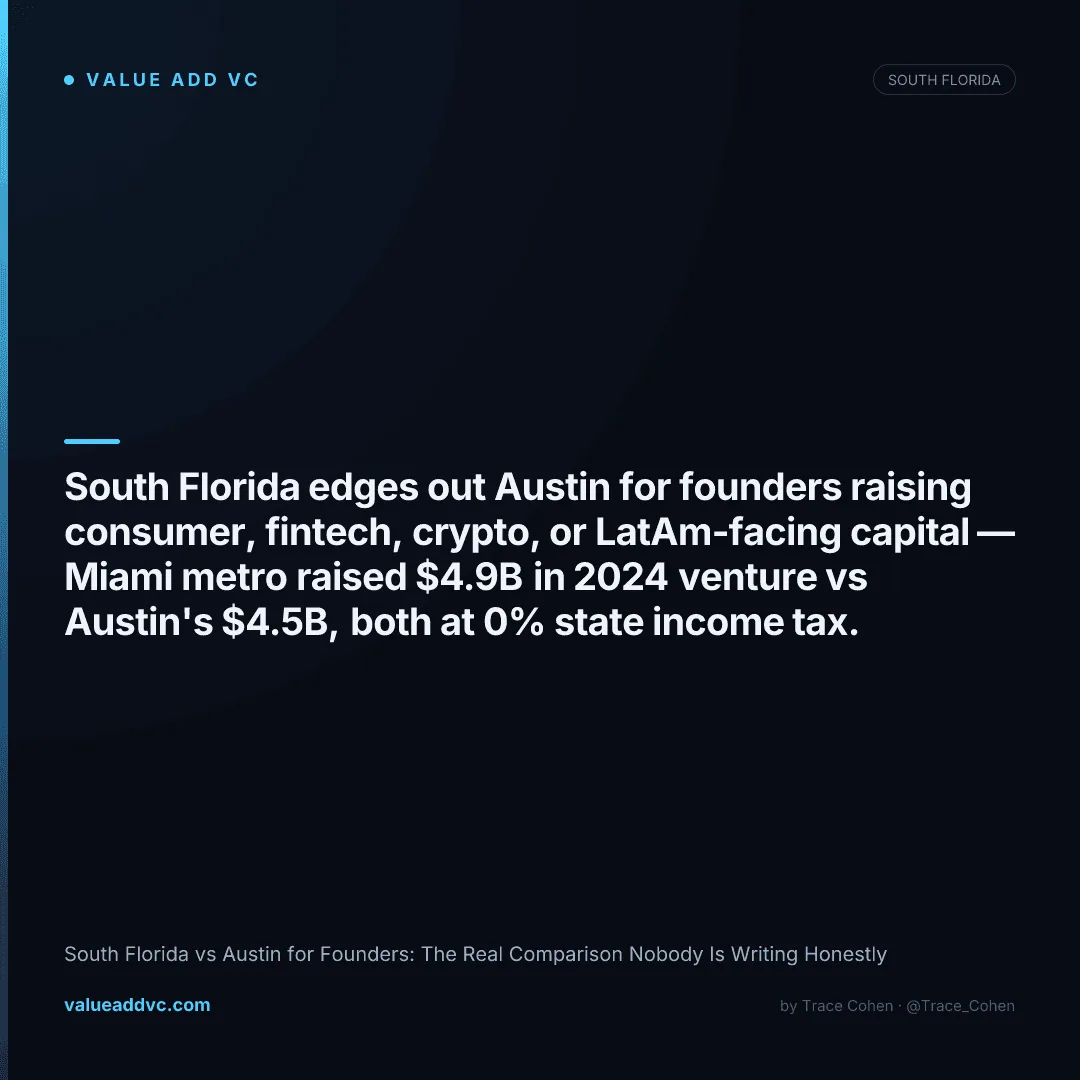
Both cities have 0% state income tax, but Miami metro raised $4.9B in venture in 2024 vs Austin's $4.5B — South Florida wins for consumer, fintech, and crypto founders, Austin wins for deep-tech and developer-facing ones. That's the short answer. The longer answer is more interesting.
I've invested in 65+ startups, founded three companies, and watched both ecosystems go from "emerging" to "real" over the last six years. Most comparisons are written by tourism boards or relocation consultants with an agenda. This one isn't. The decision is less about the city and more about who your customers are, where your capital comes from, and how much runway your burn allows.
South Florida vs Austin for Startups and Founders: Side-by-Side
For founders choosing between South Florida and Austin, the two cities are nearly identical on the headline financial driver — 0% state income tax — but diverge sharply on venture concentration, cost of living, and talent depth. South Florida leads on total 2024 venture dollars and fintech/crypto density; Austin leads on senior engineering talent and lower housing costs. Here is the honest head-to-head.
| Attribute | South Florida (Miami) | Austin |
|---|---|---|
| State income tax | 0% | 0% |
| 2024 venture raised | ~$4.9B (~350 deals) | ~$4.5B (~300 deals) |
| Median rent (1BR) | ~$1,950/mo | ~$1,650/mo |
| Median home price | ~$580,000 | ~$450,000 |
| Property tax rate | ~1.0% | ~2.0%+ |
| Strongest sectors | Fintech, crypto, consumer, LatAm | Enterprise SaaS, semis, deep tech |
| Anchor employers | Citadel, Blackstone, Founders Fund (office) | Apple, Tesla, Oracle, Dell |
| Senior engineer density | Moderate, growing | High, established |
Capital Access: Where the Money Actually Is
Miami's ~$4.9B in 2024 venture funding looks like a narrow win over Austin's ~$4.5B, but the composition matters more than the headline. Roughly 40% of Miami's deal volume sits in fintech and crypto — a direct result of Citadel, Blackstone, and dozens of family offices relocating since 2020, plus a city government that branded itself the crypto capital. If you're building stablecoin rails, cross-border payments, or consumer fintech, the local check-writers — mapped on our Miami VC Firms directory — actually understand your business.
Austin's capital is older and more enterprise-flavored. Firms like Next Coast Ventures, S3 Ventures, and LiveOak have backed B2B SaaS and deep tech for over a decade, and the Apple/Tesla/Oracle gravity creates a steady supply of operator-angels who've seen software scale. For a Series A enterprise startup, Austin's investor base is more battle-tested. For a seed-stage consumer or crypto play, Miami's is hungrier. Either way, both cities still depend on coastal capital for growth rounds — you can track how fund performance varies by vintage on the VC Performance dashboard.
Cost of Living: The 0% Tax Isn't the Whole Story
The 0% state income tax is identical and it's real money — a founder paying themselves $500,000 saves roughly $46,000 a year versus California's 13.3% top rate and about $35,000 versus New York. On an exit, neither state taxes capital gains. That's the gravitational pull behind every relocation thread. But the day-to-day math diverges.
Austin Is Cheaper to Live
- ✓ Median 1BR rent ~$1,650 vs Miami's ~$1,950
- ✓ Median home ~$450K vs Miami's ~$580K
- ✓ Lower restaurant and services pricing
- ✓ Shorter commutes, less density premium
Miami's Hidden Costs & Edges
- ✓ Lower property tax (~1% vs Austin's ~2%+)
- ✕ Home insurance can run $5,000–$10,000+/yr
- ✕ Summer humidity and hurricane risk
- ✓ No state filing burden of any kind
For a renting founder, Austin's ~$300/month rent gap compounds into real runway. For a founder who buys, Texas property taxes above 2% of assessed value can erase the headline savings within a few years, while Florida's ballooning home-insurance market does the same in coastal zones. Run your own numbers before assuming either is "cheap."
Talent: The Single Biggest Gap Between the Two
This is where Austin's decade-long head start shows. Apple's 6,000+ employee campus, Tesla's Gigafactory, Oracle's headquarters move, and Dell's long presence mean Austin has tens of thousands of senior software and hardware engineers within commuting distance. The University of Texas pumps out roughly 1,500 CS-adjacent graduates a year. If you need to hire your 5th through 50th engineer locally, Austin is materially easier.
Miami's technical talent pool is real but thinner and younger, heavily weighted toward fintech, crypto, and product/design rather than infrastructure engineering. The upside: Miami's proximity to Latin America gives founders access to a deep, lower-cost, same-time-zone engineering market in Colombia, Mexico, and Brazil — many of the strongest Miami startups run hybrid teams that would be impractical from Austin. The lean-team math here mirrors what I covered in AI-native hiring.
Lifestyle and Density: Who You Bump Into Matters
Ecosystems compound on serendipity. Austin's startup scene is concentrated, walkable around downtown and East Austin, and culturally cohesive — SXSW, a tight founder Slack culture, and years of accumulated network density. Miami is geographically sprawled across Brickell, Wynwood, and Coral Gables, which dilutes spontaneous collisions, but the sheer volume of capital allocators, family offices, and international founders passing through creates a different kind of density: money and global deal flow rather than engineers and product people.
If your edge is fundraising, partnerships, and LatAm or international expansion, Miami's rooms are more valuable. If your edge is shipping product and recruiting builders, Austin's are. As a New York-based investor, I see far more cross-border fintech and crypto deal flow route through Miami, while the deep-tech and enterprise pitches still skew toward Austin and the Bay.
The Verdict: Who Actually Wins
There's no "it depends" cop-out here — the answer splits cleanly by company type. South Florida wins if you're building consumer, fintech, crypto, or anything LatAm-facing, if your moat is capital access and global partnerships, and if you can recruit engineering across the Americas. Austin wins if you're building enterprise SaaS, semiconductors, hardware, or developer tools, if you need to hire dozens of senior engineers locally, and if you want lower rent and a denser founder community in a smaller footprint.
For the median early-stage founder optimizing for talent and burn, Austin is the safer default. For the founder whose business lives and dies on capital, distribution, and international reach, Miami is the asymmetric bet. Both beat staying in a 13% tax state and watching your post-exit proceeds get clipped.
The city doesn't build your company. Your customers, capital, and team do.
Pick the place that shortens the distance to all three — not the one with the best relocation pitch.
Track venture trends and fund performance on the VC Performance dashboard at Value Add VC. Originally published in the Trace Cohen newsletter.
Latest from the Pulse
Get VC data most people never see
— 100% free
Weekly benchmarks, valuations, and fund data. Join 5,000+ investors. No spam.