
In 2011, Marc Andreessen wrote that software was eating the world. He was right. But he didn't finish the sentence.
Software ate retail. Then logistics. Then healthcare. Then finance. Then every industry that thought it was immune.
By 2024, the mission was largely accomplished. Every industry had been softwarized. There was a SaaS tool for everything. A dashboard for every workflow. An API for every integration.
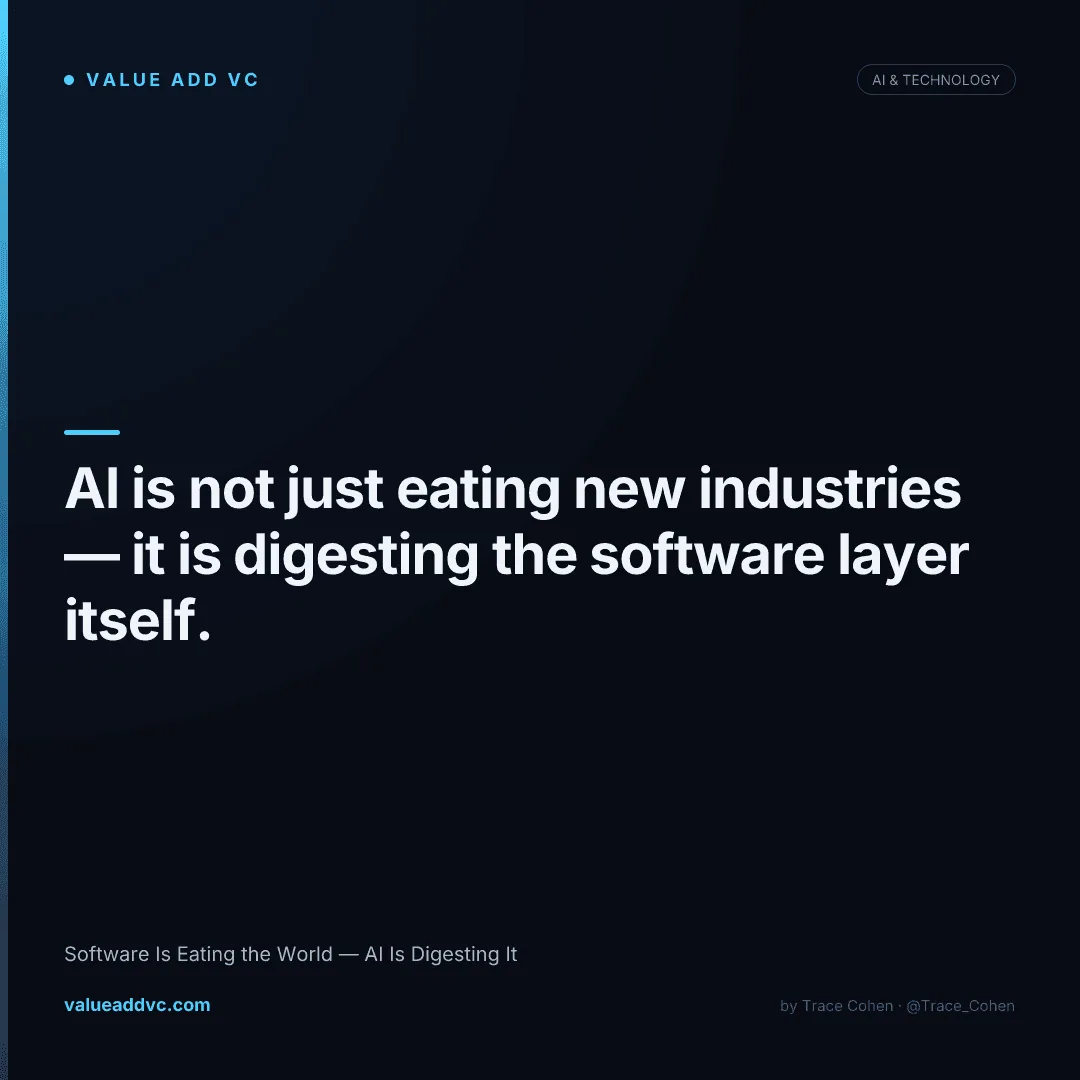
And now? AI isn't eating new industries. It's digesting the software layer itself.
Two Phases, Two Revolutions
Phase one (2011-2024) was about software replacing manual processes. Every industry got a SaaS stack. The winners were the ones who could build horizontal tools — CRM, payments, collaboration, analytics — and sell them to everyone.
PHASE 1: Software Eats the World
2011 - 2024
- Manual processes become software
- Horizontal SaaS wins
- Winner-take-all in each category
- Distribution = moat
- Seats-based pricing
PHASE 2: AI Digests It
2024 - Present
- Software processes become AI agents
- Vertical AI wins
- Incumbents get unbundled
- Intelligence = moat
- Outcome-based pricing
Phase two is fundamentally different. AI doesn't digitize workflows — it eliminates them. It doesn't put a dashboard on a process. It removes the process entirely.
SaaS Incumbents Are More Vulnerable Than They Think
Here's the uncomfortable truth for every SaaS company sitting on $50M+ ARR: your product might be a feature of an AI agent.
Think about what most SaaS tools actually do. They structure data, present it in a UI, let humans make decisions, and record the outcomes. That's the whole value chain: input, display, decide, record.
AI collapses that chain. If an agent can ingest the data, make the decision, and execute the outcome — what's the SaaS tool for?
The UI becomes optional. The dashboard becomes a rearview mirror. The human in the loop becomes the human who set up the agent and checks in once a week.
Software gave humans superpowers. AI makes the humans optional.
That's not a feature update. That's a category reset.
Vertical AI Is Replacing Horizontal SaaS
The first wave of software was horizontal. Salesforce sold CRM to everyone. Slack sold messaging to everyone. Stripe sold payments to everyone.
The AI wave is vertical. The winners are building deep, industry-specific intelligence that can't be replicated by a general-purpose model with a nice prompt.
Consider what's happening right now:
AI that doesn't just organize contracts but reviews, redlines, and negotiates them. Entire paralegal workflows compressed into an agent.
AI that doesn't just manage patient records but triages symptoms, generates treatment plans, and handles prior authorizations autonomously.
AI that doesn't just display financial data but runs the close, catches anomalies, and generates audit-ready reports.
AI that doesn't just list properties but underwrites deals, generates comps, and drafts LOIs in minutes.
AI that doesn't just track applicants but sources candidates, screens resumes, and schedules interviews without human intervention.
Each of these vertical AI companies is collapsing a stack of 5-10 horizontal SaaS tools into a single intelligent system. The software meltdown isn't coming. It's here.
The Value Chain Is Compressing
In the SaaS era, value was distributed across a long chain: data ingestion, processing, visualization, decision support, execution, and reporting. Each step was a potential SaaS company.
AI compresses the entire chain into one step. The agent ingests, processes, decides, executes, and reports — in a single loop. That means the middle of the value chain is getting crushed.
Most Vulnerable
- \u2715Dashboard/analytics tools (replaced by agents that act on data)
- \u2715Workflow automation (replaced by AI that decides the workflow)
- \u2715Data transformation (replaced by AI that handles messy data natively)
- \u2715Low-end content creation (replaced entirely)
More Durable
- \u2713Systems of record (data gravity is real)
- \u2713Infrastructure (compute, storage, networking)
- \u2713Compliance/regulatory tools (risk tolerance stays human)
- \u2713Platforms that agents build on (the new canals)
If your product sits between raw data and human decisions, you should be worried. That's exactly where AI agents live.
What This Means for Founders
If you're building a startup today, stop thinking in SaaS categories. “We're the Salesforce for X” was a winning pitch in 2015. In 2026, it's a warning sign.
The question isn't “what software tool can I build?” It's “what outcome can I deliver?”
Customers don't want a CRM. They want more closed deals. They don't want an analytics dashboard. They want better decisions. They don't want a project management tool. They want shipped products.
AI lets you sell the outcome directly. Skip the tool. Deliver the result. That's the leap.
What This Means for Investors
The AI valuation landscape is tricky right now. Too many companies are raising on “we added AI to our SaaS tool” narratives. That's a feature, not a thesis.
The real opportunities are in companies that rethink the value chain from scratch. Not “we made the dashboard smarter” but “we eliminated the need for a dashboard.”
Look for AI-native companies that:
And be skeptical of anything that looks like “SaaS + AI sprinkled on top.” That's the equivalent of “we added a website” in 2005. The moat is dead. The dashboard is dying. The money is moving toward companies that understand this.
The End State
Where does this end? I don't think software dies. It just becomes invisible.
The best software in five years won't have a UI you log into daily. It'll run in the background, making decisions, taking actions, and surfacing itself only when it needs human judgment. The interface will be a conversation, not a dashboard.
Software ate the world. AI is digesting it into something leaner, faster, and less visible. The companies that survive are the ones that see themselves not as software vendors but as intelligence providers.
Software ate the world.
AI is eating the software.
The transition from SaaS to AI-native software is the most significant structural shift in tech since mobile. Explore our Is SaaS Dead? dashboard and the AI Landscape tracker for the data behind this thesis.
Latest from the Pulse
Get VC data most people never see
— free to subscribe
Trace's notes on venture, AI and startups, a few times a week. Join 5,000+ subscribers. No spam.
No spam, unsubscribe anytime. Sent via Substack · Privacy · or subscribe on Substack ↗