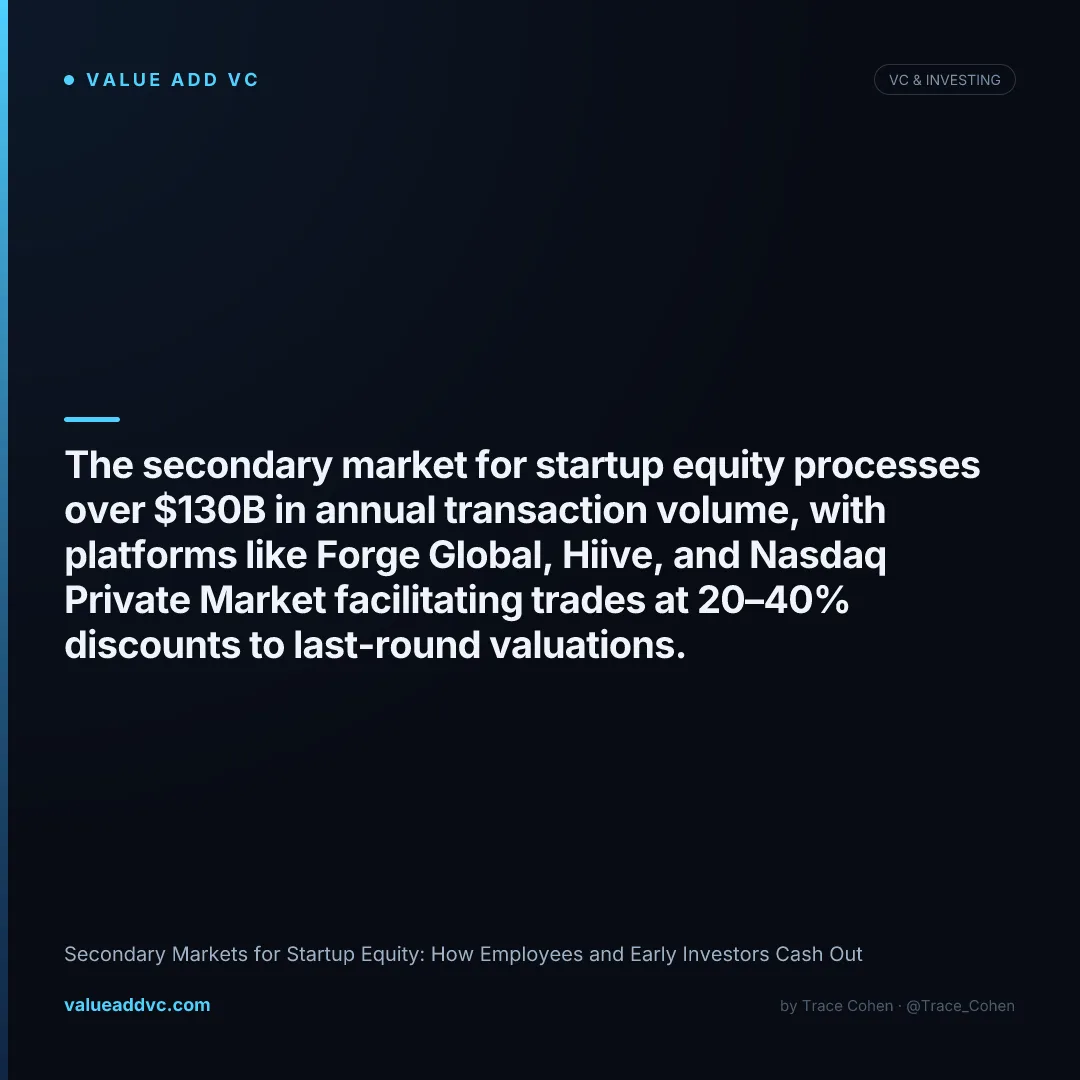
The secondary market for startup equity processes over $130B in annual transaction volume — and it exists because most startup employees and early investors will never see an IPO.
The median time from founding to IPO is now 12+ years. A startup employee who joined at year two and vested over four years may wait another decade before public liquidity. Secondary markets close that gap — imperfectly, with discounts, restrictions, and friction — but they work.
Understanding how these markets function, who the buyers are, and what the real pricing looks like is essential for any employee, angel, or early-stage fund manager sitting on paper gains in a private company.
How the Secondary Market for Startup Equity Works
In a primary round, a company issues new shares and receives the proceeds. In a secondary transaction, existing shareholders sell their shares to a new buyer — the company receives nothing. The mechanics differ depending on the path taken:
A secondary fund (or the company itself) offers to buy shares from employees and early holders at a fixed price. Company approves the process and facilitates logistics.
Cleanest path — single price, legal simplicity, high participation
Employee lists shares on Forge, Hiive, or Nasdaq Private Market. Qualified buyers bid. Transaction requires company approval and ROFR clearance.
Most flexible but slower (4–12 weeks to close) and subject to company veto
Seller finds buyer directly — often through their network. Terms negotiated privately. Still requires company approval and ROFR waiver.
Common for larger blocks (>$1M); avoids platform fees (typically 3–5%)
Investor provides capital to exercise options; takes a share of the upside at exit. Employee doesn't sell shares immediately but monetizes option value.
Useful when employee can't afford to exercise options but doesn't want to lose them
The Major Secondary Market Platforms in 2026
The secondary market for startup equity has consolidated around a handful of broker-dealer platforms that match buyers and sellers, handle compliance, and facilitate company approvals:
| Platform | Min. Transaction | Seller Fee | Best For |
|---|---|---|---|
| Forge Global | $100K | 3–5% | Late-stage unicorns; largest liquidity pool |
| Hiive | $50K | 3–5% | Mid-stage companies; faster matching |
| Nasdaq Private Market | $250K | Varies | Tender offers; institutional buyers |
| EquityBee | $25K (options) | Revenue share | Employees who can't afford to exercise |
| Rainmaker Securities | $100K | 2–4% | Seller-side advisory for larger blocks |
Platform fees and minimums are approximate; terms vary by company and deal size.
Secondary Market Pricing: What Startup Shares Actually Trade At
The most common misconception is that secondary shares trade at or near the last primary round valuation. They almost never do. The discount reflects the illiquidity premium buyers demand and the uncertainty around future exit value. Here's what the data shows:
Tier 1 Unicorns (SpaceX, Stripe, Databricks)
5–20% below last round
Clear exit thesis, strong demand from secondary funds, constrained supply of shares
Growth-Stage Startups ($1B–$5B)
20–35% below last round
Moderate liquidity, buyer pool is smaller, exit timing uncertain
2021 Peak Valuations (marked down)
40–70% below peak
Primary round was at inflated multiple; secondary pricing reflects current fundamentals
Pre-Product or Pre-Revenue
50–80% below last round
Almost no secondary buyer demand; transactions are rare and heavily discounted
The secondary market is also one of the best real-time signals for how institutional investors actually value late-stage private companies — often more accurate than the headline valuation on a primary term sheet. Check the AI Valuations Dashboard for current secondary pricing data on major AI companies.
The Blockers: What Restricts Secondary Sales
Most startup equity comes with restrictions that make secondary sales harder than they look. Sellers need to understand these before assuming they can simply list shares on Forge and get paid:
Right of First Refusal (ROFR)
The company (and sometimes existing investors) has the right to match any secondary offer and buy the shares themselves before the transaction closes. Most late-stage companies exercise ROFR selectively — usually on large blocks or from employees with competitor concerns.
Board Approval Requirements
Almost all secondary transactions require board or company approval. Companies can and do decline transfers to unknown buyers, competitors, or if they believe the transaction creates unwanted cap table complexity.
Transfer Restrictions in Stock Plan
Most option grants prohibit transfer to anyone except through approved channels. RSUs have different rules but are similarly restricted before vesting.
Lock-Up Periods Post-IPO
Even after a company IPOs, employees and early investors typically face 90–180 day lock-up periods before they can sell in the public market.
Accredited Investor Requirements
Secondary buyers must be accredited investors (typically $1M+ net worth or $200K+ income). This limits the buyer pool compared to public markets.
Who the Buyers Are — and What They're Looking For
The buyer side of the secondary market for startup equity is dominated by institutional players with specific return profiles and risk tolerances:
Secondary Funds
Industry Ventures, Greenspring Associates, Industry Ventures, Meritech Capital
Buy at discount; hold until IPO or acquisition. Target 2–3x return on discounted basis. Prefer late-stage, identifiable exit timelines.
Family Offices
UHNW family office investment arms
Access to pre-IPO names they can't get into via primary rounds. Willing to hold 3–7 years. Price-sensitive but less so than institutional funds.
Crossover Hedge Funds
Coatue, Tiger Global (re-entering), D1 Capital
Build position ahead of IPO lock-up expiration. Value price certainty before public market volatility kicks in.
Strategic Buyers
Existing shareholders (lead VCs) exercising pro-rata rights or buying secondary
Maintain ownership percentage or block outside investor entry. May use secondary to increase ownership at discount to internal valuation.
The Secondary Market as a Fund Liquidity Tool
For early-stage VC funds, the secondary market has become a critical DPI (distributions to paid-in capital) tool in a world where IPOs are scarce. A seed fund that backed a company at $5M valuation and is now sitting on a paper position worth $50M at the last primary round may be able to sell a portion at $35–40M — not full price, but real cash returned to LPs.
This is why VC fund performance data increasingly distinguishes between TVPI (paper gains included) and DPI (cash returned). LPs are putting more weight on DPI, which means GPs who can engineer secondary liquidity are valued more than those sitting on the same paper returns with no distribution plan.
Secondary volume in the broader private markets (including LP stake sales and GP-led continuation funds) exceeded $130B in 2023 according to Jefferies, and the market is projected to grow to $200B+ by 2026. For employees and early investors in the right companies, this is a real, functional market — not a theoretical one.
The secondary market isn't a workaround — it's the market.
With 12+ year median paths to IPO, secondary transactions are how most startup equity actually converts to cash. Know the platforms, understand the pricing, and clear the blockers before you need the money.
Track secondary market data and private company valuations on the AI Valuations Dashboard and VC Performance Dashboard at Value Add VC. Originally published in the Trace Cohen newsletter.
Latest from the Pulse
Get VC data most people never see
— free to subscribe
Trace's notes on venture, AI and startups, a few times a week. Join 5,000+ subscribers. No spam.
No spam, unsubscribe anytime. Sent via Substack · Privacy · or subscribe on Substack ↗