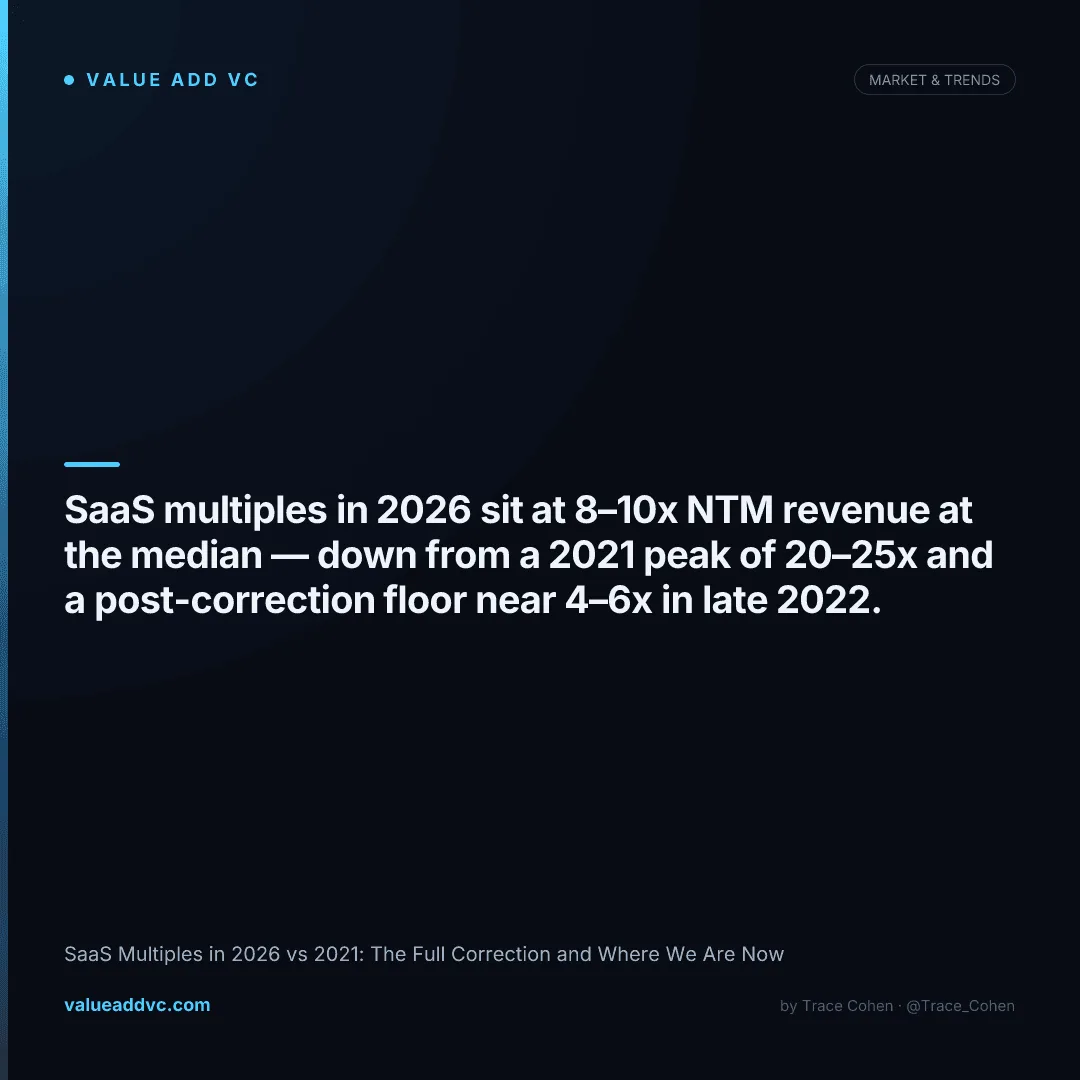
The median public SaaS company traded above 20x NTM revenue in November 2021. Today it trades at 8–10x. That is not a recovery — that is the new normal.
The SaaS multiple correction is complete. From late 2021 to late 2022, median multiples collapsed roughly 70%. The partial recovery since then has been real but uneven — top-decile growers got most of it back, while everything else got a structural reset. Understanding what drove the peak, the crash, and the 2026 equilibrium is the only way to correctly price private SaaS companies, set realistic exit expectations, or build a pitch that resonates with investors who have lived through both extremes.
The 2021 Peak: What SaaS Multiples vs 2026 Actually Looked Like
In November 2021, the BVP Nasdaq Emerging Cloud Index hit its all-time high. The median EV/NTM revenue multiple for publicly traded SaaS was approximately 20–22x. The top quartile — companies growing above 40% with strong retention — was pricing at 30–45x. Individual names went further: Snowflake hit 100x forward revenue at its peak, Zoom crossed 60x, UiPath and Confluent both exceeded 50x. These were not anomalies. They were the median-adjacent.
Three forces drove the 2021 peak simultaneously. First, the Fed Funds rate was essentially zero, making future cash flows worth more in present value terms. Second, pandemic digitization created a genuine pull-forward in enterprise software spend — companies were buying five years of tools in 18 months. Third, the IPO window was wide open, creating a public market bid for anything with a software revenue model.
The result was an environment where even SaaS businesses growing at 20% with no clear path to profitability traded at 15–18x revenue. Every growth company was priced like the next Salesforce.
| Benchmark | 2021 Peak | Late 2022 Trough | Mid-2026 |
|---|---|---|---|
| Median EV/NTM Revenue | 20–22x | 5–7x | 8–10x |
| Top-quartile growth (>40% YoY) | 35–50x | 10–15x | 18–28x |
| Rule of 40 leaders (>60 score) | 40–60x | 12–18x | 22–35x |
| Slow-growth (<15% YoY) | 10–14x | 3–5x | 4–7x |
The 2022 Crash: Why SaaS Multiples Fell 70% in 12 Months
The Fed raised rates 425 basis points in 2022 — the fastest tightening cycle since the 1980s. For SaaS, this was a double hit: the discount rate on future cash flows spiked, and enterprise software budgets froze simultaneously. Companies that had been buying tools aggressively in 2020–2021 entered a correction phase. Seat expansions stalled. NRR contracted. Churn ticked up.
The multiple compression was mechanical and fast. When the 10-year Treasury moved from 1.5% to 4.5%, a SaaS business priced at a 5% terminal free cash flow yield became worth 60% less almost instantly. The market did not wait for revenue to slow — it re-priced the entire category based on the new discount rate.
By November 2022, the BVP Cloud Index median had fallen to roughly 5.5x NTM revenue. Companies that had IPO'd at 30x were trading at 6x. The Snowflakes and Databricks of the world held better — but even they saw 60–70% drawdowns from peak. Rates were not the only force: crossover funds (Tiger, Coatue, T. Rowe) that had bid up late-stage rounds pulled back hard, and enterprise budget freezes in late 2022 cut NTM revenue estimates — compressing multiples on a shrinking denominator.
The company-level data makes the dispersion concrete. Peak multiples versus the latest readings (as of late 2025):
| Company | Peak NTM Multiple | Peak Date | Latest (as of late 2025) |
|---|---|---|---|
| Snowflake | ~100x | Nov 2021 | ~18–22x |
| HashiCorp | ~60x | Dec 2021 | Acquired by IBM |
| Cloudflare | ~65x | Nov 2021 | ~22–28x |
| Asana | ~45x | Nov 2021 | ~5–8x |
| Monday.com | ~50x | Nov 2021 | ~10–14x |
| Veeva Systems | ~30x | Nov 2021 | ~8–10x |
| Salesforce | ~9x | Nov 2021 | ~6–8x |
Where SaaS Multiples Stand in 2026 vs 2021
The 2026 equilibrium is not a recovery to 2021. It is a permanent re-rating. The median public SaaS EV/NTM revenue multiple has settled in the 8–10x range as of mid-2026, with the 10-year Treasury at roughly 4.3%. That is the math: at structurally higher risk-free rates, terminal multiples compress, and the premium paid for future growth shrinks.
What has partially recovered is the premium for genuine quality. In 2022, the market sold everything indiscriminately. By 2024–2026, the market re-learned to differentiate. A SaaS company growing 35%+ YoY with 125% NRR and a Rule of 40 score above 55 genuinely commands 20–28x today. I've seen private market comps for Series B and C SaaS that reflect this — term sheets for high-growth B2B SaaS are pricing at 15–20x ARR when the metrics are clean.
The AI tailwind is real but selective. SaaS companies with credible AI revenue (not just a chatbot bolt-on) are commanding an incremental 3–5x turn on the multiple. But the market is getting better at distinguishing genuine AI leverage from marketing — companies claiming "AI-native" without the ARR growth to prove it are not being rewarded.
Track current public SaaS comps on the SaaS Valuations Dashboard — it updates weekly with EV/NTM and EV/ARR data for 100+ public software companies.
What Drives Premium Multiples in 2026
ARR Growth Rate >30% YoY
+4–8x multipleThe single biggest driver. At 50%+ growth, you are still in a different conversation — 25–35x is achievable for the best names. Below 20% growth, the multiple conversation starts below 10x regardless of other metrics.
Net Revenue Retention >120%
+3–6x multipleNRR above 120% implies the business grows without any new logo acquisition. The market treats this as a proxy for product-market fit durability. The difference between 110% and 130% NRR is often 5–8 turns on the multiple.
Rule of 40 Score >50
+3–5x multipleThe sum of ARR growth rate and FCF margin. A company growing 35% with 20% FCF margin scores 55 — that is top quartile and commands a clear premium. Companies scoring above 40 typically trade at 1.5–2x the multiple of same-growth-tier peers with weaker margins — the Rule of 40 became the gating metric after the correction, and that is structural, not cyclical.
Credible AI Revenue Layer
+2–5x multipleAI features that drive measurable ARPU expansion or faster land-and-expand cycles are being rewarded. The bar is rising: investors want to see AI contribution as a percentage of NRR expansion, not just product announcements.
Gross Margin >75%
Table stakesGross margin above 75% no longer earns a premium — it just gets you in the room. SaaS gross margins have normalized across the category. Below 70%, you face a meaningful discount; above 80%, it is expected for pure-software businesses.
What This Means for Private Company Valuations
Private SaaS valuations lag public comps by 6–18 months and apply a liquidity discount — typically 20–35% below comparable public multiples. In practice, that means: a private SaaS company with $20M ARR, 40% growth, 115% NRR, and a clean cap table should expect term sheets at 12–18x ARR if the process is competitive. That is dramatically lower than the 25–35x the same company might have seen in 2021.
The founders who are struggling right now are those who raised in 2021 at 30–40x ARR and now need to raise at 15–18x — a down round by definition, even if revenue has grown 2–3x. I've seen dozens of these situations. The down round stigma has faded somewhat, but the cap table complexity from 2021-vintage terms (participating preferred, high liquidation stacks) makes these situations genuinely painful. Secondary market pricing tells the honest story: many 2021-vintage rounds are still clearing at 40–60% haircuts, and flat rounds are the new clean — down rounds are more common than reported.
The founders winning in 2026 are those who stayed capital efficient in 2022–2023, grew into their valuation, and are now raising at metrics that justify a clean multiple. The market rewards discipline retroactively.
SaaS multiples are not broken. They are correctly priced.
8–10x NTM revenue is what a software business earning future cash flows in a 4%+ rate environment should trade at. 2021 was the anomaly — not 2026.
Track live SaaS EV/NTM revenue multiples for 100+ public software companies on the SaaS Valuations Dashboard. Published by Value Add VC.
Get VC data most people never see — free.
Weekly benchmarks, valuations, and fund data. No spam, unsubscribe anytime.