
The average VC finds out a portfolio company is in trouble at a board meeting. The best funds find out three to six months earlier — because they built a real portfolio monitoring system.
Across Value Add VC's review of fund operations, the portfolio companies that surprise investors negatively almost always had early signals that went unwatched or had no system to surface them: gross margin quietly compressing, burn creeping up, the founding team quietly scaling back hiring. Portfolio monitoring in venture capital isn't about being a micromanager. It's about having enough signal, early enough, to actually be useful.
Here's exactly what to track, how often, and what should trigger an alert.
The Core Portfolio Monitoring Metrics for VC Funds
Not all metrics are created equal. The best portfolio monitoring frameworks distinguish between health metrics (is the company going to run out of money?), growth metrics (is it compounding the way we underwrote?), and efficiency metrics (is it spending wisely?). Here's the core set that top funds track.
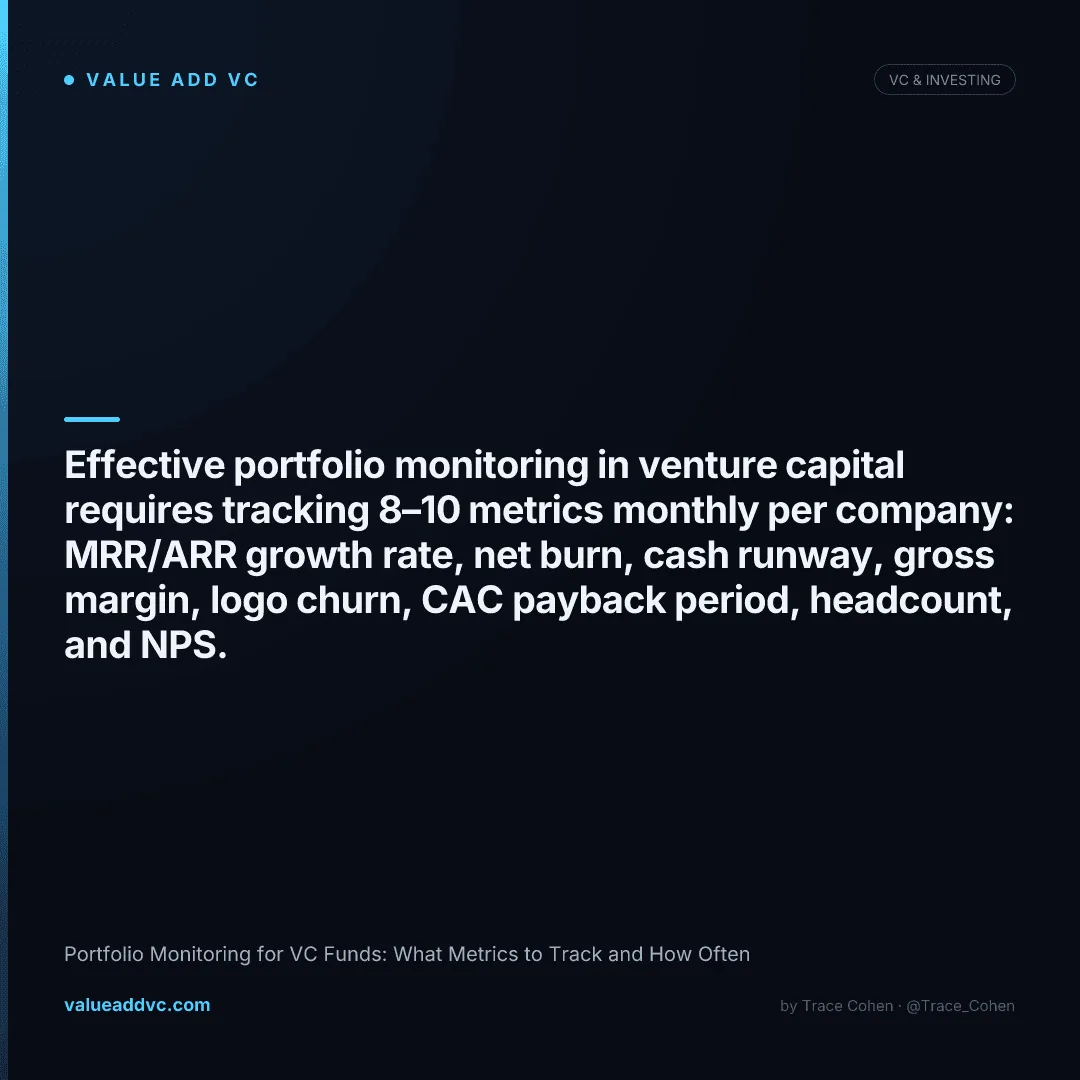
| Metric | Category | Frequency | Red Flag Threshold |
|---|---|---|---|
| MRR/ARR Growth Rate | Growth | Monthly | <5% MoM (early) or <80% YoY (growth) |
| Net Burn Rate | Health | Monthly | >20% increase MoM without explanation |
| Cash Runway | Health | Monthly / Weekly if <12mo | <9 months without active raise |
| Gross Margin | Efficiency | Monthly | >5pp compression quarter-over-quarter |
| Logo Churn | Growth | Monthly | >2% monthly logo churn |
| NRR (Net Revenue Retention) | Growth | Quarterly | <100% — any contraction signals product risk |
| CAC Payback Period | Efficiency | Quarterly | >24 months for SMB, >36 months for enterprise |
| Headcount (by department) | Efficiency | Monthly | G&A > 20% of total headcount |
| Cash Balance | Health | Monthly | Below 6 months of runway at current burn |
| Pipeline Coverage | Growth | Monthly | <3x quarterly target in pipeline |
Monitoring Frequency: How Often to Track Each Signal
The right cadence for portfolio monitoring in venture capital isn't one-size-fits-all. It should scale with risk — and risk is primarily a function of runway and growth trajectory.
Weekly
Companies with <12 months runway, or experiencing >30% MoM burn increase
- • Cash balance
- • Net burn vs prior week
- • Any large unexpected expenses
- • Headcount changes
Monthly
All active portfolio companies (standard cadence)
- • MRR/ARR growth
- • Gross margin
- • Logo churn
- • Pipeline
- • Headcount by dept
Quarterly
Growth-stage companies with 18+ months runway and healthy growth
- • NRR
- • CAC payback
- • LTV:CAC ratio
- • Unit economics deep dive
- • Competitive positioning
The biggest mistake emerging managers make: treating all portfolio companies identically. A Series A company with 8 months of runway and slowing growth needs weekly attention. A Series B company with 24 months of runway and 150% NRR can handle quarterly check-ins.
The 5 Red Flags That Should Trigger Immediate Action
Pattern-matching across 65+ investments, these are the five signals that have consistently preceded serious company distress — often by 3–6 months before the formal problem statement arrives.
Runway under 9 months without an active fundraise in progress
At typical raise timelines (4–6 months for Series A, 3–4 months for Seed), a company with 9 months of runway and no active process is already in danger. The math doesn't work unless they've started.
Action: Immediately align on the fundraising plan or a path to default alive.
MoM revenue growth decelerating below 5% for an early-stage company
Early-stage companies that priced on 10–15% MoM growth need that rate to justify their valuations and hit the next round's benchmarks. Consistent 5% MoM growth is less than 80% YoY — not a high-growth company anymore.
Action: Get on a call within the week. Understand whether it's a sales execution problem, product-market fit issue, or market change.
Gross margin compression of 5+ percentage points in a single quarter
Margin compression usually signals that COGS is growing faster than revenue — often because of cloud infrastructure cost creep, professional services over-reliance, or customer success bloat. It compounds quickly.
Action: Request a detailed COGS breakdown. This is rarely a one-quarter phenomenon — you're usually seeing the leading edge of a trend.
Logo churn exceeding 2% per month
2% monthly logo churn annualizes to 22%+ — a structurally broken retention profile. Even with strong new logo additions, a 22% annual churn rate creates a leaky bucket that eventually overwhelms growth.
Action: Review cohort analysis by customer segment, contract size, and acquisition channel. High churn is almost always concentrated in one segment.
Disproportionate G&A headcount growth relative to engineering and sales
When G&A starts growing faster than revenue-generating functions, it signals the company is building organizational complexity instead of product or distribution. G&A above 20% of total headcount at early stage is a warning sign.
Action: Review the org chart and upcoming hiring plan. This is often a founder management issue, not a market issue.
The Tools Top Funds Use for Portfolio Monitoring
The VC portfolio monitoring tooling market has matured significantly in the last three years, and the newest wave of products automates the parts that used to require an analyst: pulling financials from a board deck, answering a question across the whole portfolio, or flagging an outlier before it shows up in a quarterly review. Standard Metrics describes this directly as "AI Analyst" querying and an MCP server that connects portfolio data to Claude and other LLMs, as of October 2026. The best setup for a $25–100M fund is still layered: a data collection tool, a visualization layer, and a communication system — AI now does more of the first layer's manual work.
Standard Metrics
Portfolio monitoring, data collection & investor reporting
AI-driven platform used by 150+ VC and PE firms managing $500B+ in AUM, including Bessemer, General Catalyst, and Accel, per the company's site as of October 2026. Its AI Analyst answers natural-language questions across a portfolio, an AI agent extracts data from board decks and financial statements with human QA, and an MCP server connects the platform directly to Claude and other LLMs for querying portfolio data. The pick for established funds ($200M+ AUM, 20+ portfolio companies) that have outgrown lighter-weight tools.
Visible.vc
Portfolio data collection & LP reporting
The most widely adopted tool for emerging managers. Portfolio companies submit monthly updates via standardized forms. Integrates with Stripe, QuickBooks, and Xero. Pricing starts at $500/month for a 20-company portfolio.
Harmonic
Passive deal flow + company signal monitoring
Tracks funding rounds, headcount changes, job postings, and web traffic across portfolio companies automatically. Flags signals without requiring founder input — good for the companies that stop sending updates.
Airtable + custom dashboards
Lightweight ops for small funds
Many emerging managers build their own monitoring system in Airtable with Zapier automations pulling in Stripe and QuickBooks data. Works well up to about 20 companies before the maintenance overhead gets prohibitive.
Causal or Mosaic
Financial modeling & budget vs actual
For portfolio companies that have committed to monthly financial reporting, Causal lets portfolio companies build and share dynamic financial models. Mosaic is more enterprise-grade and works better at growth stage.
See the full Standard Metrics profile in the Value Add VC tools directory. Track the full emerging manager tech stack — including portfolio monitoring tools — on the VC Performance Dashboard and Fund Benchmarking pages at Value Add VC.
How AI Is Changing Portfolio Monitoring in Venture Capital
The frontier of portfolio monitoring is moving from reactive dashboards to proactive AI-driven anomaly detection. Several trends are reshaping how top funds operate:
Automated signal scraping
Tools like Harmonic and Demyst now track web traffic, job postings, news sentiment, and GitHub commit frequency without founder input. If a portfolio company stops posting jobs and starts losing engineering talent on LinkedIn, you know before the board meeting.
AI memo generation from portfolio data
Funds are using Claude and GPT-4 to draft quarterly company memos from structured data inputs — flagging what changed, what's at risk, and what needs a conversation. This compresses the time for a portfolio associate to review 30 companies from a week to a day.
Predictive runway modeling
Instead of static runway calculations, AI-powered tools run Monte Carlo simulations on burn trajectories, incorporating historical burn pattern variance, seasonality, and upcoming known expenses to give probabilistic runway estimates rather than point-in-time figures.
Benchmark comparison automation
The best monitoring platforms like Standard Metrics now automatically compare portfolio company metrics against stage-matched peer data — so you see not just 'this company grew 8% MoM' but 'this company grew 8% MoM when the median comparable company grew 14%.' Context is everything.
Building a Portfolio Monitoring System: The Practical Setup
For a $25–75M fund with 15–30 portfolio companies, here's the monitoring architecture that works without requiring a dedicated platform team:
Standardize data collection
Use a purpose-built portfolio monitoring platform like Standard Metrics to send structured, automated data requests to portfolio companies. The alternative — Google Forms and email follow-ups — breaks down past 15 companies. Standard Metrics automates the collection cycle, parses financial documents with AI, and benchmarks your data against 10,000+ venture-backed startups so you see performance in context, not isolation. Keep requests to 10–12 metrics max regardless of tool.
Set automated alerts
Configure alerts in your spreadsheet when runway drops below 12 months, burn increases more than 20% MoM, or revenue growth drops below your threshold for each stage.
Run a weekly triage
Every Monday, scan the dashboard. Flag any company that triggered an alert. Reach out same-day — not at the next board meeting.
Maintain a company health score
Rate each company 1–5 every month across growth, health, and team dimensions. Trends in this score over 3+ months are more reliable signals than any single data point.
Use passive signals for silent companies
Companies that stop sending monthly updates are often the ones most in trouble. Set up Harmonic or LinkedIn monitoring to track headcount changes passively for companies that go quiet.
The funds that outperform don't just pick better companies.
They build information systems that surface problems early enough to actually fix them — and opportunities early enough to double down before the next round.
Portfolio monitoring isn't a back-office function. It's how you earn the right to be helpful at the moment it matters most.
Disclosure: Standard Metrics is a Value Add VC partner. All opinions and editorial analysis are our own.
Track fund performance benchmarks and portfolio metrics at the VC Performance Dashboard and Fund Benchmarking Tool at Value Add VC. Originally published in the Trace Cohen newsletter.
Latest from the Pulse
Get VC data most people never see
— free to subscribe
Trace's notes on venture, AI and startups, a few times a week. Join 5,000+ subscribers. No spam.
No spam, unsubscribe anytime. Sent via Substack · Privacy · or subscribe on Substack ↗