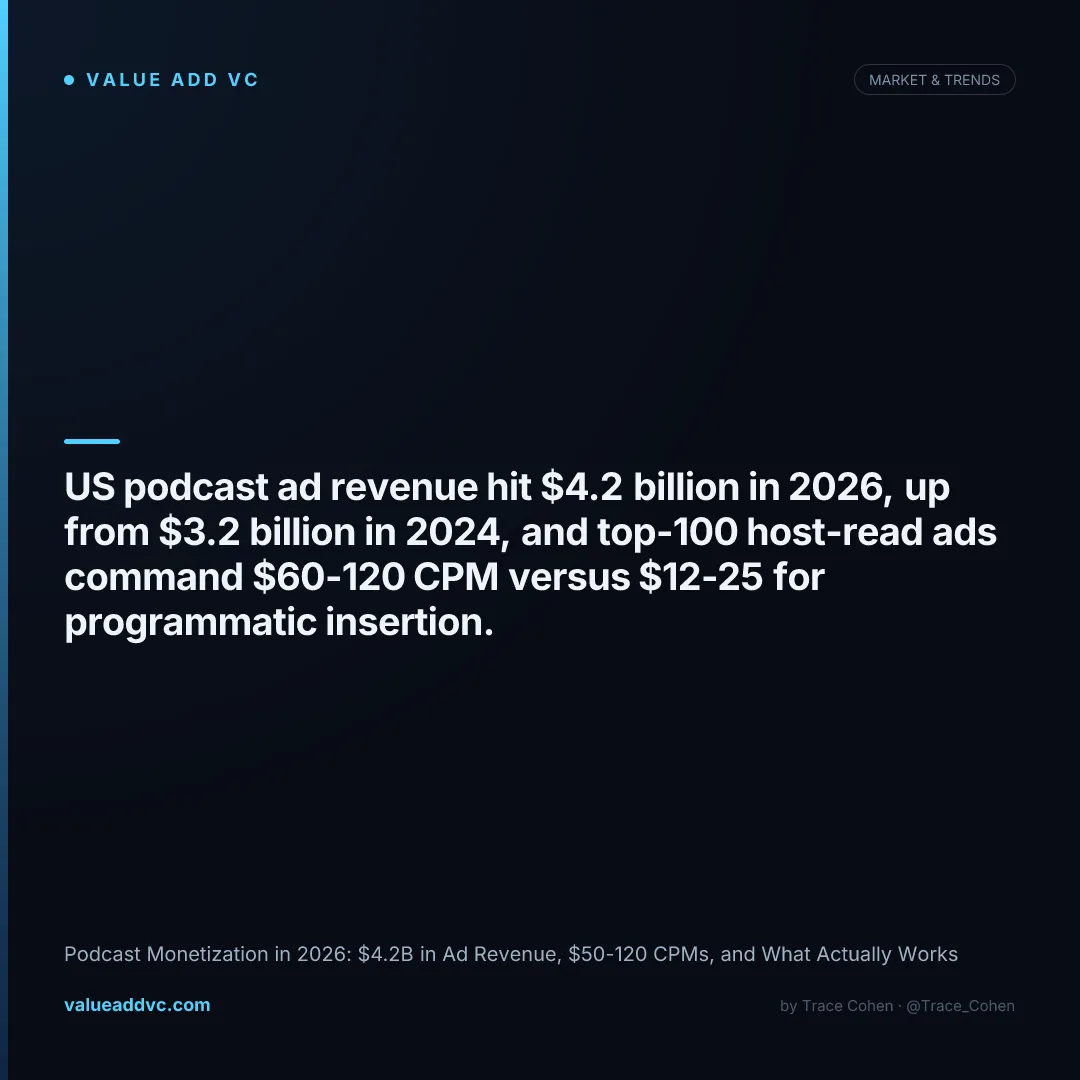
US podcast ad revenue hit $4.2 billion in 2026, up from $3.2 billion in 2024, and top-100 host-read ad placements now command $60-120 CPM. Ads still dominate podcast monetization by a wide margin — subscriptions and memberships are real but supplementary, not a replacement.
Every year someone declares podcast advertising saturated and subscriptions the future. The 2026 numbers say otherwise: ad spend keeps climbing, dynamic ad insertion has made back-catalog episodes monetizable indefinitely, and the CPM gap between a host-read spot on a top show and a programmatic drop-in is now wide enough to change how creators think about growth versus intimacy tradeoffs.
Figures blended from IAB/PwC podcast advertising revenue studies, industry CPM surveys (MillionPodcasts, Springcast, Improvado), and Patreon's 2025 creator earnings disclosure, as of July 2026.
Podcast monetization in 2026: how ads, subscriptions, and memberships actually stack up
Podcast monetization in 2026 runs through three real channels: direct/host-read advertising, programmatic dynamic ad insertion, and listener-funded subscriptions or memberships. Ads remain dominant, generating an estimated 80%+ of total creator and network revenue combined, with US ad spend at $4.2 billion. Subscriptions are growing fast in absolute terms — podcasters earned $629 million on Patreon in 2025 alone, up 33% year over year — but still represent a fraction of the ad market.
The practical takeaway for anyone building a show or evaluating a media investment: ad revenue scales with audience size and genre, while subscription revenue scales with audience loyalty and niche depth. The two aren't competing strategies — the highest-earning independent shows run both simultaneously, using a free ad-supported feed to grow reach and a paid tier for bonus content to capture the most engaged fraction of that audience.
Podcast ad rates in 2026: CPM by genre and placement type
CPM (cost per thousand downloads) varies more by genre and ad format than almost any other digital media category. Standard 2026 host-read rates run $25-40 for mid-tier shows and $60-120 for top-100 titles, while programmatic dynamic ad insertion averages $12-25 regardless of show size. Personal finance and investing podcasts top every genre ranking at $50-100+ CPM, reflecting the high purchase intent and above-average household income of that audience.
Technology and SaaS shows follow at $40-80 CPM and business/entrepreneurship shows at $35-75 CPM — both audiences B2B advertisers pay a premium to reach. Health and wellness sits lower at $25-50 CPM, and general entertainment programmatic inventory closes out the range at $12-25. For a founder or fund evaluating a podcast sponsorship as a growth channel, the genre-CPM gap is the single biggest lever on cost per acquisition, often larger than the gap between individual shows within the same genre.
Dynamic ad insertion: the infrastructure change that made back-catalog monetization real
Dynamic ad insertion (DAI) now accounts for roughly 90% of podcast ad revenue by delivery method in 2026, up from a minority share just a few years ago. DAI swaps ads into an episode at the moment of download rather than embedding them permanently in the file, which means a three-year-old episode can serve a 2026 ad campaign and be re-targeted by geography, device, and inferred interest — something baked-in ads never allowed.
That shift matters more than it sounds: it converts a podcast's entire archive into a permanently monetizable asset instead of a decaying one, which is a meaningfully different revenue model than most content formats get. Programmatic DAI CPMs run $12-25 and hold fairly steady, while pixel-based attribution has made it easier for advertisers to actually measure podcast ROI against downstream conversions — a measurement gap that used to be podcast advertising's biggest weakness relative to performance-driven SaaS marketing channels.
Subscription and membership revenue: real, but still a supplement
Podcasters earned $629 million on Patreon in 2025, up 33% year over year, making podcasting the platform's single largest content category by revenue — ahead of video, music, and writing. More than 47,000 podcasters currently earn income through Patreon memberships, spread across 7.6 million paid subscriptions in the category. Top earners like Joe Budden reportedly clear $1 million or more per month, and mid-tier true-crime and interview shows in the tens-of-thousands-of-patrons range generate $150,000-200,000 monthly.
Platform economics matter here: Patreon takes roughly 10% of revenue before payment processing fees, while Substack takes about 10% plus Stripe's ~2.9% + $0.30 per transaction, netting creators roughly 87% of gross subscription revenue. Both are meaningfully better creator splits than most ad-network revenue shares, which is why subscriptions have become the preferred second channel for shows with an established, loyal core audience rather than a first channel for growth-stage shows still building reach.
The math explains why: $629 million in total 2025 Patreon podcast revenue is still well under a sixth of the $4.2 billion US podcast ad market. Subscriptions reward depth of relationship with a smaller audience; ads reward scale. Shows without a large enough audience to hit meaningful ad CPMs use subscriptions to monetize the audience they do have — but almost no show at real scale walks away from ad revenue once it's earned the download numbers to command it.
Podcast monetization channels compared
The table below compares the main monetization channels available to podcast creators and networks in 2026, including typical revenue share and where each one works best.
| Channel | Typical Rate/Split | Best For | 2026 Market Size |
|---|---|---|---|
| Host-read ads (top 100 shows) | $60-120 CPM | Large, loyal audiences | Majority of $4.2B US total |
| Host-read ads (mid-tier shows) | $25-40 CPM | Established niche shows | Included above |
| Programmatic dynamic insertion | $12-25 CPM | Back-catalog, long-tail shows | ~90% of ad delivery volume |
| Patreon memberships | ~90% net to creator | Loyal core-audience shows | $629M podcast revenue, 2025 |
| Substack subscriptions | ~87% net to creator | Newsletter-podcast hybrids | Not separately disclosed |
| Live events / merch | Varies widely | Top-tier shows with fanbases | Small % of total, high-margin |
Figures blended from IAB/PwC, Patreon's 2025 creator earnings report, Substack's published fee structure, and industry CPM surveys. Market size figures are estimates, not audited totals.
Why finance and business podcasts earn 3-4x the CPM of general entertainment shows
The CPM gap between genres isn't about production quality or audience size — it's about how much an advertiser can plausibly earn back per listener. A finance or investing podcast listener who converts on a brokerage sign-up, a SaaS subscription, or a high-ticket financial product is worth far more to an advertiser than a true-crime or comedy listener who converts on a $15 meal kit or a mattress discount code. That's why finance shows hold the top CPM tier at $50-100+ even when their download counts are a fraction of the biggest comedy or true-crime shows.
This is the same purchase-intent logic that shows up across every performance channel we track — search ads, LinkedIn sponsorships, even the LP-facing content funds use to reach allocators. Podcast advertisers increasingly buy based on modeled downstream conversion value rather than raw reach, which is exactly why programmatic CPMs ($12-25) sit so far below host-read rates on niche high-intent shows ($60-120) — the host-read format converts better and the audience is worth more per listener, not just per download.
What this means for creators and investors evaluating podcast economics
For creators, the 2026 data points to a clear sequencing strategy: build audience and download volume first to unlock host-read CPM tiers, layer in dynamic ad insertion to monetize the back catalog passively, and only then add a subscription tier to capture the most engaged segment of listeners without cannibalizing the larger ad-supported audience. Shows that flip that order — going subscription-first before reaching meaningful scale — tend to leave the larger ad revenue pool on the table.
For investors and operators thinking about media as an asset class, podcasting in 2026 looks less like a disruption story and more like a maturing ad market with a real, if secondary, direct-payment layer underneath it — similar in shape to how venture-backed media businesses have generally diversified revenue without abandoning their primary channel. The CPM spread between finance/tech genres and general entertainment is also a useful signal for any fund or founder considering a branded podcast: audience purchase intent, not just audience size, is what the market actually pays for.
Bottom line: Podcast advertising remains the dominant monetization channel in 2026 at $4.2 billion in US spend, with host-read CPMs on top shows running as high as $120 versus $12-25 for programmatic inventory. Subscriptions are real and growing — $629 million earned on Patreon alone in 2025, up 33% year over year — but they supplement ad revenue rather than replace it for the vast majority of shows. The winning playbook is still both: grow reach to command premium ad CPMs, then layer subscriptions on top to monetize the audience's most loyal fraction.
Latest from the Pulse
Get VC data most people never see
— free to subscribe
Trace's notes on venture, AI and startups, a few times a week. Join 5,000+ subscribers. No spam.
No spam, unsubscribe anytime. Sent via Substack · Privacy · or subscribe on Substack ↗