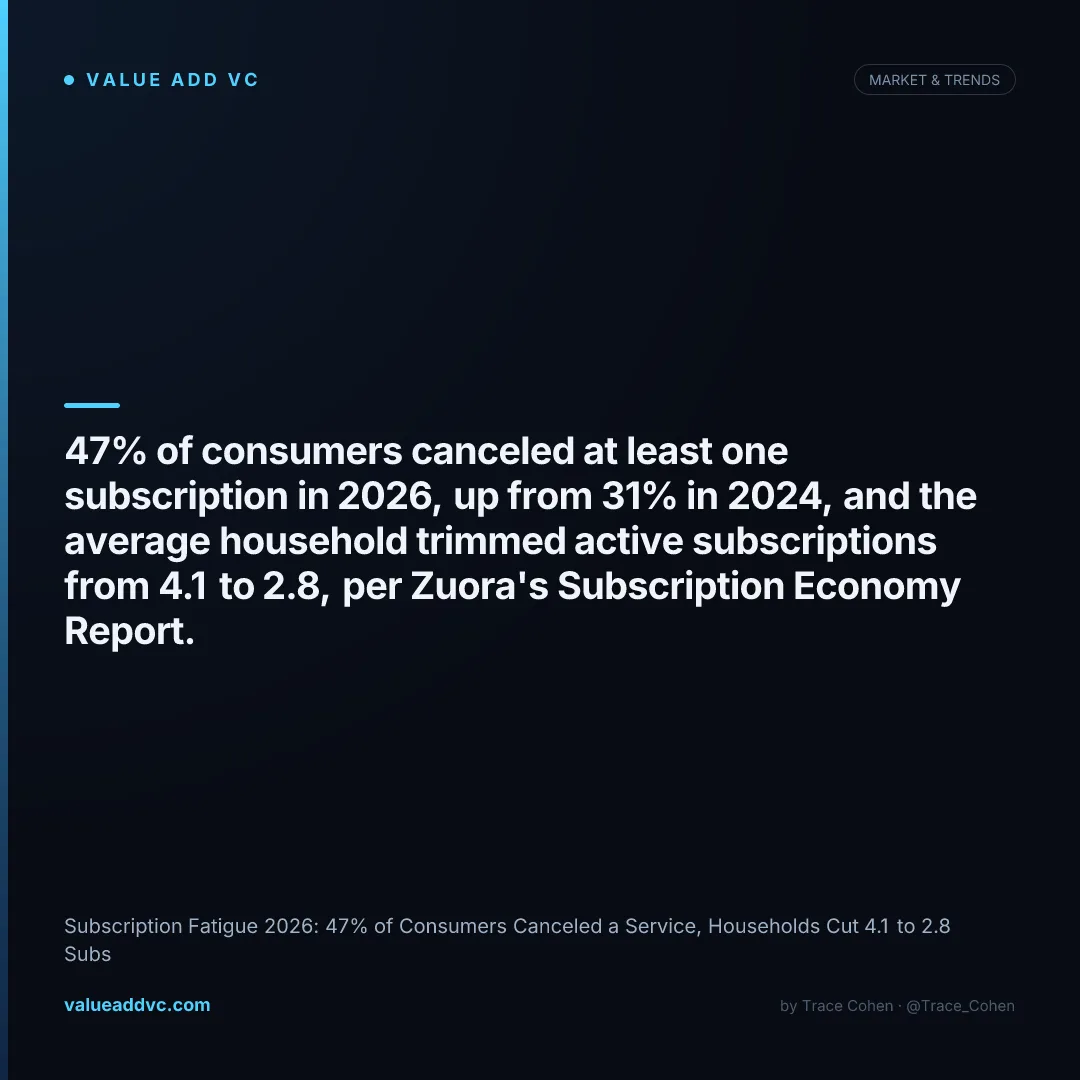
47% of consumers canceled at least one subscription in 2026, up from 31% in 2024, and the average household has cut its active subscription count from 4.1 to 2.8. That's the short answer. The longer answer is that the subscription economy didn't shrink — it just stopped being able to hide how much it costs.
For a decade, the playbook was simple: put everything behind a recurring charge, rely on inertia, and let auto-renewal do the rest. That playbook is breaking. Households are auditing their statements, canceling in bulk, and app makers who built their entire model on "set it and forget it" billing are now scrambling toward usage-based and hybrid pricing before their churn numbers get worse.
Figures are 2026 estimates blended from Zuora's Subscription Economy Report, Fortune Business Insights, and OpenView Partners' SaaS Benchmarks. Household figures reflect U.S. consumer averages across streaming, software, and app-based subscriptions.
Why Subscription Fatigue Is Hitting Consumer Apps So Hard in 2026
Subscription fatigue in consumer apps in 2026 is being driven by a simple math problem: the average household spends $273 a month across 8.2 active subscriptions, but 90% of consumers underestimate that number, typically guessing a figure roughly a third of what they actually pay. Once people audit their bank statements, they cancel in bulk rather than trimming one service at a time.
That gap between perceived and actual spend is the real story. It's not that people suddenly dislike streaming, fitness apps, or AI tools — it's that nobody had bothered to add up what all of them cost together until credit card statements, and a wave of "subscription audit" TikTok content, made the total impossible to ignore.
The global subscription economy hasn't shrunk in dollar terms — it's projected to grow from $536 billion in 2025 to $859 billion in 2026, per Fortune Business Insights. That combination is what makes 2026 different from a normal down cycle: total market spend is rising even as individual households cancel more services, which means the growth is coming from price increases on the subscriptions people keep, not from adding new subscribers per household. For app makers, that's a warning sign, not a comfort — revenue growth built on price hikes to a shrinking, more price-sensitive base is a much shakier foundation than growth built on new signups.
Subscription Cancellation and Churn Rates by Category, 2026
| Category | Monthly Churn | Top Cancellation Trigger | 2026 Trend |
|---|---|---|---|
| Video streaming (avg.) | 6.3% | Cost-cutting (30%) | Bundling to slow churn |
| Video streaming (Netflix) | ~2% | Content exhaustion | Live sports as retention hook |
| Music streaming | ~2% | Habit disruption | Most stable category |
| AI tools (per app) | High, cyclical | Tool stacking cost | 53% cancel/restart per project |
| Fitness & wellness apps | 5-8% | Poor value perception | Shifting to pay-per-class |
| Consumer SaaS/productivity | 5-8% | Forgot about it (41%) | Usage-based tiers rising |
| Subscription boxes | 8%+ | Too many subscriptions (52%) | Consolidation, fewer SKUs |
Figures are 2026 estimates blended from RetentionCheck's Streaming Services Churn Benchmarks, RevenueCat's State of Subscription Apps report, and Zuora's Subscription Economy Report. Churn ranges reflect cross-category averages, not any single company's disclosed figure.
The Reasons Behind 2026's Subscription Cancellation Wave
When Zuora asked consumers why they canceled, the top three answers were too many subscriptions (52%), forgot about it (41%), and poor value perception (38%). None of those are about a single app failing to deliver — they're about the aggregate weight of running a dozen recurring charges at once, which is exactly why 46% of app cancellations now happen within the first billing cycle and 44% happen within the first 90 days.
The billing-cycle timing matters for founders. If nearly half of your cancellations land before day 30, the problem usually isn't your product's long-term retention curve — it's that the free trial to paid conversion moment doesn't match how much value a user has actually experienced yet. Our SaaS valuations dashboard tracks how churn assumptions feed directly into how consumer and SaaS companies get priced, and 2026's churn data is pushing multiples down for subscription-only businesses without a usage or engagement backstop.
AI Subscription Stacking: A New Category of Fatigue
AI tools have added a new layer to subscription fatigue in 2026 rather than replacing older subscriptions. The average paying user now runs four separate AI subscriptions simultaneously — a coding assistant, a general chatbot, an image generator, and a niche vertical tool — at roughly $66 combined per month. Unlike streaming, where one service usually wins the household's attention, AI tools tend to be complementary rather than substitutable, which is why 53% of users report canceling and restarting individual AI subscriptions on a per-project basis instead of committing to all four indefinitely.
That cancel-and-restart behavior is a direct rebuke of flat monthly pricing for AI products specifically. A user who needs a coding assistant for two weeks of a sprint and nothing for the next six doesn't want a $20/month evergreen charge — they want to pay for the two weeks. It's the single biggest reason AI-native companies have moved faster toward usage-based pricing than any other software category in the last three years.
Subscription Fatigue by Generation: Who's Canceling the Most in 2026
Subscription fatigue isn't evenly distributed. Gen Z consumers spend the most on subscriptions in absolute terms — about $377 a month — followed by Millennials at $276 a month, both well above the $273 household average once you account for younger consumers being more likely to split subscription costs with roommates rather than a full household. That higher spend also comes with higher cancellation activity: younger, digitally native consumers are the ones driving most of the "subscription audit" behavior showing up in the 2026 cancellation data, largely because they're more comfortable comparing prices across apps and switching on a whim than older cohorts who set up auto-pay once and rarely revisit it.
For consumer app founders, that means the segment spending the most is also the segment most willing to walk away, which flips the usual retention playbook. Loyalty programs and long-term discounts matter less to this cohort than transparent, flexible billing — the ability to pause, downgrade, or split a plan without calling support. Apps that make cancellation easy but reactivation even easier are seeing better long-run revenue from Gen Z and Millennial users than apps that rely on cancellation friction to hold onto them.
How Consumer Apps Are Rethinking Monetization Beyond Flat Subscriptions
The response from consumer apps and SaaS companies has been to move away from pure flat-fee subscriptions toward usage-based and hybrid models. By 2026, 61% of SaaS companies had adopted some form of usage-based pricing, up from roughly 30% in 2019, and hybrid models — a base fee plus a variable usage component — are projected to reach 61% adoption by the end of the year, up from 43% just two years earlier. Companies that made the switch are growing about 38% faster than peers still running pure per-seat or flat-subscription pricing, according to OpenView Partners.
Retention tactics are shifting too. Bundling — grouping multiple services under one combined subscription, the way streaming platforms now pair video with live sports or music — reduces churn by roughly 34% versus standalone subscriptions. Family and multi-user plans do even better, improving retention by about 52%, because canceling now means coordinating with other people rather than a single tap in a settings menu.
For founders, the practical takeaway is that subscription fatigue isn't a reason to avoid recurring revenue — it's a reason to stop treating every product as flat-fee-forever by default. A usage floor with metered overage, a family plan option, or a pause-instead-of-cancel flow all address the specific reasons consumers say they're canceling in 2026, rather than fighting the symptom with better win-back emails.
What Subscription Fatigue Means for Consumer App Valuations in 2026
Investors are already pricing this in. Consumer subscription apps with cross-category churn above 8% and no usage or engagement backstop are trading at meaningfully lower revenue multiples than hybrid-pricing peers, because a 6.3% monthly churn rate compounds into more than half the customer base turning over annually if left unaddressed. Meanwhile, companies that can show a usage-based or bundled component to their revenue are being underwritten more like consumption businesses — closer to how investors price cloud infrastructure — than like traditional media subscriptions.
That repricing is showing up earliest in fundraising conversations. Series A and B consumer app founders are now getting asked for cohort-level churn broken out by pricing tier, not just a blended average, because blended churn hides which segment of users is actually driving the 47% cancellation wave. Our benchmarking data shows the gap between top-quartile and bottom-quartile consumer subscription retention has widened noticeably since 2024, and that gap is now a bigger driver of valuation than growth rate alone for late-stage consumer rounds.
Bottom line: 47% of consumers canceled a subscription in 2026, households cut their active subscription count from 4.1 to 2.8, and the response from the industry has been fast — 61% of SaaS companies now run usage-based or hybrid pricing, up from roughly 30% in 2019. Subscription fatigue isn't killing recurring revenue; it's killing the assumption that a flat monthly charge is the default answer for every product, and the founders who redesign pricing around actual usage before their churn numbers force the issue are the ones who'll come out ahead.
Latest from the Pulse
Get VC data most people never see
— free to subscribe
Trace's notes on venture, AI and startups, a few times a week. Join 5,000+ subscribers. No spam.