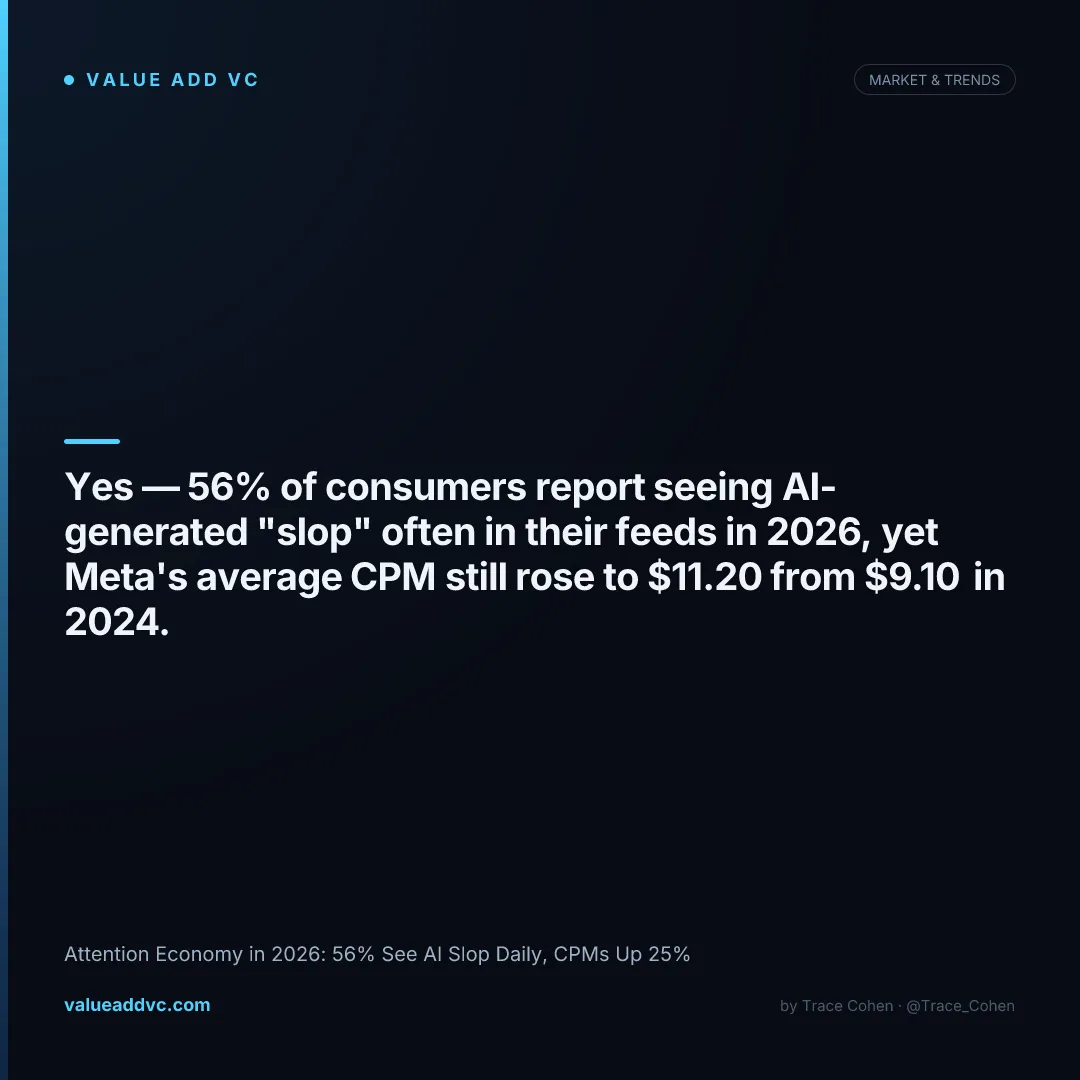
56% of consumers report seeing AI-generated "slop" often or very often in their feeds in 2026, and generative AI now produces an estimated 48% of brand social content — yet Meta's average ad CPM still climbed to $11.20 from $9.10 in 2024. That's the short answer: content got cheaper to produce, but attention that actually converts got more expensive. The longer answer is what's actually still scarce.
For a decade, "the attention economy" meant the fight for eyeballs — more feed, more autoplay, more notifications. In 2026 that fight has been won so thoroughly by AI content generators that the constraint flipped. There's effectively unlimited content now. What's scarce is content people actually trust enough to act on, and that scarcity is showing up directly in ad pricing, creator rate cards, and platform policy.
Figures are 2026 estimates blended from Sprout Social's Q1 2026 consumer survey, Digital Applied's 2026 social advertising benchmarks, and Microsoft Research attention-tracking data cited across multiple 2026 screen-time reports.
Is there any value left after AI saturates content?
Yes, but it has shifted from content volume to verified trust. The 2026 attention economy still runs on roughly 2 hours 40 minutes of daily social media use per person, but with 48% of brand content now AI-generated and 56% of consumers noticing "slop" regularly, advertisers are bidding up the shrinking supply of content proven to convert — which is why average CPMs rose 18-25% across major platforms even as content supply exploded.
The AI content flood, by the numbers
The scale of AI content production in 2026 is no longer a novelty statistic — it's the baseline. 42% of brands already use AI for social copy, visuals, and video, a figure projected to clear 65% by 2027. 70% of Gen Z use AI-generated content weekly in some form. On YouTube specifically, a 2025 Kapwing study found 21-33% of a new user's feed consists of AI-generated or low-effort "brainrot" videos before any personalization kicks in.
The trust data tells a starker story than the volume data. Content flagged by audiences as AI-generated takes roughly a 12% engagement penalty. Half of Gen Z (50%) have unfollowed, muted, or blocked an account over suspected AI content, and 88% of consumers say AI video tools have made them trust social media as a news source less. Meanwhile Sprout Social's Q1 2026 survey puts the share who see "slop" often or very often at 56% — meaning more than half the audience is now actively discounting a large chunk of what shows up in front of them.
Attention itself is getting shorter, not just more contested
Total screen time keeps climbing — 6 hours 40 minutes daily on average globally — but it's being sliced into smaller pieces. Microsoft Research attention-tracking data cited across 2026 reports puts sustained on-screen focus at just 43 seconds per session, with users switching apps, tabs, or devices an average of 1,847 times per day, up 22% from 1,512 switches in 2023. TikTok alone accounts for roughly 1 hour 37 minutes of that daily time per user — nearly 60% of total social media time on one app.
Gen Z spends the most: roughly 4 hours daily on social media versus roughly 2 hours 40 minutes for the average user across all ages. That gap matters for anyone modeling the next generation entering the workforce — attention habits formed on 3-second hooks don't disappear when someone starts a job.
Ad prices in the attention economy: what platforms actually charge in 2026
If AI content saturation were actually devaluing attention, CPMs would be falling. They're not. Global social ad spend is projected to hit $338B in 2026, and per-platform CPMs have risen 18-25% since 2024 across the board — direct evidence that advertisers are paying more, not less, for the attention that still converts.
| Platform / Tier | 2026 CPM / Rate | 2024 Comparison | Change | Why |
|---|---|---|---|---|
| TikTok | $4-5 | ~$3.50-4 | Up ~15-20% | Highest engagement intensity per minute |
| YouTube | $4-5 | ~$3.50-4 | Up ~15-20% | Long-form + Shorts inventory demand |
| Snapchat | $9-11 | ~$7-9 | Up ~20% | Younger, harder-to-reach demo premium |
| X | $9-11 | ~$7-9 | Up ~20% | Reduced overall inventory, brand caution |
| Meta (avg. across apps) | $11.20 | $9.10 | Up 23% | AI-driven targeting still outperforms |
| Global social ad spend | $338B (2026) | ~$270B (2024) | Up ~25% | Advertisers chasing verified conversion |
Figures are 2026 estimates blended from Emulent's social advertising trend projections, Digital Applied's 2026 pricing guide, and platform-reported average CPM data. 2024 comparisons are rounded from the same sources' historical series.
What AI content saturation means for the creator economy
The clearest evidence that trust, not volume, is the scarce resource shows up in creator pricing. Average influencer CPM actually fell to $2.68 in 2025, down 42% year-over-year, as AI tools made mass-produced sponsored content cheap to generate. But nano and micro creators — the accounts brands can most easily verify as run by real people with real, engaged audiences — now command median CPMs of $211 and $119 respectively, far above the market average.
That bifurcation is the whole story in miniature. Global influencer marketing spend is still projected to top $40B in 2026, up from $32.55B in 2025 — an industry growing even as its average per-post price falls, because brands are reallocating budget away from bulk AI-assisted content toward a smaller pool of provably human creators. Average measured ROI across top campaigns still runs $5.78-$18 per dollar spent, which is why the spend keeps growing despite falling averages.
How platforms are responding to the AI content flood
Platforms have been forced to react to the trust gap, not just the volume. YouTube now requires creators to disclose "meaningfully altered" or synthetic content through a mandatory labeling toggle, and Meta rolled out similar "AI info" labels across Facebook, Instagram, and Threads. TikTok's own policy requires labeling for realistic AI-generated media, with automatic detection flagging content that lacks a creator-added disclosure. None of these policies have slowed AI adoption — 42% of brands using AI for social content in 2026 is itself evidence of that — but they've made disclosure a de facto pricing signal: labeled AI content and unlabeled human content are no longer competing in the same trust tier.
Regulation is layering on top of platform self-policing. The EU's AI Act transparency requirements for synthetic media took effect on a phased timeline through 2026, and several US states have advanced their own AI-disclosure bills targeting political and commercial content specifically. For platforms and advertisers, the practical effect is the same one showing up in the CPM data: compliance and verifiable provenance are becoming table stakes for the content that still commands a premium, while unlabeled bulk AI content increasingly gets treated — and priced — like the commodity it now is.
What's actually scarce in the 2026 attention economy
Every number here points the same direction: content volume is no longer the constraint, verified trust is. The 43-second sustained-focus figure and the 1,847 daily app switches mean audiences are triaging faster than ever, and they're triaging against a background where 56% of them expect to be shown "slop." Winning a share of that shrinking, faster-moving attention pool now requires proving you're not part of the flood — which is exactly what the CPM and creator-tier data show advertisers paying up for.
For founders building consumer or media products, the operating implication is direct: don't compete on content volume against generative AI, because that market is already saturated and pricing power there is falling (the 42% YoY influencer CPM drop is the clearest proof). Compete on verification, provenance, and format innovation that AI content can't cheaply replicate — the same logic reshaping how the largest platforms are pricing their own ad inventory in 2026.
For investors, the attention economy thesis has flipped from "distribution is the moat" to "trust is the moat." A startup that can prove a human made something, or that its recommendations reliably convert despite an AI-saturated feed, is now defensible in a way pure content-volume plays no longer are. That's a meaningfully different underwriting question than the one VCs were asking about attention businesses even two years ago.
Bottom line: AI didn't destroy the attention economy in 2026 — it repriced it. Content production got nearly free, with 48% of brand social output now AI-generated and 56% of consumers noticing the flood, but verified human attention got more expensive: Meta's average CPM rose 23% to $11.20, global social ad spend hit $338B, and nano/micro creators now out-earn the influencer-market average by 44x to 79x per impression. The scarce resource was never content. It was always trust, and 2026 is the year the pricing finally caught up to that fact.
Latest from the Pulse
Get VC data most people never see
— free to subscribe
Trace's notes on venture, AI and startups, a few times a week. Join 5,000+ subscribers. No spam.
No spam, unsubscribe anytime. Sent via Substack · Privacy · or subscribe on Substack ↗