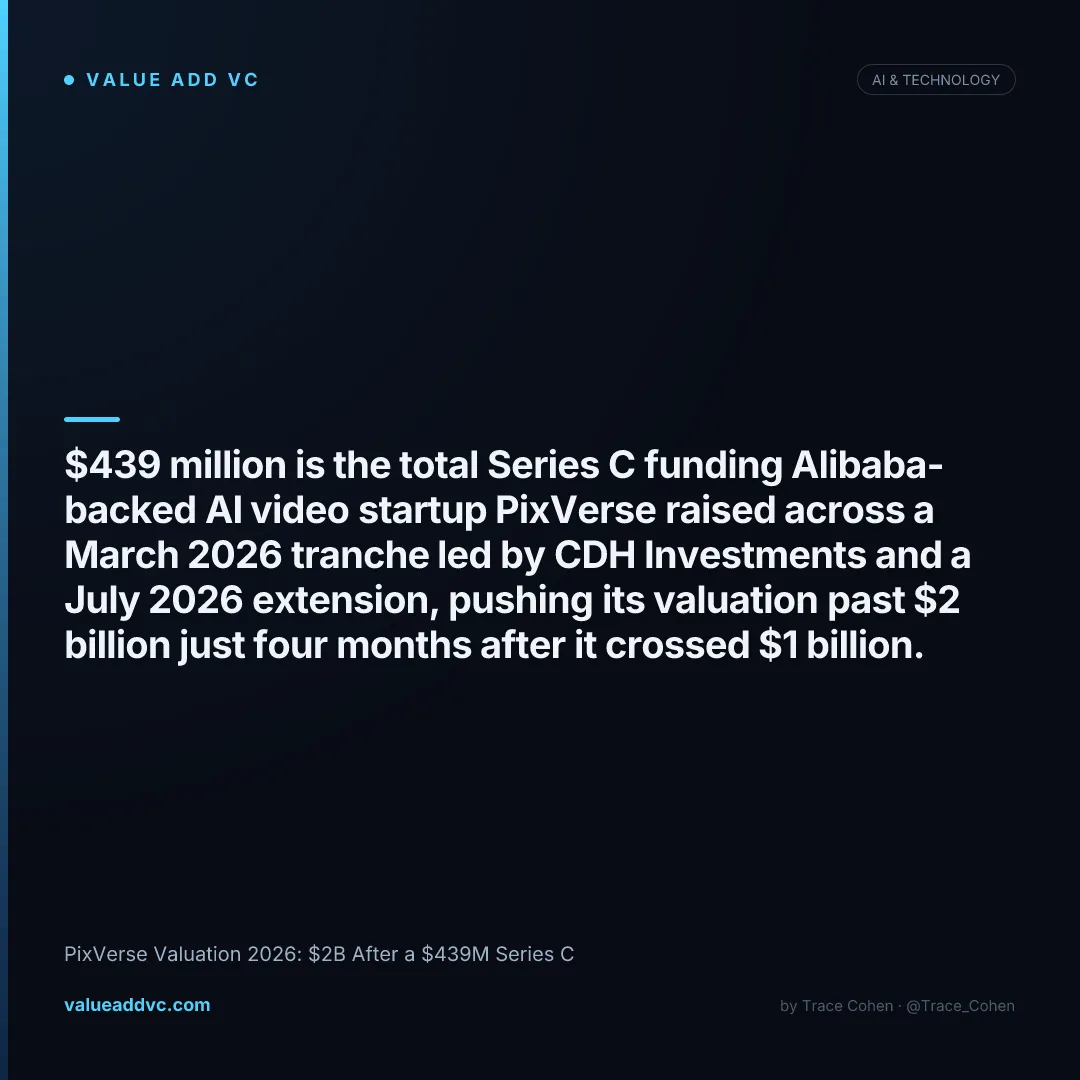
PixVerse just crossed a $2 billion valuation on a $439 million Series C — four months after Alibaba and CDH Investments made it a unicorn, and on revenue that hasn't been updated since October 2025.
PixVerse, the AI video generation app built by Beijing-based AIsphere, closed its Series C round at a combined $439 million and a valuation north of $2 billion, according to a TechCrunch report published July 13, 2026. The round came in two pieces: an initial ~$300 million tranche led by CDH Investments that closed in March 2026 and made PixVerse a unicorn, and a July 2026 extension anchored by Alibaba that roughly doubled the valuation in four months. The company, founded in April 2023 by former Microsoft Research Asia and ByteDance executive Wang Changhu, has now raised well over $550 million in total.
What Is PixVerse's Valuation After the 2026 Series C?
PixVerse's valuation is north of $2 billion as of July 2026, set by a $439 million Series C round that combined a March 2026 tranche led by CDH Investments with a July 2026 extension backed by Alibaba and nine other investors. That price is roughly double the just-over-$1-billion mark the company hit four months earlier, when the initial March tranche first made it a unicorn.
PixVerse's Full Funding History
PixVerse's Series A raised more than $55 million from Ant Group, Lighthouse Capital, and the Beijing Artificial Intelligence Industry Investment Fund, backing the product ahead of its global consumer launch in January 2024. A $60 million Series B followed in September 2025, led by Alibaba with new investor Antler joining — the round that set up Alibaba's deeper bet seven months later. The Series C then arrived in two tranches: roughly $300 million in March 2026 led by CDH Investments, and a $439 million combined total once the July 2026 extension closed, per DealStreetAsia's reporting on the extension.
The founding team is part of why investors moved this fast. AIsphere founder Wang Changhu holds a PhD from the University of Science and Technology of China, joined Microsoft Research Asia in 2004 to work on AI video research, and became director of ByteDance's AI Lab in 2017 before starting AIsphere in April 2023. That background — nearly two decades in AI video specifically, at two of the institutions that trained a large share of China's current AI research talent — is a big part of the pitch investors are underwriting, separate from the revenue figures themselves.
CDH Investments, the lead on the March tranche, is a different kind of backer than the venture funds that typically lead AI rounds. Founded in 2002 and based in Beijing, CDH runs a diversified alternative-asset platform spanning private equity, venture, credit, and real assets, with roughly $20-27 billion in assets under management and more than 350 portfolio companies concentrated in consumer, hard technology, new energy, and healthcare. A generalist PE firm of that size leading a $300 million AI round is itself a signal: it suggests CDH is treating PixVerse less like a speculative early-stage bet and more like a growth-equity position in an already-scaling consumer platform.
What Does PixVerse Actually Do?
PixVerse is a text-to-video and image-to-video generation platform, competing directly with OpenAI's Sora, Runway, Higgsfield, and China's Kling AI. In January 2026, the company launched a real-time, interactive video generation tool alongside its V5.6 model, a top executive told CNBC — the same push into interactive "world model" tooling that Runway cited when it raised its own $315 million round the following month. Alongside its globally marketed consumer app, AIsphere runs a separate China-facing version of the product. Company-reported figures put combined users across both apps above 100 million, with 16 million monthly active users, though independent verification of that user count isn't available.
The product bet matters because it explains why Alibaba is the common thread across PixVerse's last two rounds. Alibaba Cloud sells the compute that trains and serves PixVerse's models, and Alibaba's e-commerce businesses (Taobao and Tmall among them) are a plausible distribution channel for AI-generated product video and ad creative — the same enterprise-marketing use case that's driving Higgsfield's revenue growth in the US market. That vertical integration gives Alibaba a reason to fund PixVerse even without a fresher revenue number: the investment can pay off through Alibaba Cloud consumption and e-commerce tooling, not just PixVerse's own subscription revenue.
How Does PixVerse Compare to Runway, Higgsfield, and Kling AI?
PixVerse's $2 billion-plus mark places it mid-pack in a crowded and fast-repricing AI video category. Kuaishou's Kling AI sits well above everyone else at an $18 billion valuation after raising $2.8 billion in a round backed by Alibaba and Tencent, according to Dealroom. Higgsfield ($5.4 billion) and Runway ($5.3 billion) are both roughly 2.5x PixVerse's valuation, and Luma AI sits at $4 billion after a $900 million round led by HUMAIN in November 2025. Pika, by contrast, was last disclosed at a $470 million valuation in mid-2024 and hasn't announced a new round since.
The go-to-market split matters as much as the valuation gap. PixVerse, Kling AI, Runway, and Luma AI all built their initial user bases around individual creators and social-video use cases, leaning on raw download and user-count metrics — the same 100 million-plus figure PixVerse cites. Higgsfield pivoted hardest toward enterprise marketing budgets and points to named Fortune 500 customers instead of user counts. Which strategy holds pricing power as output quality converges across vendors is still unresolved, but it explains why two companies with similar-sounding "AI video" pitches end up defending very different metrics to investors.
| Company | Latest Valuation | Latest Round | Lead Investor(s) | Disclosed ARR |
|---|---|---|---|---|
| Kling AI (Kuaishou) | $18B | $2.8B round, Jul 2026 | Alibaba, Tencent | ~$500M run rate (Mar 2026) |
| Higgsfield | $5.4B | Series B, Aug 2026 | DST Global | $700M |
| Runway | $5.3B | Series E, Feb 2026 | General Atlantic | Not disclosed here |
| Luma AI | $4B | Series C, Nov 2025 | HUMAIN | Not disclosed |
| PixVerse (AIsphere) | $2B+ | Series C, Mar–Jul 2026 | CDH Investments, Alibaba | $40M (Oct 2025) |
| Pika | $470M | Series B, Jun 2024 | Not disclosed | Not disclosed |
Source: TechCrunch, Bloomberg, Dealroom, CNBC, DealStreetAsia, company announcements — valuations and rounds as last disclosed as of September 2026; not every company discloses ARR.
What the headline misses
The doubling-in-four-months framing obscures a revenue gap that the round announcement didn't address: PixVerse's last disclosed ARR is $40 million, reported by CNBC in January 2026 as an October 2025 figure. That number is nine months old by the time the $2 billion valuation was set, and no updated revenue figure accompanied the July round. At $2 billion against that $40 million base, PixVerse is priced at roughly 50x trailing revenue — far above Higgsfield's roughly 7.7x multiple on $700 million ARR and Kling AI's roughly 36x multiple on an estimated $500 million run rate. This likely means investors are pricing PixVerse more on its Alibaba distribution relationship, user growth, and China-market access than on disclosed revenue — a bet that only pays off if PixVerse's actual current ARR has grown well past what was last reported.
What This Means for the AI Video Funding Race
Alibaba now backs both Kling AI, valued at $18 billion, and PixVerse, valued at $2 billion-plus, while Tencent, Mirae Asset, and CDH Investments spread their own capital across the same two deals. That overlap is unusual: it's rare for one strategic investor to fund two direct competitors in the same product category within months of each other, and it suggests Alibaba is hedging on which Chinese AI video platform ends up with the bigger global user base rather than picking a single winner. Meanwhile Runway, Higgsfield, and Luma AI are raising from a separate pool of US and Gulf-region investors (General Atlantic, DST Global, HUMAIN), so the category is effectively splitting into a China-capital cluster and a US-capital cluster competing for the same global creator and enterprise-marketing spend. Adding up the disclosed rounds for Kling AI, PixVerse, Higgsfield, Runway, and Luma AI alone comes to roughly $4.85 billion raised across the five companies between November 2025 and August 2026 — a rough measure of how much fresh capital has piled into AI video specifically, separate from the broader AI infrastructure spending covered elsewhere on this site.
One read on this: PixVerse's China-founder, China-headquartered structure carries a distinct risk that its US-based competitors don't face. AI apps built by Chinese companies have drawn US regulatory and legislative scrutiny before — TikTok is the obvious precedent — and a video-generation tool with a China-facing sister app and Alibaba as a lead investor could face the same kind of access or ownership questions in the US market if PixVerse's global user base keeps growing. That risk doesn't show up anywhere in the funding announcement, but it's a real variable for a company whose valuation increasingly depends on global, not just China-market, adoption. Track how PixVerse stacks up against other AI names on the AI valuations dashboard, and follow new entrants on the unicorn tracker.
The Bottom Line
PixVerse went from just-over-$1-billion to $2 billion-plus in four months on a $439 million Series C, with Alibaba doubling down alongside CDH Investments and nine other backers. That's a real, well-documented valuation jump — but it's happening on a revenue figure that's nine months stale and priced far richer against trailing ARR than either Higgsfield or Kling AI.
Watch whether PixVerse discloses a fresher ARR number at its next round, and whether Alibaba's parallel bets on PixVerse and Kling AI eventually consolidate into a single horse — running two competitors at once is an expensive hedge to keep funding indefinitely. For now, PixVerse is the clearest evidence yet that AI video valuations are moving on user growth and strategic distribution deals as much as on the disclosed revenue that's supposed to anchor a $2 billion price tag.
$439 million raised. $2 billion-plus valuation. $40 million in last-disclosed ARR.
Alibaba is now funding two rivals in the same AI video race.
Explore more AI funding and valuation coverage on Value Add VC and in the Trace Cohen newsletter.
Latest from the Pulse
Get VC data most people never see
— 100% free
Weekly benchmarks, valuations, and fund data. Join 5,000+ investors. No spam.