
Update (June 2026): The flagship models have advanced — OpenAI's current frontier model is the latest GPT-5.x and Google's is the latest Gemini 3.x Pro (with the cost-optimized Gemini Flash line continuing underneath). The model-specific benchmark and pricing figures below reflect the GPT-5 / Gemini 2.5 generation as launched; the strategic picture — OpenAI leading mindshare, Google leading economics and distribution — still holds.
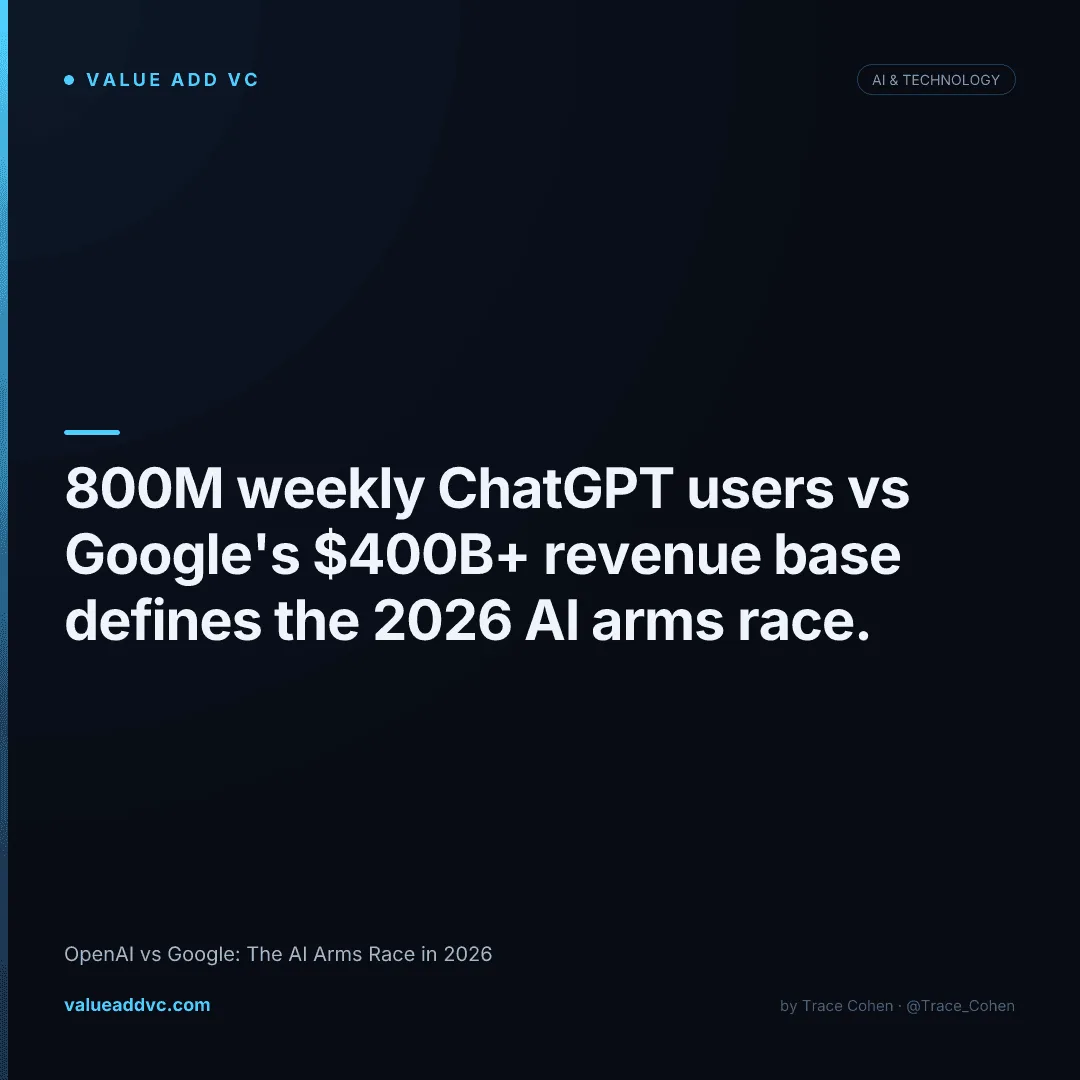
OpenAI has ~800M weekly users and ~$20B in annualized revenue; Google has $400B+ in annual revenue, its own AI chips, and Gemini embedded in products billions already use. That's the short answer. The longer answer is more interesting.
The 2026 AI arms race isn't one race — it's three running at once: a benchmark race, a price race, and a distribution race. OpenAI is winning the first two-thirds of the attention war. Google is quietly winning the part that compounds: cost structure and reach. Elon Musk's lab is running its own version of that race too — Grok now posts benchmark scores that rival both on math and reasoning. Here's the head-to-head, with the numbers.
OpenAI vs Google AI 2026: The Side-by-Side Comparison
In 2026, OpenAI leads on consumer mindshare and flagship coding benchmarks, while Google leads on price, context length, and distribution. OpenAI runs roughly $20B in annualized revenue against Google's $400B+; OpenAI burns cash while Google funds AI from profit. Neither has knocked the other out — the gap on raw model quality is now measured in single benchmark points.
| Attribute | OpenAI | |
|---|---|---|
| Flagship model | GPT-5 | Gemini 2.5 Pro |
| Weekly / monthly users | ~800M weekly (ChatGPT) | ~600–650M app + billions via Search |
| Annualized revenue | ~$20B ARR | $400B+ total company |
| Flagship input price (per 1M tokens) | ~$1.25–$2.50 | ~$1.25 (Pro), $0.30 (Flash) |
| Max context window | ~400K tokens | 1–2M tokens |
| Owns its AI chips? | No (Nvidia + Microsoft) | Yes (TPU v6/v7) |
| Profitable? | No — burns billions/yr | Yes — $100B+ net income |
| Distribution moat | ChatGPT brand + API | Search, Android, Workspace, Cloud |
GPT-5 vs Gemini 2.5: The Benchmark Race
The honest read on 2026 benchmarks: the models are close enough that benchmark choice determines the winner. GPT-5 tends to lead on agentic and software-engineering tasks (SWE-bench Verified in the low-to-mid 70s%), while Gemini 2.5 Pro leads on long-context retrieval and multimodal video. A year ago the gap between frontier and second-tier was 15–20 points. Now it's 2–5.
| Benchmark | GPT-5 | Gemini 2.5 Pro | Edge |
|---|---|---|---|
| SWE-bench Verified (coding) | ~74% | ~70% | OpenAI |
| MMLU (general knowledge) | ~91% | ~90% | Tie |
| GPQA Diamond (science) | ~88% | ~86% | OpenAI |
| AIME 2025 (math) | ~95% | ~92% | OpenAI |
| Long-context recall (1M+) | Limited | Strong | |
| Video/multimodal | Good | Best-in-class | |
| LMSYS Arena (human pref) | Top 2 | Top 2 | Tie |
Benchmark figures are approximate 2026 published/reported ranges and shift with each model revision. The takeaway isn't the decimal — it's that on raw capability, neither company has a moat. When two products are within 3 points on quality, the competition moves to price and distribution. That's exactly where it has moved.
OpenAI vs Google API Pricing: The Race to the Bottom
On API pricing in 2026, Google undercuts OpenAI at almost every tier because it owns its TPU silicon and doesn't pay an Nvidia or cloud-provider margin. Gemini 2.5 Flash runs roughly $0.30 per million input tokens versus GPT-5 mini's higher floor, and on flagship models Google matches or beats OpenAI. For high-volume agentic workloads — where token spend is the dominant cost — that 5–10x Flash gap compounds into real money.
| Model tier | Input / 1M | Output / 1M | Best for |
|---|---|---|---|
| GPT-5 (flagship) | $1.25 | ~$10 | Hardest reasoning + coding |
| GPT-5 mini | ~$0.25 | ~$2 | Cost-sensitive volume |
| Gemini 2.5 Pro | ~$1.25 | ~$10 | Long context + multimodal |
| Gemini 2.5 Flash | ~$0.30 | ~$2.50 | Cheapest high-volume |
| Gemini 2.5 Flash-Lite | ~$0.10 | ~$0.40 | Classification at scale |
| GPT-5 nano | ~$0.05 | ~$0.40 | Lightweight tasks |
Prices are approximate 2026 list rates and change frequently. The structural point survives the noise: Google can win a price war because Gemini inference runs on TPUs it designed, while OpenAI rents Nvidia GPUs through Microsoft and Oracle. If margins compress to zero, Google still has a $400B business behind it. OpenAI has to keep raising. Track how this flows through to the public names on our Big Tech Earnings dashboard.
OpenAI vs Google Market Share: Attention vs Distribution
In raw consumer mindshare, OpenAI wins: ChatGPT reached roughly 800M weekly active users in 2026, up from ~300M a year earlier, and "ChatGPT" has become a verb the way "Google" did in 2004. But market share in AI isn't just the standalone app. Google distributes Gemini through Search AI Overviews (billions of queries/day), Android (3B+ devices), Workspace (3B+ users), and Google Cloud. OpenAI has to win each user one signup at a time; Google ships AI to users who never asked for it.
Where OpenAI Wins
- ✓ ~800M weekly ChatGPT users — the default AI brand
- ✓ Strongest agentic coding (GPT-5, Codex)
- ✓ Developer mindshare and API momentum
- ✓ Faster product velocity, no legacy to protect
- ✓ Enterprise ChatGPT seats growing fast
Where Google Wins
- ✓ $400B+ revenue funds AI from profit, not raises
- ✓ Owns TPU silicon — structural cost advantage
- ✓ Distribution to billions via Search, Android, Workspace
- ✓ Best long-context (1–2M tokens) and video models
- ✓ DeepMind research depth and full vertical stack
The Business Model Gap Nobody Talks About
Here's the part that gets lost in benchmark threads. OpenAI reportedly generates ~$20B in annualized revenue but spends far more — on compute, talent, and training runs that cost hundreds of millions each. It survives on capital: a reported $40B+ raised across rounds and a deep Microsoft relationship. Google generated over $100B in net income last year and self-funds every TPU cluster. In a price war, the company that can lose money forever usually wins. That's Google.
But there's a counter-case, and it's why I don't fully write OpenAI off. Brand and habit are real moats. Google had every advantage in 2022 — more researchers, more compute, more data — and OpenAI still defined the category. Defaults are sticky. If 800M people open ChatGPT every week out of habit, Google's superior cost structure doesn't automatically convert into market share. Distribution beats quality, but habit beats distribution when the habit is already formed. You can see the valuation implications of this on our AI Valuations tracker.
Who's winning the AI arms race in 2026?
OpenAI is winning attention. Google is winning the economics. On a 5-year view, vertical integration and cash favor Google — but defaults are sticky, and OpenAI built one first.
If forced to pick a single winner for the next 24 months: Google's cost and distribution edge is the bet I'd make — while watching whether OpenAI's 800M-user habit holds.
Track AI model valuations and big-tech AI spend on the AI Valuations Dashboard and Big Tech Earnings tools at Value Add VC. Originally published in the Trace Cohen newsletter.
Latest from the Pulse
Get VC data most people never see
— free to subscribe
Trace's notes on venture, AI and startups, a few times a week. Join 5,000+ subscribers. No spam.
No spam, unsubscribe anytime. Sent via Substack · Privacy · or subscribe on Substack ↗