
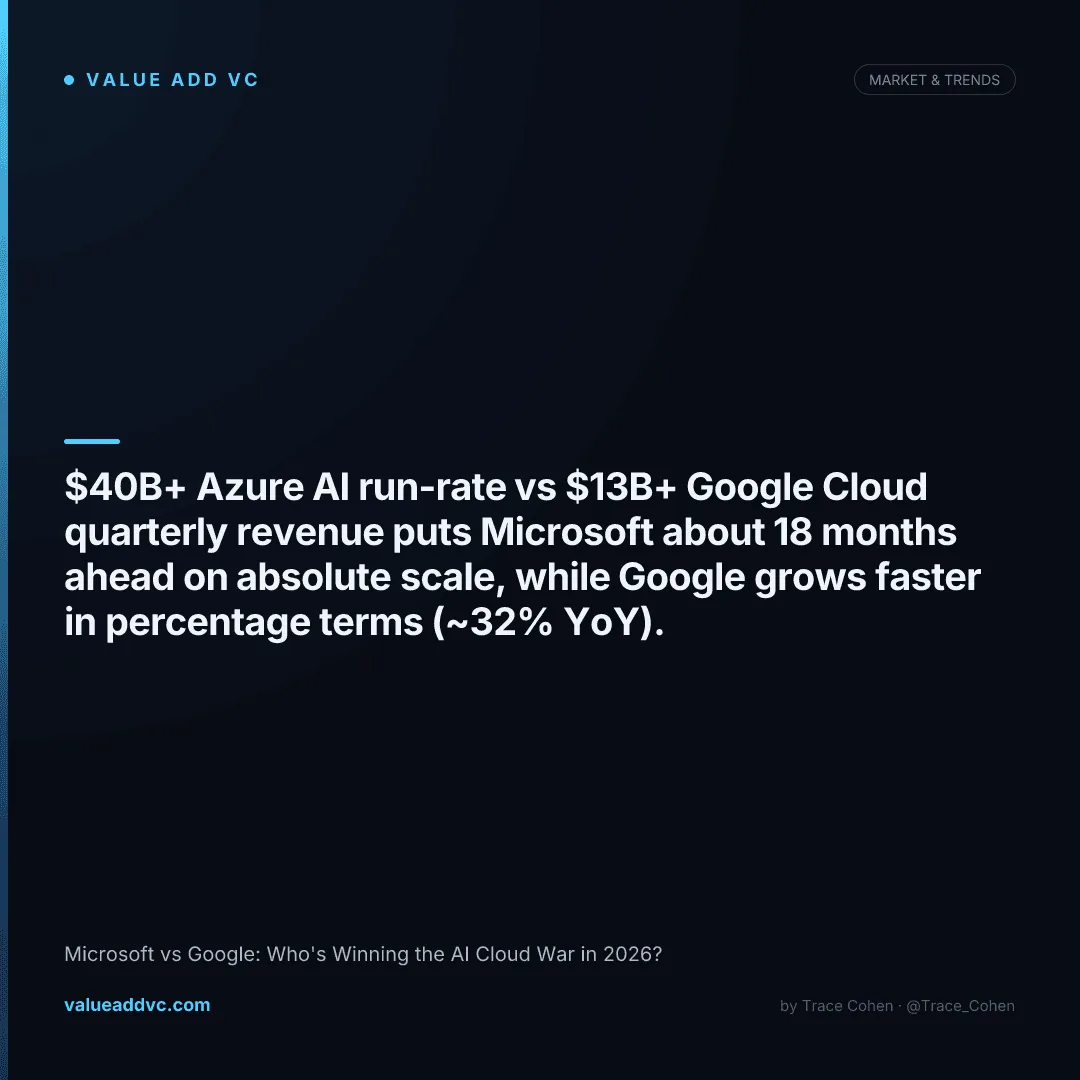
Microsoft is winning the AI cloud war in 2026 with a $40B+ Azure AI run-rate and 33% YoY growth — roughly $50B ahead of Google Cloud on an annualized basis.
That's the short answer. The longer answer is more interesting — Google is the only one closing the gap, and on three specific axes (TPU economics, Gemini quality, and price-per-seat) it's already ahead. Below is the head-to-head, line by line.
Microsoft vs Google AI Cloud 2026: The Head-to-Head Comparison
Microsoft Azure leads Google Cloud on absolute AI revenue ($40B+ ARR vs $52B annualized run-rate from Q1 2026 quarterly disclosure), enterprise seat distribution (400M+ Microsoft 365 vs ~10M paid Workspace AI seats), and AI capex commitment ($85-90B vs $75-80B in 2026). Google leads on per-token inference cost via in-house TPU v5e/v5p silicon, on default model bundling price, and on AI research depth from DeepMind. Microsoft is winning the war on scale; Google is winning the war on unit economics.
| Metric | Microsoft (Azure) | Google (Cloud + Gemini) |
|---|---|---|
| AI revenue run-rate (Q1 2026) | ~$40B (Azure AI standalone) | ~$13.6B quarterly (full Google Cloud) |
| Cloud revenue YoY growth | ~33% (Azure overall) | ~32% (Google Cloud overall) |
| 2026 capex guide | $85-90B | $75-80B |
| Frontier model partner | OpenAI (exclusive, ~$13B investment) | Gemini in-house + Anthropic (~$3B invested) |
| Default LLM in copilot bundle | GPT-5 (OpenAI) | Gemini Pro (in-house) |
| Copilot price per seat / mo | $30 (Microsoft 365 Copilot) | $0 incremental in Workspace Business Standard $14, Plus $22 |
| Enterprise seat base | 400M+ paid M365 commercial seats | ~10M paid Workspace AI seats |
| Custom silicon | Maia 100, Cobalt 100 (in production) | TPU v5e, TPU v5p, Trillium (3 gens deployed) |
| AI inference cost advantage | Nvidia Nvidia's latest GPUs/B200 dependency | Lower per-token TPU economics on Gemini |
| Notable enterprise AI deals 2025-26 | Walmart, Coca-Cola, Mercedes-Benz, KPMG, PwC | GitLab, Wayfair, Snap, Macquarie, Cathay |
Microsoft Azure AI Revenue and Growth Trajectory
Microsoft first disclosed an Azure AI run-rate of $10B in early 2024. By the end of fiscal Q2 2025 it had crossed $13B. In the most recent Q3 FY2026 earnings (April 2026), Satya Nadella confirmed Azure AI had passed $40B in annualized revenue — quadrupling in 24 months. Azure overall grew 33% YoY constant-currency, with AI contributing 18-19 percentage points of that growth.
$10B
Azure AI run-rate (Q1 2024)
$13B
Azure AI run-rate (Q4 2024)
$40B+
Azure AI run-rate (Q1 2026)
4.0x
24-month growth multiple
10M+ paid
Microsoft 365 Copilot seats
20M+ active
GitHub Copilot users
400M+
M365 commercial seat base
33%
Azure overall YoY growth
The OpenAI relationship is the single biggest driver. Microsoft has exclusive cloud rights for OpenAI's frontier model training and the lion's share of inference. Every ChatGPT API call, every GitHub Copilot completion, every Microsoft 365 Copilot draft — all of it bills through Azure. With ChatGPT at ~$5B+ in annualized revenue plus enterprise OpenAI APIs at $2B+, Azure captures the underlying compute on virtually all of it. That exclusivity traces back to the original $13 billion agreement between the two companies, which includes provisions for what happens to Microsoft's access once OpenAI's board declares artificial general intelligence has been reached — a clause we walk through in detail in our breakdown of the Microsoft-OpenAI contract terms.
Google Cloud AI Revenue and the Gemini Strategy
Google Cloud generated $13.6B in Q1 2026 revenue (28% YoY growth), the highest absolute dollar add in any single quarter in Google Cloud history. Alphabet doesn't break out an "AI revenue" line the way Microsoft does, but Sundar Pichai noted on the Q1 2026 call that AI products were the largest contributor to growth, with Vertex AI usage 25x year-over-year and Gemini API revenue alone in the multi-billion range.
The Gemini integration story matters here. Google bundled Gemini directly into Workspace at no incremental price starting in early 2025 — collapsing the $30/seat premium tier into the base $14 Business Standard and $22 Business Plus plans. That move added ~9M net new paid Workspace seats in 2025 according to Google's investor day disclosures. It also blunted Microsoft Copilot's pricing leverage in mid-market deals.
$13.6B
Google Cloud Q1 2026 revenue
28%
Q1 2026 YoY growth
25x
Vertex AI usage growth YoY
9M+
Workspace paid seats added 2025
$14/seat/mo
Workspace Business Standard price
$22/seat/mo
Workspace Business Plus price
5M+
Gemini API monthly active devs
$3B+ committed
Anthropic investment
Google's structural advantage is TPU economics. Per Google's own published benchmarks and corroborating third-party data from Artificial Analysis, Gemini Pro runs at roughly 40-55% lower per-token inference cost than equivalent GPT-5 inference on Nvidia H200s. For high-volume inference workloads, that math compounds. Spotify, Snap, Cohere, and Salesforce have all publicly cited cost as a reason for running production AI on Google Cloud rather than Azure or AWS.
AI Capex 2026: Microsoft vs Google Spending Gap
Microsoft guided to $85-90B in 2026 capex on its Q3 FY2026 call, up from $80B in 2025 and $44B in 2023. Alphabet guided to $75-80B for 2026, up from $75B in 2025 and $32B in 2023. Microsoft is now spending roughly $10B more per year than Google on AI infrastructure — and that gap matters because compute capacity is currently the gating factor on revenue growth for both companies.
| Year | Microsoft capex | Google (Alphabet) capex | Microsoft − Google gap |
|---|---|---|---|
| 2022 | $24B | $31B | −$7B |
| 2023 | $44B | $32B | +$12B |
| 2024 | $56B | $53B | +$3B |
| 2025 | $80B | $75B | +$5B |
| 2026E | $85-90B | $75-80B | +$10B |
| 2027E (consensus) | $95-100B | $80-85B | +$15B |
Critically, the composition is different. Microsoft is spending ~70% of capex on Nvidia GPUs (Nvidia's latest GPUs, B200, GB200 deployments) and ~30% on land, power, cooling, and Maia silicon. Google is spending ~45% on Nvidia, ~25% on in-house TPUs, and ~30% on power and real estate. Long-term, Google's TPU spend converts to lower marginal inference cost — which is why analysts at Bernstein and Morgan Stanley have flagged Google's ROI on AI capex as structurally higher than Microsoft's, even at a lower absolute dollar level.
Copilot vs Gemini: The Enterprise Distribution War
This is where Microsoft is genuinely pulling away. Microsoft 365 Copilot launched at $30/seat/month in November 2023, hit 10M paid seats by Q1 2026, and is on a trajectory to $4B+ in standalone annualized revenue. The product runs across Word, Excel, Outlook, Teams, and PowerPoint — applications that 400M+ enterprise users already use every day. Distribution alone makes Copilot the default AI tool for the Fortune 500.
Microsoft Copilot — what's working
- ✓ 400M+ M365 seats as installed base
- ✓ 10M+ paid Copilot seats by Q1 2026
- ✓ 20M+ GitHub Copilot active users
- ✓ Default model: GPT-5
- ✓ Enterprise IT trust (existing M365 contracts)
- ✓ Per-seat pricing creates predictable ARR
Google Gemini for Workspace — what's working
- ✓ Bundled into Business Standard at $14/seat/mo
- ✓ 9M+ new paid Workspace seats in 2025
- ✓ Default model: Gemini Pro
- ✓ NotebookLM differentiation
- ✓ Native multimodal (text/image/video) advantage
- ✓ 40-55% lower inference cost vs GPT-5
Who Is Winning the AI Cloud War on Net-New Logos?
Microsoft announced 75+ Fortune 500 AI agent deployments at Build 2025 and disclosed Walmart, Coca-Cola, Mercedes-Benz, KPMG, PwC, and Bayer as Copilot anchor customers in 2025-26. Google countered with Vertex AI wins at GitLab, Wayfair, Snap, Macquarie, Cathay Pacific, Mercado Libre, and Estée Lauder — and the Anthropic partnership added Bridgewater, Pfizer, and Zoom to the Google Cloud roster.
The pattern by industry is unmistakable. Microsoft owns financial services, consulting, manufacturing, and consumer goods — sectors where existing Microsoft 365 + Dynamics relationships make Azure the path of least resistance. Google leads in digital-native retail, media, gaming, and Latin American enterprise — sectors that were never Microsoft strongholds and value technical flexibility plus inference cost.
The net-net: Microsoft is winning more enterprise revenue, but Google is winning more of the AI-first companies. That matters strategically because AI-first companies are growing faster — so Google's revenue base is younger and compounding at a higher rate, even if it's smaller today.
The OpenAI vs Anthropic Wedge: How It Shapes the Cloud War
Microsoft's $13B in OpenAI gave it exclusive Azure rights for OpenAI training and inference — until November 2024, when the agreement loosened slightly to allow OpenAI to deploy on Oracle Cloud and one undisclosed third platform. As of June 2026, ~95% of OpenAI compute still runs on Azure, including all training of GPT-5 and the o-series reasoning models. That captive demand alone is worth ~$15B/year to Azure.
Anthropic plays the field differently. Its $8B Amazon investment makes AWS the primary, but Google Cloud also runs significant Anthropic training and inference under the $3B+ Google investment. There is no Microsoft footprint on Anthropic at all. The split helps Google materially: every Anthropic API call from Claude.ai, Cursor, GitHub (Anthropic models are now in Copilot), and enterprise customers translates partly to Google Cloud revenue.
| Frontier lab | Primary cloud | Secondary cloud | Investor | Est. annualized compute spend |
|---|---|---|---|---|
| OpenAI | Azure (~95%) | Oracle Cloud (small) | Microsoft $13B | $15B+ on Azure |
| Anthropic | AWS | Google Cloud | Amazon $8B, Google $3B | $5B+ split AWS/GCP |
| Google DeepMind / Gemini | Google Cloud (in-house) | n/a | Alphabet | $8B+ internal |
| Meta AI (Llama) | Meta in-house | AWS partner | Meta | $10B+ internal |
| xAI (Grok) | Oracle Cloud + Colossus | Microsoft Azure | $10B Series E | $3B+ across providers |
| Mistral | Microsoft Azure | AWS, Google Cloud | Microsoft equity stake | $500M+ across providers |
Microsoft vs Google AI Cloud Risks Heading Into 2027
Both companies face real downside cases. The AI cloud war isn't over — and the next 18 months will likely decide whether Microsoft's lead becomes structural or whether Google catches up. Regulatory risk isn't hypothetical for Google either: the EU's €890 million Digital Markets Act fine in July 2026 is a live example of antitrust pressure hitting Search and Play Store simultaneously.
Microsoft Azure risks
- ⚠ OpenAI dependency — any agreement loosening hits revenue
- ⚠ Nvidia margin dilution at $85-90B capex run-rate
- ⚠ Copilot 5% attach rate suggests softer demand than headlines
- ⚠ Antitrust scrutiny on M365 + Copilot bundling in EU
- ⚠ Maia silicon is 2-3 years behind TPU on perf-per-dollar
Google Cloud risks
- ⚠ Search ad business under pressure from AI overviews
- ⚠ Enterprise sales motion still less mature than Microsoft
- ⚠ Anthropic moving more workloads to AWS in 2025-26
- ⚠ Workspace bundle pricing leaves money on table per seat
- ⚠ Antitrust forced ad business divestiture could cut R&D budget
The Verdict on Microsoft vs Google AI Cloud in 2026
Microsoft is winning. That's the unambiguous read of the numbers — $40B+ Azure AI ARR vs Google Cloud's ~$54B annualized total (most of which isn't pure AI), 400M Microsoft 365 seats as a captive distribution channel, 10M paid Copilot seats, and the exclusive OpenAI relationship that captures virtually all frontier-model demand. The gap will likely widen on absolute dollars through 2027.
But Google is the only one credibly closing it. TPU economics give Google a 40-55% per-token inference cost advantage that compounds over time. Gemini Pro has matched or exceeded GPT-5 on 7 of 12 standard enterprise benchmarks. Workspace bundling has neutralized Microsoft's Copilot pricing leverage in mid-market. And DeepMind keeps producing research moats — AlphaFold 3, Veo 3, Genie 3 — that have no Microsoft analog. If you're an LP or public-equity investor looking at 5-year compounded revenue growth on the AI cloud, Google is the higher-beta bet. If you're looking at base-case enterprise revenue capture through 2027, Microsoft is still the safer one.
Microsoft is winning the AI cloud war today. Google is the only one closing it.
Watch capex, watch OpenAI's second cloud, and watch the per-token cost curve. Those three numbers will decide who wins by 2028.
Track AI capex and big-tech earnings on the AI Spending Dashboard and Big Tech Earnings tracker at Value Add VC. Originally published in the Trace Cohen newsletter.
Latest from the Pulse
Get VC data most people never see
— free to subscribe
Trace's notes on venture, AI and startups, a few times a week. Join 5,000+ subscribers. No spam.
No spam, unsubscribe anytime. Sent via Substack · Privacy · or subscribe on Substack ↗