
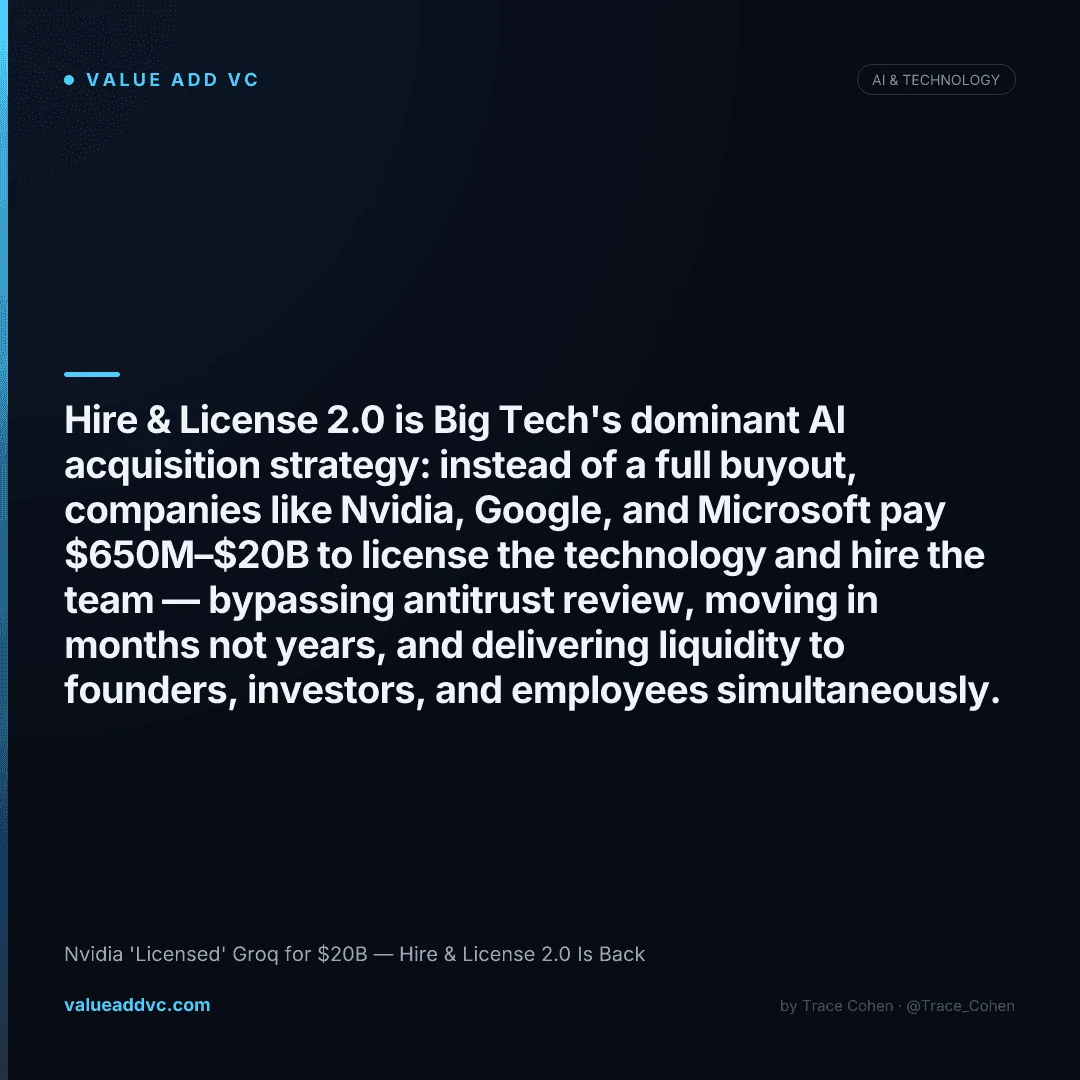
Time is the scarce resource. In frontier AI markets, competitive advantage decays in quarters, not years.
NVIDIA structured a license-and-hire arrangement with Groq for $20B, securing the technology and 90% of the team behind it — now, not a year from now. Founders achieved meaningful liquidity. Investors exited or materially de-risked. The team transitioned with continuity and upside intact.
That outcome was not incidental. It was the point.
The Pattern Is Now Unmistakable
Different structures. Different companies. The same underlying logic.
Why This Model Works: Everyone Gets Paid
Founders
Receive meaningful payouts
Investors
Exit or partially de-risk at substantial valuations
Employees
Paid on vested equity; compensated for unvested shares through cash, stock, or retention packages
Teams
Transition with continuity, upside, and incentives aligned
Liquidity is not a side effect of Hire & License 2.0. It is the enabling condition. These transactions must be repeatable — they only work if participants leave whole and willing to build again.
Not Anti-Regulation — Pre-Regulation
It's tempting to frame Hire & License 2.0 as regulatory arbitrage. History suggests a more accurate interpretation:
Hire & License 2.0 is a bridge between innovation cycles measured in months and governance systems measured in years. Innovation does not pause while that happens.
This is the fastest, safest, and most repeatable way for Big Tech to acquire critical capability.
While still creating real liquidity for all stakeholders.
Track AI landscape trends on the AI Landscape Dashboard at Value Add VC. Originally published in the Trace Cohen newsletter.
Latest from the Pulse
Get VC data most people never see
— free to subscribe
Trace's notes on venture, AI and startups, a few times a week. Join 5,000+ subscribers. No spam.
No spam, unsubscribe anytime. Sent via Substack · Privacy · or subscribe on Substack ↗