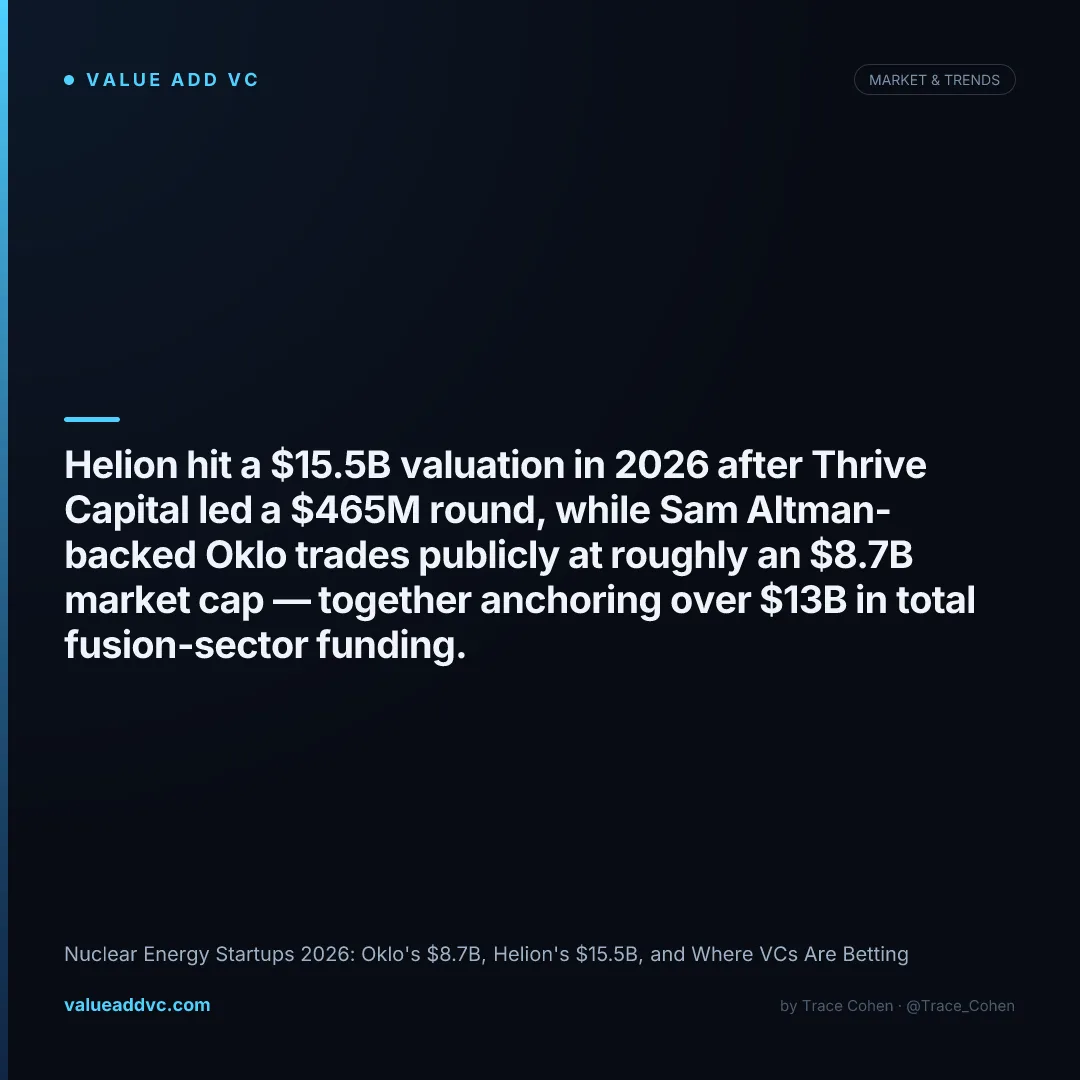
Helion Energy hit a $15.5 billion valuation in 2026 after Thrive Capital led a $465 million round — nearly triple its prior mark — while Sam Altman-backed Oklo trades publicly at roughly an $8.7 billion market cap despite being down more than 70% from its 2025 highs. That's the short answer. The longer answer is why VCs, Sam Altman, and Bill Gates are all now betting billions that nuclear solves the AI power crunch before 2030.
I've watched plenty of capital-intensive, regulation-heavy sectors go from uninvestable to venture-backed in a single cycle, but nuclear is the strangest one yet. A technology that VCs avoided for 40 years because of construction-cost blowouts and 15-year permitting timelines is now pulling in billions from the same firms that fund SaaS and consumer apps — because AI data centers need power the grid can't deliver, and nuclear is the only source that runs 24/7 without a fuel bill that scales with usage.
Nuclear Energy Startups in 2026: Where VC Money Is Actually Going
Nuclear energy startups raised more than $13 billion in private fusion funding alone by mid-2026, led by Helion ($15.5B valuation) and Commonwealth Fusion Systems (~$3B raised), alongside fission SMR developers like Oklo ($8.7B market cap), TerraPower, and X-Energy. VCs including Thrive Capital, Lux Capital, and Peak XV Partners are betting that AI's power demand makes nuclear investable again after four decades of dormancy.
Fission vs Fusion: The Two Nuclear Bets VCs Are Making
The nuclear startup wave splits into two distinct bets: fission small modular reactors (SMRs), which use proven physics and are closer to deployment, and fusion, which is unproven at commercial scale but promises near-limitless fuel. Oklo, TerraPower, X-Energy, Last Energy, and NuScale are fission plays; Helion and Commonwealth Fusion Systems are the two best-funded fusion bets, with Helion targeting first commercial power as early as 2028.
| Company | Tech | Funding / Valuation | Key Backer | Anchor Deal |
|---|---|---|---|---|
| Oklo (NYSE: OKLO) | Fission SMR | $8.7B market cap | Sam Altman (~4%) | Meta 1.2GW campus, Ohio |
| Helion Energy | Fusion | $15.5B valuation | Thrive Capital, Altman | Microsoft power by 2028 |
| Commonwealth Fusion Systems | Fusion (tokamak) | ~$3B raised | Bill Gates, Google | SPARC reactor 75% built |
| TerraPower | Fission (Natrium) | $1.6B total, $3.8B last valuation | Bill Gates, Nvidia | NRC permit, Kemmerer, WY |
| X-Energy | Fission SMR | $1.1B equity funding | Amazon | Dow Chemical reactor site |
| Radiant | Microreactor | $300M+ round (Dec 2025) | Astera Institute | Portable defense/commercial |
| Last Energy | Fission SMR | $100M+ Series C | Astera Institute, JAM Fund | 20MW modular reactors |
| Newcleo | Fission (lead-cooled) | $585M raised | European strategic investors | UK/Italy reactor sites |
| NuScale Power (NYSE: SMR) | Fission SMR | $468.7M equity funding | Public markets | First NRC-certified SMR design |
Figures are 2026 estimates blended from company disclosures, TechCrunch, GeekWire, The Information, Fortune, NucNet, and Global Venturing. Market caps as of April 2026; private valuations reflect the most recently disclosed priced round.
Why VCs and Sam Altman Are Betting on Nuclear Energy Startups in 2026
Sam Altman has been Oklo's most visible backer since investing in 2015, stepping down as chairman in April 2025 only to avoid a conflict of interest while OpenAI negotiated energy supply deals — he still holds nearly 4% of the company. Oklo's January 2026 deal with Meta to build a 1.2 gigawatt nuclear campus in Pike County, Ohio makes Meta one of the largest corporate nuclear power purchasers in U.S. history, and it followed a $1.182 billion equity raise that left Oklo with $2.5 billion in cash to fund construction.
Bill Gates has put a similar amount of conviction — and capital — behind TerraPower, where he's personally invested more than $1 billion and said he's willing to put in billions more. The NRC's March 2026 approval of TerraPower's Kemmerer, Wyoming construction permit was the first new reactor design permit in decades, and Nvidia's participation in TerraPower's $650 million June 2025 round signals that chip makers now see nuclear as direct AI infrastructure, not adjacent climate tech. We track the broader hyperscaler spending behind this shift on the AI Valuations dashboard.
Helion and the Fusion Funding Race: Inside the $15.5B Round
Helion's $465 million Series G, led by Thrive Capital with new participation from Lux Capital, Peak XV Partners, Alta Park Capital, and Ford Motor Company Executive Chairman Bill Ford, nearly tripled the company's valuation to $15.5 billion and pushed its lifetime private funding past $1.5 billion. Helion is operating on the sector's most aggressive timeline, with a binding commitment to supply Microsoft's Central Washington data center with fusion power by 2028 — a deadline most fusion scientists outside the company still consider implausible.
Commonwealth Fusion Systems, the only fusion company with more total funding than Helion at roughly $3 billion, is taking the opposite approach: a slower, government-and-Google-backed path targeting commercial power in the early 2030s, with its SPARC tokamak reactor reported about 75% complete at its Devens, Massachusetts facility. The gap between the two strategies — Helion's 2028 sprint versus CFS's early-2030s build-out — is the central bet every fusion investor is making right now.
The Risk: Why Nuclear Energy Startups in 2026 Still Aren't a Sure Bet
Oklo is the cautionary tale embedded in the bull case: even with a real Meta offtake deal and $2.5 billion in cash, OKLO shares are down more than 70% from their 2025 highs and fell another 20% after a March 2026 regulatory approval that should have been good news — a reminder that public nuclear stocks trade on multi-decade execution risk, not quarterly results. NuScale, the only SMR developer with an NRC-certified design, has spent over a decade and roughly $468.7 million in equity funding without a single operating commercial reactor.
Fusion carries the same risk at a higher multiple: no company has ever produced net-positive commercial fusion power, and Helion's 2028 Microsoft deadline depends on engineering milestones that have slipped industry-wide for 70 years. The honest framing for LPs is that nuclear and fusion are now venture bets on physics and permitting timelines simultaneously — the $13 billion in fusion funding and $1 billion-plus in corporate-backed nuclear VC (up from $645 million in 2024) reflect genuine AI-driven demand, but the payback horizon is measured in years most venture funds don't have left on their fund life.
Helion is worth $15.5B. Oklo is worth $8.7B. Neither has built a commercial reactor that's actually online yet.
AI's power crunch turned nuclear into a venture asset class overnight — but the underlying physics still runs on a 2030s clock, not a startup's fundraising calendar.
Track AI infrastructure and valuation trends on the AI Valuations dashboard at Value Add VC. Originally published in the Trace Cohen newsletter.
Latest from the Pulse
Get VC data most people never see
— 100% free
Weekly benchmarks, valuations, and fund data. Join 5,000+ investors. No spam.