
92% of VCs describe themselves as value-add investors. Only 15% of founders call that value-add critical to their outcome, and 61% rate the actual experience below average. That's the short answer. The longer answer is more interesting.
I run a fund called Value Add VC. I built the brand on the premise that most VCs are not, in fact, adding much value beyond the check — and every founder survey I've read since has only confirmed it. This isn't a takedown of the concept. It's an argument that the industry's own marketing has outrun what the data says it's actually delivering.
Figures blended from First Round Capital's State of Startups survey data and industry founder-experience research cited across multiple 2025-2026 VC platform reports.
The consensus: value-add is now table stakes
Walk through any Series A pitch process in 2026 and you'll hear some version of the same pitch from every VC in the room: we're not just capital, we're a platform. Firms have spent the last decade building out recruiting teams, in-house marketing shops, legal desks, and BD networks specifically to differentiate on something other than price — because price (equity given up for capital raised) is basically fixed within a stage and round size. Value-add became the tiebreaker.
The scale of the buildout is real. a16z runs a platform team of well over 100 non-investment staff. Tier-1 multi-stage funds now spend an estimated $2-5 million a year on operating partners, talent, and marketing headcount dedicated purely to portfolio support, according to industry benchmarking. That's not a rounding error — it's a deliberate, expensive bet that founders will select and pay a premium (in valuation terms) for a fund with a bigger platform team, though our framework for evaluating that promise before signing suggests headcount alone is a poor proxy for what actually gets delivered.
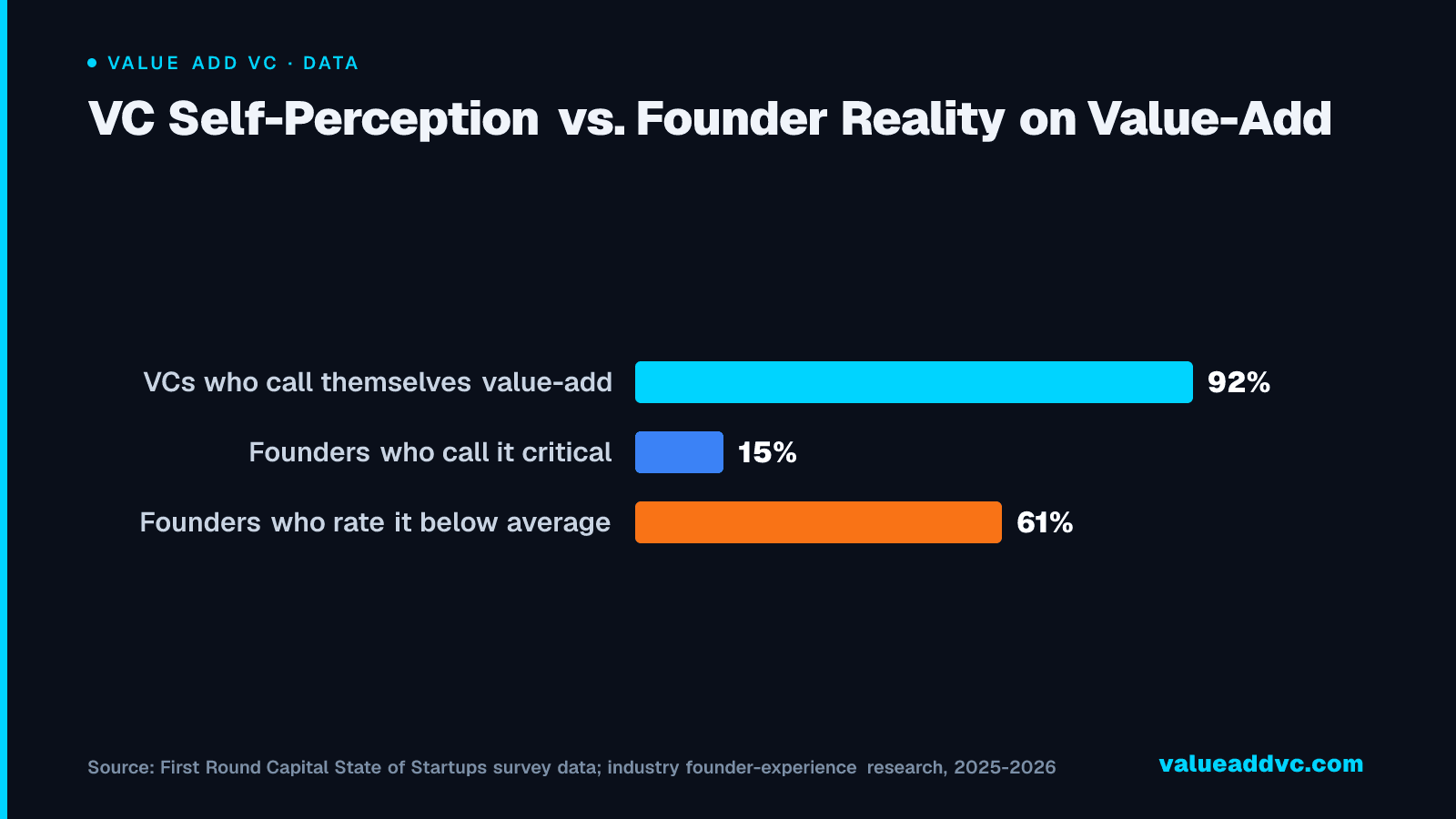
VC Self-Perception vs. Founder Reality on Value-Add
92% of VCs brand themselves value-add, but only 15% of founders say it's actually critical to their outcome — a 77-point gap between the pitch and the experience.
First Round Capital State of Startups survey data; industry founder-experience research, 2025-2026
Data
| Item | Value |
|---|---|
| VCs who call themselves value-add | 92% |
| Founders who call it critical | 15% |
| Founders who rate it below average | 61% |
Here's where I push back on the consensus
I've made 65+ angel investments and built three companies myself, and the pattern I see from the founder side rhymes exactly with what the surveys say: most of what gets pitched as value-add during diligence quietly evaporates by month six of the cap table relationship. The intro deck slide with six logos of "portfolio support services" becomes, in practice, one Slack message a quarter and a spot in a Discord full of 200 other founders competing for the same GP's attention.
The 61% below-average figure is the number that should worry the industry most, because it isn't measuring whether value-add exists — it's measuring whether founders who actually received it walked away satisfied. That's a much harder miss than simply not delivering a service at all. It means the platform teams are showing up, and founders are still unimpressed.
My contrarian read: the value-add arms race optimized for the wrong metric. Funds built breadth — legal, PR, recruiting, BD, marketing, community — when founders overwhelmingly needed depth in exactly one place: hiring.
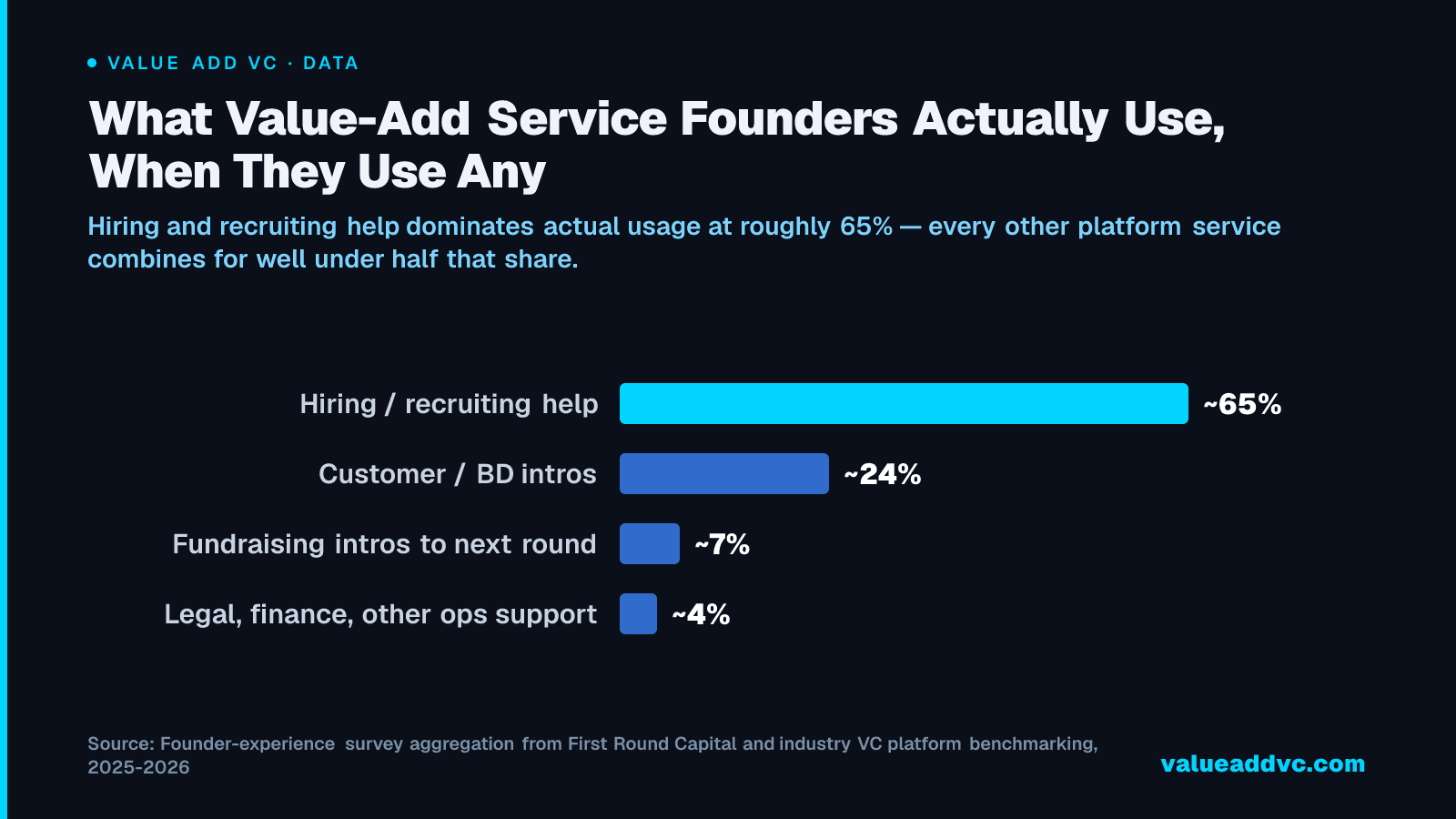
What Value-Add Service Founders Actually Use, When They Use Any
Hiring and recruiting help dominates actual usage at roughly 65% — every other platform service combines for well under half that share.
Founder-experience survey aggregation from First Round Capital and industry VC platform benchmarking, 2025-2026
Data
| Item | Value |
|---|---|
| Hiring / recruiting help | ~65% |
| Customer / BD intros | ~24% |
| Fundraising intros to next round | ~7% |
| Legal, finance, other ops support | ~4% |
Why the gap exists: incentives, not intent
Most GPs I know genuinely want to help. The gap isn't cynicism — it's math. A typical Series A partner sits on 8-12 active boards. A platform team of 5-10 people supports an entire portfolio of 40-80 companies across every fund vintage the firm has raised. Divide the attention and the arithmetic explains the 61% below-average number without needing to assume anyone is lying in the pitch meeting.
There's also a selection bias baked into how value-add gets marketed: the case studies funds put on their website are the 15% where it worked spectacularly — the intro that became the anchor customer, the recruiting help that landed the VP of Engineering. Those stories are real, but they're survivorship bias dressed up as a repeatable service, not evidence that the median portfolio company gets anywhere close to that outcome.
Check our VC Performance Dashboard for how fund-level returns actually correlate with reported founder satisfaction — the two metrics move together less than the industry's own marketing implies.
Best VC portfolio value-add services: what actually clears the bar
Strip out the marketing and the founder data points to three things worth actually screening for in a term sheet conversation: a named partner (not "the platform team") who has personally made 3+ warm intros that converted into pipeline for a prior portfolio company; a recruiting function with a track record of closing specific senior hires, not just forwarding resumes; and reference calls with founders from the same fund vintage who are two years further along than you are.
Everything else — the demo-day-style platform pitch, the generic community Slack, the quarterly newsletter — is closer to a nice-to-have than a differentiator. If a fund can't name a specific founder who'll vouch for a specific outcome, treat the value-add slide as marketing until proven otherwise.
Bottom line: 92% of VCs claim to be value-add, and the data says roughly 15% of founders agree it mattered. That gap isn't going away because the incentive to claim value-add — differentiation without giving up equity terms — is stronger than the incentive to actually staff for it at the density founders need. Pick your investors on the one or two things they can prove they've delivered before, not the six things on the platform slide.
Latest from the Pulse
Get VC data most people never see
— free to subscribe
Trace's notes on venture, AI and startups, a few times a week. Join 5,000+ subscribers. No spam.
No spam, unsubscribe anytime. Sent via Substack · Privacy · or subscribe on Substack ↗