In 2022, the Nasdaq saw virtually zero significant tech IPOs. Mobileye — at $17B — was it.
That single fact explains more about venture capital return compression, LP liquidity problems, and the overhang going into 2026 than any quarterly earnings report. The IPO window is not just a capital markets phenomenon — it is the valve that releases pressure from a decade of private market inflation.
What follows is the complete dataset: every major tech IPO from 2020 through 2025, their market cap at listing, and what actually happened after. The data is organized by year so you can see the full arc — from the 2020 COVID-era bonanza through the 2021 peak, the 2022 freeze, the 2023 partial reopening, and the slow 2024–2025 recovery that still hasn't returned to 2021 volumes.
Market Cap at IPO by Year: The Complete Table
Track the full IPO window history — including pricing, first-day performance, and context — on the Tech IPO Dashboard.
2020 Class
| Company | Ticker | Market Cap at IPO | First Day Close |
|---|---|---|---|
| Snowflake | SNOW | $33.3B | $253.93 |
| DoorDash | DASH | $60.2B | $189.51 |
| Airbnb | ABNB | $86.5B | $144.71 |
| Unity Software | U | $13.7B | $68.35 |
| Palantir | PLTR | $15.8B | $9.50 |
| Wish (ContextLogic) | WISH | $14.0B | $20.05 |
2021 Class
| Company | Ticker | Market Cap at IPO | First Day Close |
|---|---|---|---|
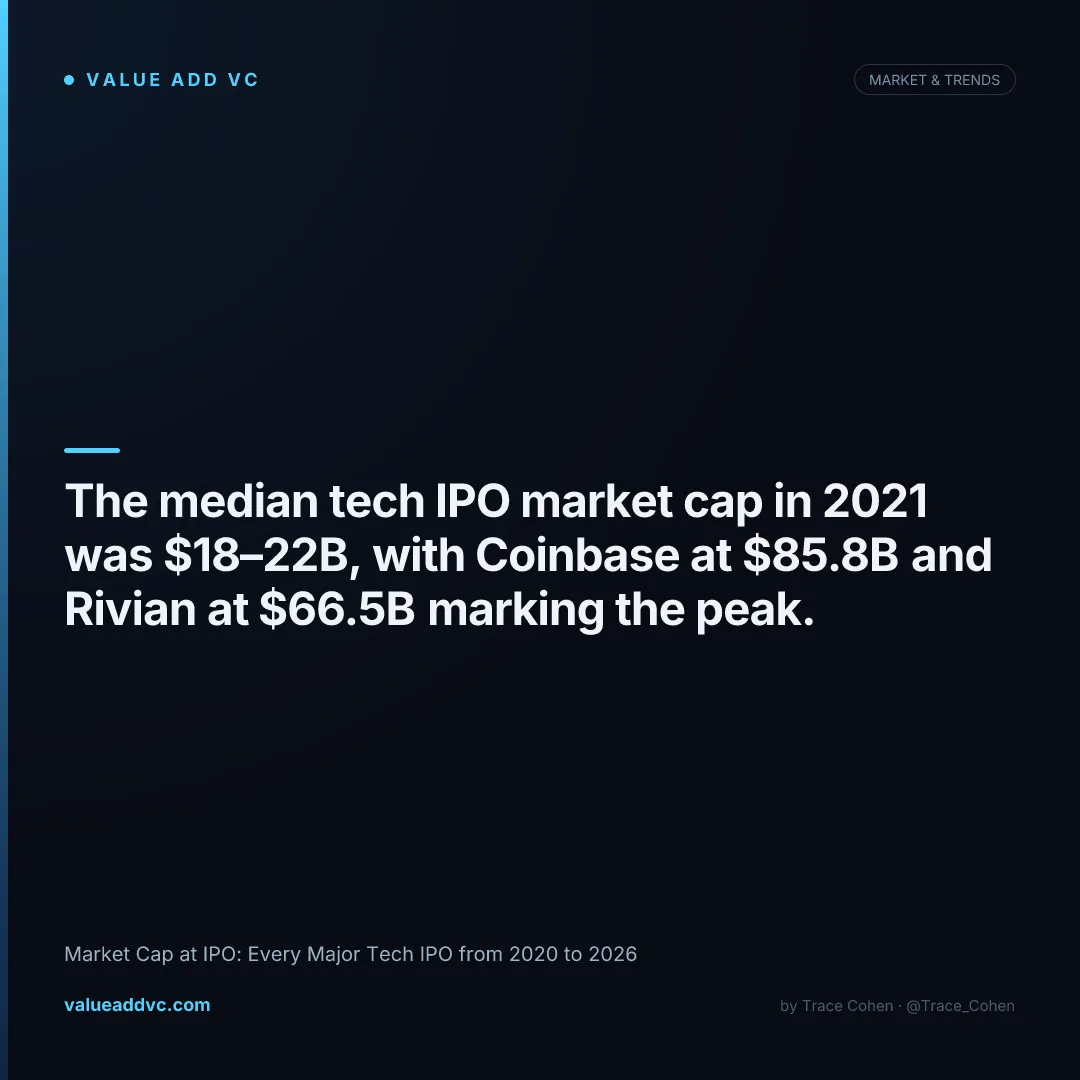
| Coinbase | COIN | $85.8B | $328.28 |
| Rivian | RIVN | $66.5B | $100.73 |
| Nubank | NU | $41.5B | $9.25 |
| Robinhood | HOOD | $32.0B | $34.82 |
| UiPath | PATH | $28.8B | $69.00 |
| Duolingo | DUOL | $5.1B | $139.01 |
| Coupang | CPNG | $84.0B | $49.25 |
| Toast | TOST | $20.0B | $62.51 |
| Confluent | CFLT | $11.7B | $36.00 |
| SentinelOne | S | $8.9B | $42.50 |
2022 Class
| Company | Ticker | Market Cap at IPO | First Day Close |
|---|---|---|---|
| Mobileye | MBLY | $17.0B | $28.97 |
2023 Class
| Company | Ticker | Market Cap at IPO | First Day Close |
|---|---|---|---|
| ARM Holdings | ARM | $54.5B | $63.59 |
| Instacart (Maplebear) | CART | $9.9B | $33.70 |
| Klaviyo | KVYO | $9.2B | $32.76 |
| Birkenstock | BIRK | $8.6B | $40.20 |
2024 Class
| Company | Ticker | Market Cap at IPO | First Day Close |
|---|---|---|---|
| RDDT | $6.4B | $50.44 | |
| Astera Labs | ALAB | $5.5B | $72.89 |
| Rubrik | RBRK | $5.6B | $38.60 |
| Viking Holdings | VIK | $11.2B | $26.16 |
2025 Class
| Company | Ticker | Market Cap at IPO | First Day Close |
|---|---|---|---|
| Klarna | KLAR | $15.0B | $40.00 |
| Chime | CHME | $11.6B | $28.50 |
| CoreWeave | CRWV | $23.0B | $40.00 |
| SailPoint | SAIL | $11.5B | $23.42 |
2026 Class
| Company | Ticker | Market Cap at IPO | First Day Close |
|---|---|---|---|
| SpaceX | SPCX | $1,770B | $161 |
| Cerebras Systems | CBRS | $56.4B | $64.25 |
Why 2022 Had Almost No IPOs — And What That Cost Founders
The Fed hiked rates from 0.25% to 4.5% in a single year. Public market growth multiples collapsed from 15–20x NTM revenue to 4–6x. That meant a company with $100M ARR growing at 60% went from being worth $3B in the public markets to $600–800M.
The problem: that same company had raised its last private round at a $2.5B valuation. No rational founder lists at a $700M market cap when their last round was at $2.5B. So they didn't. They burned through cash, hired bankers to explore options, and waited.
The 2021 Peak: How It Happened and Why It Was Unsustainable
Five forces converged in 2021 to create the most extreme IPO market cap inflation in history:
The result was Rivian IPO'ing at $66.5B before delivering a single production vehicle at scale. Coinbase at $85.8B. Nubank at $41.5B. These were not fraud — the companies were real — but the prices were set by a market that had forgotten what valuation discipline looks like.
The 2023 Recovery: ARM Sets the New Benchmark
ARM's September 2023 IPO was the pivot moment. At $54.5B market cap, it was the largest tech IPO in two years — and it worked. ARM priced in the middle of its range, first-day trading was orderly, and it has since risen to roughly $347B (as of June 2026) as AI chip royalty revenue accelerated.
The rest of the 2023 class told a different story. Instacart listed at $9.9B — a 75% haircut from its $39B peak 2021 private valuation. Klaviyo listed at $9.2B on strong fundamentals but at a fraction of what comparable companies had priced at in 2021. These were not failed IPOs — they traded well. But they required founders and early investors to take a real valuation reset.
That reset is healthy. The 2021 cohort is underperforming because it listed at prices that assumed interest rates would stay near zero permanently and that growth would compound indefinitely at COVID-elevated rates. Neither happened. The 2024 class showed what a disciplined debut can still deliver — Reddit priced conservatively and still gained roughly 6x within a year, a sharp contrast to the 2021 cohort's post-IPO decline.
What This Data Tells Us About the 2026 IPO Window
The 2025 class proved the point: Klarna listed in September 2025 at $40/share for roughly $15B at pricing, and Chime listed in June 2025 at an $11.6B valuation — a 54% discount to its $25B peak private mark. Both priced into a market that has learned from 2021. Then Cerebras kicked off 2026 with a $56.4B debut in May — followed by SpaceX's $1.77 trillion IPO, the largest offering in history. Investors are demanding real profitability or a clear path to it. NRR above 110%, Rule of 40 scores above 50, and predictable growth are table stakes.
The market cap at IPO is no longer a function of narrative momentum — it is a function of FCF yield, cohort retention, and comparable public company multiples. That is actually a healthier market. The window in 2026 is open, but not uncritically so. For a full breakdown, see our Tech IPO Dashboard tracking every candidate and its current metrics. For the readiness bar most of these companies still have to clear, read our guide to what it actually takes to go public.
The most important number in every IPO table is not the market cap at listing.
It's the market cap three years later. By that metric, 2021 was the worst IPO vintage in 30 years. 2023 and beyond look considerably better.
Track every company in the current IPO pipeline on the Tech IPO Dashboard. Originally published at Value Add VC.
Latest from the Pulse
Get VC data most people never see
— free to subscribe
Trace's notes on venture, AI and startups, a few times a week. Join 5,000+ subscribers. No spam.
No spam, unsubscribe anytime. Sent via Substack · Privacy · or subscribe on Substack ↗