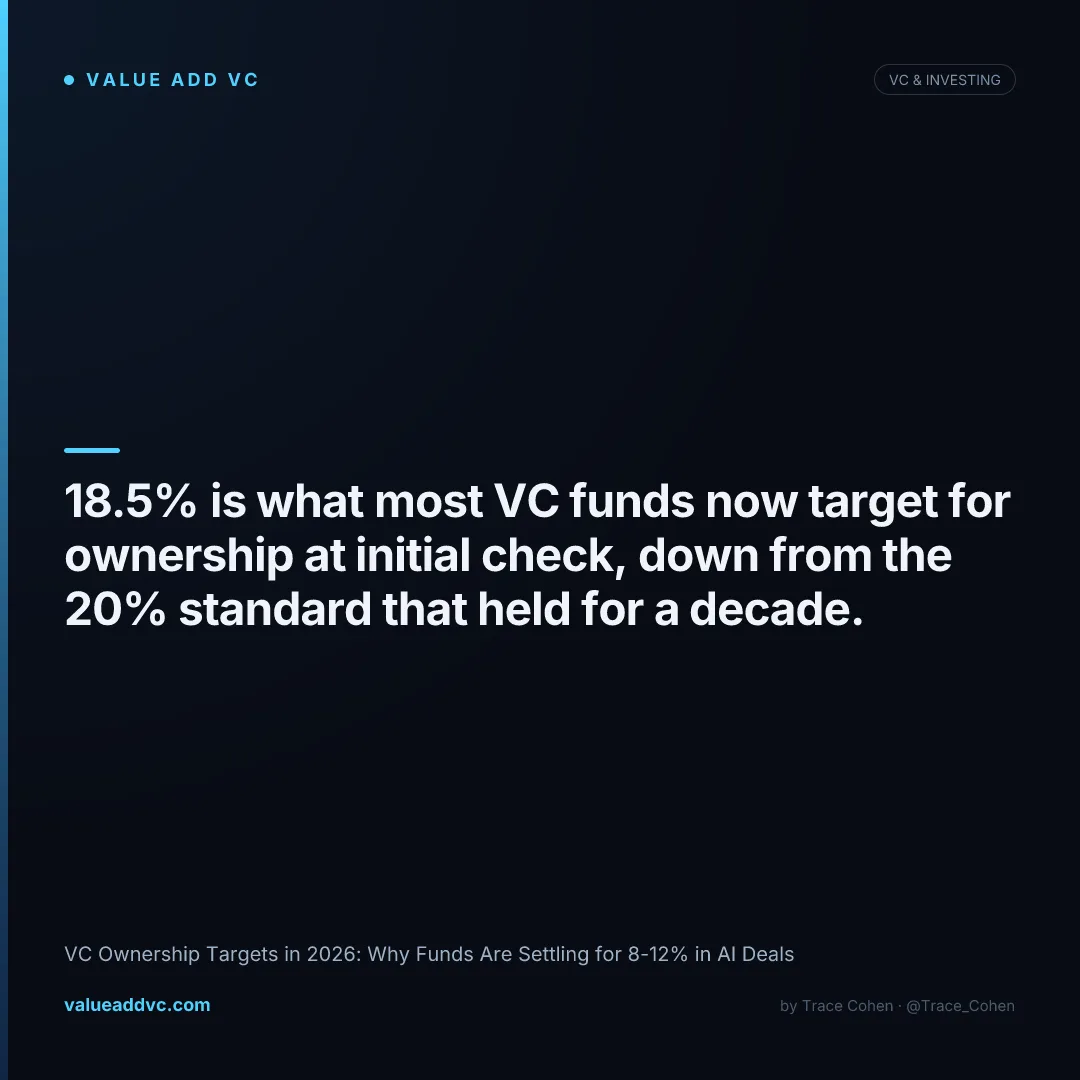
18.5% is what most VC funds now target for ownership at initial check, down from the 20% standard that held for a decade, according to Carta's 2026 fund construction data. At the extreme, a handful of AI funds are accepting 5-12% stakes just to get allocation at all.
Ownership targets used to be the most stable number in a VC fund model — pick 20%, size checks against it, move on. That stability broke in 2026. Four companies pulled in roughly two-thirds of all global venture capital in a single quarter, and funds without a position already on the cap table found themselves negotiating for scraps of a round instead of setting the terms. I track this shift closely because it changes how emerging managers should size checks, and we follow fund construction benchmarks more broadly on our VC performance dashboard.
Figures are 2026 estimates blended from Carta's Founder Ownership Report 2026, Carta's State of Private Markets Q1 2026, and Forbes Finance Council reporting on AI mega-round concentration.
How VC Fund Ownership Targets Have Changed in the AI Era
VC fund ownership targets have compressed from a 20% standard that held for roughly a decade to a blended median closer to 18.5% in 2026, driven almost entirely by AI-era capital concentration. Funds that aren't already on the cap table of a frontier AI lab are frequently accepting 5-12% stakes in oversubscribed rounds just to get an allocation at all, since existing investors — the ones with pro rata rights — defend their ownership first and leave whatever is left for new entrants.
The compression isn't evenly distributed. A disciplined seed fund writing $500K-$1M checks into a $3.1M median seed round, per Carta's 2026 data, can still realistically hold 15-20% ownership by staying selective about how many companies it backs. The squeeze is concentrated at the top of the market, where round sizes and demand have both exploded past what ownership math can absorb.
Why AI Mega-Rounds Are Compressing Ownership Targets
Four companies — OpenAI, Anthropic, xAI, and Waymo — absorbed roughly 65% of all global venture capital in Q1 2026, according to Carta's private markets data. When that much capital funnels into so few names, the ownership available to any single new investor in those rounds shrinks proportionally, no matter how large a check a fund is willing to write. A $50M check into a $40B round buys a fraction of a percent, and even a $500M check from a sovereign wealth fund barely moves past low single digits of ownership.
More than 60% of all venture dollars raised in Q1 2026 went to AI companies broadly, not just the four frontier labs, and that demand pulled valuations up across the entire early-stage market. Median seed pre-money valuations rose to roughly $16M, up about 19% year over year, which means a fund writing the same dollar check as a year earlier now buys meaningfully less ownership at seed, before a company has even reached the mega-round stage where the real compression happens.
VC Ownership Targets by Fund Type and Stage in 2026
| Fund Type / Situation | 2026 Ownership Target | Pre-2021 Standard | Compression Driver |
|---|---|---|---|
| Pre-seed specialist fund | 18-22% | 20-25% | Higher pre-money valuations at pre-seed |
| Seed specialist fund | 15-20% | 20% | Median seed pre-money up ~19% to $16M |
| Series A focused fund | 12-18% | 18-20% | Round sizes outgrowing fund check sizes |
| Multi-stage generalist | 8-15% | 15-20% | Competing across more oversubscribed rounds |
| New entrant into AI mega-round | 5-12% | N/A (rounds didn't exist at this size) | Existing investors defend pro rata first |
| Existing investor defending position | 15-25% | 15-20% | Actively increasing stake to avoid dilution |
| Sovereign wealth / crossover fund | 1-5% | N/A | Massive checks into $100B+ valuations |
| AI-focused seed fund (non-mega-round) | 15-20% | 20% | AI premium valuations offset by larger checks |
Figures are 2026 estimates blended from Carta's Founder Ownership Report 2026, Carta's State of Private Markets Q1 2026, and Forbes Finance Council analysis of AI mega-round structuring. Sovereign wealth and crossover ownership figures reflect publicly reported check sizes relative to disclosed valuations.
AI Founders Retain More Equity Than Non-AI Founders at the Same Stage
AI founding teams typically retain a larger share of equity than non-AI teams at the same round, which is the flip side of shrinking VC ownership targets. Non-AI founding teams show a median Series A ownership of about 21.8%, while AI teams often clear that by several points, because AI-premium round sizes run roughly 1.3x larger in dollar terms but valuations have risen about 1.6x — meaning each dollar an investor puts in buys proportionally less ownership than in a non-AI deal at the same stage.
That gap compounds every round. A fund targeting 20% ownership in an AI seed deal priced at a $16M-plus pre-money has to write a materially bigger check than the same target would require in a non-AI deal priced closer to the broader $12-13M median, which is exactly why reserve models built for non-AI round sizes are under-provisioned once a fund starts writing AI checks. We track how that reserve math is shifting on our reserve ratio breakdown.
Should Emerging Managers Chase Lower Ownership for AI Exposure?
The honest answer is usually no. A $10M check that buys 3% of a $330B AI lab looks impressive on a pitch deck, but it does almost nothing for fund returns unless that stake is large enough in dollar terms to move the needle against fund size — and for most emerging managers writing sub-$25M funds, it isn't. A 3% stake purchased at peak valuation also carries none of the ownership discipline that made venture returns work in the first place: enough of the company to matter if it triples, not just enough to say you were in the round.
The funds actually benefiting from AI-era ownership dynamics are the ones that got into these companies early, when round sizes were still small enough to buy real ownership, and have spent every round since defending that position with reserves. New entrants chasing mega-round allocation at 5-12% ownership are, in most cases, paying for logo value rather than portfolio construction. Emerging managers are usually better served holding to a 15-20% target in smaller, non-mega-round AI deals where check size and valuation still align.
There's also an LP-facing dimension to this that's easy to miss. LPs evaluating a fund's marks increasingly ask what ownership backs each logo, not just which logos appear on the portfolio page. A fund holding 2% of a company priced at $300B+ shows an eye-catching unrealized mark, but that mark converts into a fraction of a point of net IRR unless the position is unusually large relative to fund size. LPs who've been burned by paper-gain-heavy funds in prior cycles are now asking GPs directly what ownership percentage sits behind each mega-round logo before they credit it toward performance — which means the ownership discipline that mattered for returns always mattered just as much for fundraising credibility, even when nobody was asking the question out loud.
What This Means for Fund Construction in 2026
The practical takeaway for most funds is that the 20% ownership target isn't dead — it's just no longer achievable in the specific slice of the market getting the most attention. Funds targeting seed and Series A outside the frontier AI lab tier can and should still underwrite to 15-20%, since round sizes there ($3.1M median seed, per Carta) remain small enough for disciplined check sizing to hold a meaningful stake.
Where the math genuinely changes is for any fund whose strategy depends on late-stage or crossover exposure to the handful of companies absorbing two-thirds of all capital. Those funds need to decide explicitly whether they're optimizing for ownership percentage or for logo-and-exposure value, because in 2026 those are no longer the same strategy, and modeling them as if they were is how funds end up with portfolios full of small stakes in famous companies and not enough ownership anywhere to actually drive fund returns.
Bottom line: the median VC ownership target has compressed from 20% to about 18.5% in 2026, but that blended number masks a much sharper split — disciplined seed and Series A funds can still hold 15-20%, while any fund chasing allocation into the AI mega-rounds that captured 65% of Q1 2026 capital is often settling for 5-12% just to get in the door. The funds that will show up as top-quartile in five years are the ones that didn't chase the second kind of deal at the expense of the first.
Latest from the Pulse
Get VC data most people never see
— free to subscribe
Trace's notes on venture, AI and startups, a few times a week. Join 5,000+ subscribers. No spam.