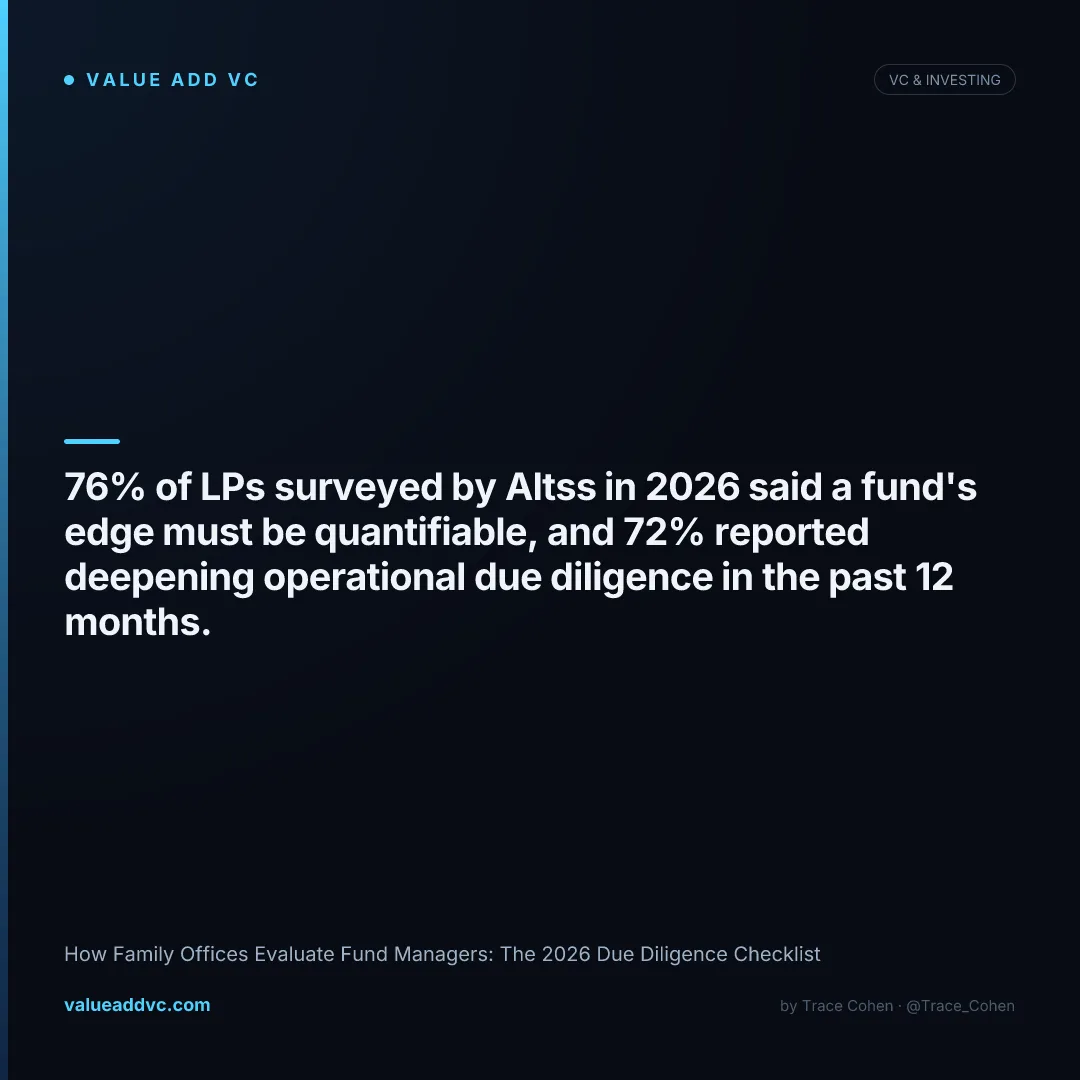
76% of LPs surveyed by Altss in 2026 said a fund manager's edge has to be quantifiable now, not just claimed — and family offices are pulling back private equity allocations from 22% in 2023 to a projected 17% in 2026. That's the short answer. The longer answer is more interesting.
Family offices have a reputation as the fastest, friendliest capital in venture — quick to say yes, easy to work with, willing to back a first fund. That reputation is only half true in 2026. The speed is real. But the bar for getting a "yes" has gone up sharply since the 2021-2022 markup era, and most emerging managers pitching family offices are still running a fundraising process built for the old, looser standard.
Figures are 2026 estimates blended from Altss, UBS Global Family Office Report, and Campden Wealth/RBC research.
How Do Family Offices Evaluate Private Equity and VC Fund Managers?
Family offices evaluate PE and VC fund managers on four pillars — People, Performance, Philosophy, and Process — the same framework institutional LPs use, but applied with more discretion and faster timelines. A 2026 Altss survey of 1,200 institutional investors found 76% now require a manager's claimed "edge" to be backed by quantifiable data rather than relationship access alone, and 72% said they've deepened operational due diligence in the past year specifically because of manager quality concerns from the 2021-2022 vintage years.
The practical difference from institutional diligence is who's doing the evaluating. In a single-family office, one or two people — often the wealth creator directly, or a hired CIO — make the final call, which compresses a process that takes a pension fund's investment committee six to twelve months down to four to eight weeks. Attracting and retaining that caliber of CIO isn't cheap — see the current pay benchmarks for family office CIOs and analysts. That speed is the main reason family offices remain a disproportionately important source of capital for first-time and emerging managers, even as the average check size and allocation percentage both shrink in 2026.
The Four-Pillar Framework Family Offices Use to Evaluate Fund Managers
| Pillar | What Gets Checked | Red Flag |
|---|---|---|
| People | Background screening, UBO verification, adverse media review, reference calls with 3+ prior LPs and 2+ portfolio founders | GP won't provide founder references, or references are all from the same fund vintage |
| Performance | TVPI/DPI/IRR by vintage, deal-level attribution (skill vs. market beta), realized vs. unrealized gains split | Track record is 90%+ unrealized markups with zero distributions after 5+ years |
| Philosophy | Strategy consistency across funds, check-size discipline, sector focus vs. drift, stated thesis vs. actual portfolio | Fund II thesis bears little resemblance to what Fund I actually invested in |
| Process | Deal sourcing pipeline, decision-making cadence, follow-on reserve discipline, portfolio construction model | No documented process — every deal decision is described as "gut feel" |
| Operational infrastructure | Fund administrator, valuation policy reviewed annually, internal audit cadence, key-person provisions | Manager self-administers the fund with no third-party fund admin |
| Alignment | GP commit size relative to fund, carry structure, management fee vs. AUM stage-appropriateness | GP commit under 1% of fund size with no clear explanation |
Framework synthesized from Altss LP due diligence research, VC Lab's LP Due Diligence Questionnaire, and standard institutional operational due diligence practice adapted for family office use.
Why Family Office Private Equity Allocations Are Shrinking in 2026
UBS's 2026 Global Family Office Report — a survey of 307 family offices with an average net worth of $2.7 billion and average AUM of $1.3 billion — shows private equity allocations falling from 22% of portfolios in 2023 to a projected 17% in 2026. Campden Wealth's North America research with RBC Wealth Management shows a similar but smaller drop: combined private markets exposure (PE, VC, and private credit together) at roughly 29% of the average family office portfolio in 2025, down from 30% a year earlier.
The pullback isn't a retreat from private markets broadly — it's a reallocation within them. Family offices are shifting dollars toward private credit and secondaries, both of which offer more downside protection and, in credit's case, actual cash yield, after several years of PE and VC portfolios sitting on paper markups with few realized distributions. That's the same "LP liquidity problem" showing up across institutional allocators, just moving faster through family offices because they can rebalance without a full committee vote.
For fund managers, the number that matters most isn't the allocation percentage — it's that overall family office alternatives exposure, at 42% of the average portfolio per UBS's 2026 data, remains near record highs even as the PE slice specifically shrinks. Track how fund performance benchmarks are shifting on our VC/PE performance dashboard.
Family Office Fund Manager Evaluation: Single-Family vs. Multi-Family Office
Not all family offices evaluate managers the same way, and the structure of the office changes both the speed and the rigor of the process. Single-family offices concentrate decision-making in one or two people — frequently the wealth creator or a hired CIO with wide latitude — which is why they can move from first meeting to signed commitment in as little as four to eight weeks. Multi-family offices and those using an outsourced CIO (OCIO) model run something closer to an institutional committee process, typically taking two to four months, because multiple client relationships and a formal investment committee both have to sign off.
Smaller single-family offices without an in-house investment team often lean on external advisors — wealth managers, attorneys, or former institutional allocators — to screen managers before the principal ever takes a meeting. That screening layer is where most emerging managers get filtered out before they realize it, since a cold email to the family often never reaches the decision-maker at all; it goes to the gatekeeper first.
What Family Offices Look for in Emerging vs. Established VC Managers
Family offices remain one of the few LP types genuinely willing to anchor a first-time fund, largely because they don't face the same fiduciary and headline-risk constraints that keep pensions and endowments concentrated in Tier 1 re-ups. But "willing to back emerging managers" doesn't mean "less rigorous" — it means the diligence gets compressed into fewer, higher-context conversations rather than a formal RFP process.
| Criterion | Emerging Manager (Fund I-II) | Established Manager (Fund III+) |
|---|---|---|
| Track record standard | Angel/pre-fund deal-by-deal returns, prior operating or investing experience | Fund-level TVPI/DPI across 2+ full vintages |
| Typical check size from a single-family office | $250K-$2M | $2M-$15M+ |
| GP commit expectation | 1-2% of fund, sometimes personal capital only | 2-5% of fund, often from prior fund carry |
| Reference check depth | Founders + co-investors, since LP references are thin | 3+ prior fund LPs plus founders |
| Diligence timeline | 4-8 weeks at single-family offices | 8-16 weeks, more committee involvement |
| What closes the deal | Personal relationship, differentiated sourcing edge, founder references | Quantified performance attribution, portfolio construction discipline |
Figures are 2026 estimates based on Sarnia Asset Management, Dakota, and Altss research on family office emerging-manager behavior.
How Family Offices Evaluate Fund Manager Performance Beyond the Headline Multiple
The single biggest shift in family office diligence since 2022 is a refusal to take a headline TVPI at face value. Family offices now routinely ask for deal-level attribution — which specific investments drove the multiple, whether those gains are realized or paper markups, and whether the winners reflect repeatable skill or one lucky entry into a company that would have found capital anyway. A fund showing 3.5x TVPI with 0.2x DPI five years into its life draws far more scrutiny in 2026 than the same fund would have in 2021, when unrealized markups were broadly accepted as a proxy for eventual returns.
This is directly downstream of the "mark-up culture" problem that inflated paper returns across the 2020-2022 VC vintages — family offices got burned watching funds report strong IRRs on paper that never converted to actual distributions, and the 2026 diligence process reflects that lesson. Compare current benchmarks by vintage year and fund size on our VC performance dashboard before taking any GP's self-reported numbers at face value.
Bottom line: Family offices are still faster and friendlier than institutional LPs — a single-family office can close in four to eight weeks versus six to twelve months at a pension fund — but the bar cleared 76% of LPs now demanding a quantifiable edge and 72% deepening operational due diligence means the old playbook of relationship-only fundraising no longer works. With PE allocations falling from 22% to a projected 17% of family office portfolios by 2026, managers competing for that shrinking slice need a track record that survives deal-level scrutiny, not just a warm introduction.
Latest from the Pulse
Get VC data most people never see
— free to subscribe
Trace's notes on venture, AI and startups, a few times a week. Join 5,000+ subscribers. No spam.
No spam, unsubscribe anytime. Sent via Substack · Privacy · or subscribe on Substack ↗