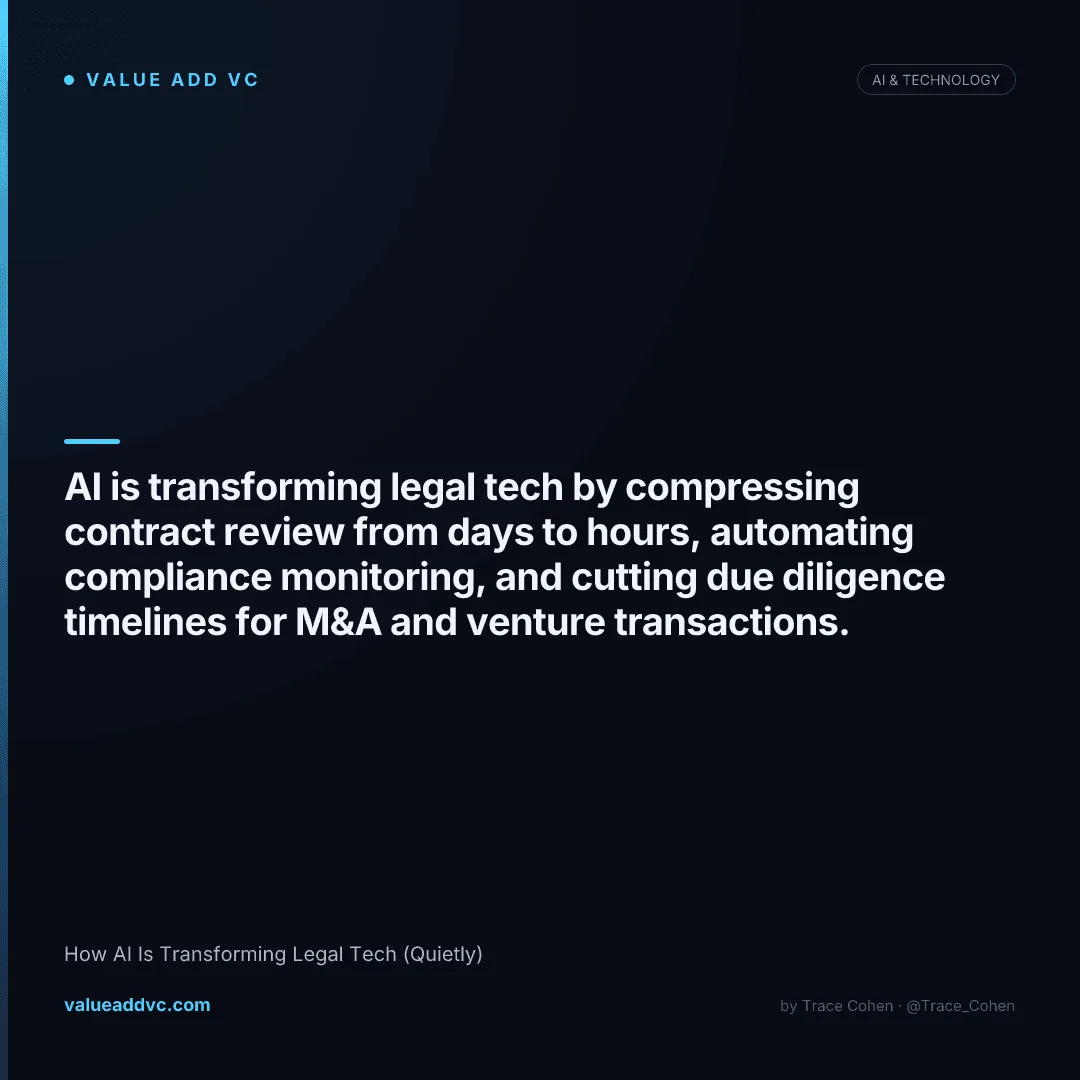
The $1.1 trillion global legal services market has been the last major professional sector meaningfully untouched by technology — until now. The era of the 8-hour contract review is ending, and most of the industry has not yet admitted it.
Why Legal Moved So Slowly — And What Finally Changed
Legal is a trust industry governed by billable hours. Partners who built their careers on the associate-leverage model had every financial incentive to resist automation — and the liability exposure in legal work made regulators and general counsel deeply cautious about deploying immature technology on high-stakes contracts.
From 2010 to 2022, "legal tech" was mostly a euphemism for better document storage, e-discovery bolt-ons, and contract lifecycle management tools that still required humans to do all the substantive work. The category raised capital, generated buzz, and largely failed to change how lawyers actually billed.
Three things changed simultaneously starting in 2023. Transformer models finally achieved the reading comprehension level required for genuine contract analysis. LLM context windows expanded to accommodate 200,000+ token documents — long enough to hold complex commercial agreements in a single prompt. And a generation of legal operations professionals who grew up with software started influencing how firms buy and deploy tools. The result: over $2.8B was invested in legal AI in 2024, up from $500M in 2019 — a 5x increase that mainstream venture coverage has largely ignored.
Where AI Is Actually Winning in Legal Right Now
The contract review category has been structurally transformed. Allen & Overy deployed Harvey AI firm-wide and reported a 40% reduction in time-to-draft on standard commercial agreements. Casetext's contract analysis feature — before its $650M acquisition by Thomson Reuters — was completing first-pass reviews in under 12 minutes that previously required 6 to 8 associate hours. These are not pilot metrics. These are production numbers across thousands of documents per week.
Due diligence for M&A and venture transactions is the second major category under compression. Luminance's platform is being deployed by top-tier law firms to analyze data rooms that would previously require weeks of associate time. In my experience watching portfolio companies go through transactions, the diligence timeline has compressed from 4 to 6 weeks to under 2 weeks for deals where both sides are using AI-assisted review. That is not incremental — it is a restructuring of transaction economics.
The compliance opportunity may be the largest of all. Financial institutions alone spend an estimated $213B annually on compliance globally. AI models trained on regulatory frameworks — GDPR, SEC disclosure requirements, HIPAA, anti-money-laundering rules — are now running first-pass compliance checks that previously required paralegals billing at $150 to $300 per hour. For large financial institutions, the math is not complicated.
Six Legal AI Use Cases Compressing Costs Right Now
- •Contract review and redlining — Harvey AI and Spellbook analyze commercial agreements in minutes, flagging non-standard clauses and suggesting market-standard alternatives. Allen & Overy reports a 40% reduction in drafting time.
- •M&A and venture due diligence — Luminance and EvenUp process data rooms at a rate no human associate team can match, identifying risk items and inconsistencies across thousands of documents simultaneously.
- •Legal research and case analysis — Westlaw AI and Lexis+ AI are replacing the junior associate research task with models that surface relevant precedent in seconds rather than hours. LexisNexis reports AI research tools reducing research time by over 50%.
- •Regulatory compliance monitoring — AI systems trained on SEC, GDPR, HIPAA, and AML regulatory corpuses are running automated compliance checks and flagging potential violations before human review — critical for regulated industries spending billions on compliance annually.
- •IP portfolio management and patent analysis — Patent claim analysis and freedom-to-operate reviews, historically expensive and time-consuming, are being automated by AI tools trained on USPTO and EPO datasets.
- •Predictive litigation modeling — Lex Machina and Premonition use historical case data to model litigation outcomes, settlement likelihood, and opposing counsel tendencies — giving litigators a data advantage that was previously impossible to synthesize at scale.
What This Means for Founders and Investors
The market structure in legal AI is unusual compared to other enterprise software categories. Unlike most SaaS adoption curves, legal AI is being adopted fastest by the largest firms — the Am Law 100 — not the smallest. That is because large firms have the legal ops infrastructure to absorb implementation complexity, and they are using AI to widen the capability gap against mid-market competitors rather than simply reduce headcount. The billable hour survives for now, but the work that fills it is changing.
For investors: the best legal AI companies in 2026 are those that own proprietary legal document corpora, not just those deploying foundation models on top of generic LLMs. Thomson Reuters acquiring Casetext for $650M was not a product acquisition — it was a data acquisition. A model trained on 40 years of contract dispute outcomes, with feedback loops from thousands of active law firm deployments, has a moat that a startup built on the OpenAI API cannot replicate in a reasonable timeframe.
For founders: the window for building a horizontal legal AI platform without a proprietary data advantage is effectively closed. The opportunity that remains is vertical depth — immigration law, employment disputes, real estate transactions, IP licensing — where unique domain-specific outcomes create feedback loops that compound over time. Vertical legal AI that embeds deeply into a specific workflow is defensible. A generic legal chatbot layered on a commodity model is not.
The legal AI companies that win this decade will not be the ones that replace lawyers. They will be the ones that make lawyers 10x more productive — and own the workflow infrastructure that the entire industry runs on.
Stay current with VC and startup trends at Value Add VC. Originally published in the Trace Cohen newsletter.
Latest from the Pulse
Get VC data most people never see
— 100% free
Weekly benchmarks, valuations, and fund data. Join 5,000+ investors. No spam.