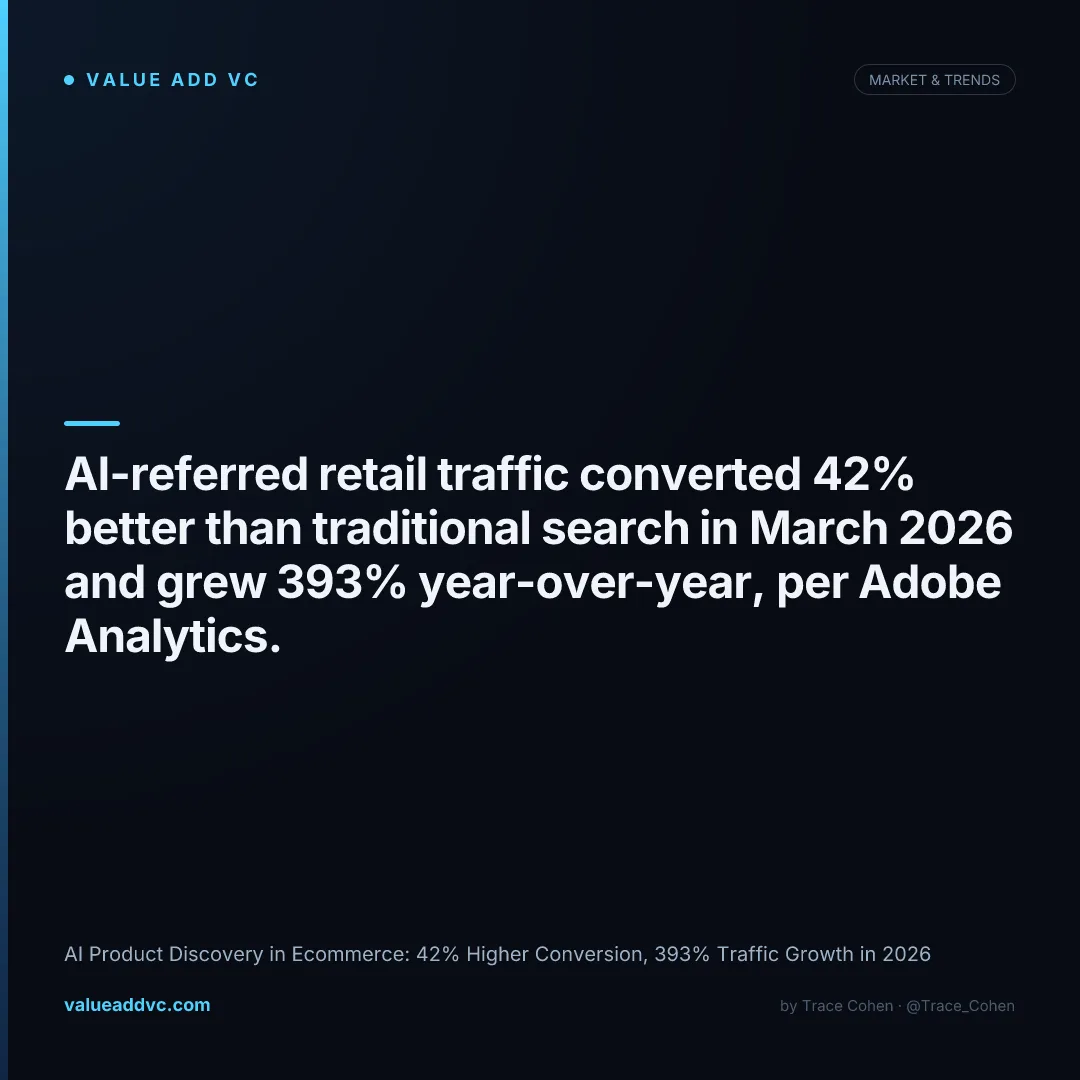
AI-referred shoppers converted 42% better than traditional search traffic in March 2026, after traffic from AI assistants grew 393% year-over-year, according to Adobe Analytics. Underneath those numbers, ecommerce search is being rebuilt around agents, not keywords, and most retailers' product data isn't ready for it.
A number of ecommerce retailers have scrambled to fix their product feeds this year once they realized ChatGPT, Gemini, and Amazon's Rufus were sending them real revenue — and converting it better than Google ever did. This isn't a future trend anymore. It's a live shift in how people find things to buy, and the data is now specific enough to act on.
How Is AI Changing Product Discovery in Ecommerce?
AI is changing product discovery in ecommerce by replacing keyword-based search boxes with conversational and agentic tools that interpret intent directly. Instead of typing "waterproof hiking boots size 10," a shopper now asks Amazon Rufus, ChatGPT, or Google AI Mode a full question and gets a synthesized, comparative answer pulled from product data, reviews, and specs — often converting into a purchase before ever landing on a traditional search results page.
The 2026 AI Shopping Platform Landscape
Every major AI assistant is now a shopping surface. Amazon folded Rufus into Alexa for Shopping in May 2026 after MAUs grew 115% year-over-year; Google shipped AI Mode shopping alongside a new Universal Commerce Protocol built with Shopify in January 2026; and ChatGPT, Gemini, Perplexity, Copilot, and Claude collectively drove an 8x year-over-year jump in AI-referred retail sessions. Usage share among shoppers who've tried AI for purchases still skews heavily toward the general-purpose chat assistants over specialized shopping tools.
| Platform | Shopping usage share | Discovery model | Key 2026 milestone |
|---|---|---|---|
| ChatGPT | 48.4% | Conversational + agentic checkout | Leading share among AI shopping users |
| Google Gemini / AI Mode | 27.9% | Search-integrated AI overviews | Universal Commerce Protocol launched Jan. 2026 |
| Amazon Rufus (now Alexa for Shopping) | n/a (platform-native) | In-app assistant on 250M+ MAUs | Merged into Alexa for Shopping, May 2026 |
| Microsoft Copilot | 9.9% | Conversational, Bing-integrated | Enterprise + consumer shopping plug-ins |
| Claude | 6.8% | Research-grade comparison | Growing use for high-consideration purchases |
| Perplexity | 3.8% | Research-first with direct checkout | Perplexity Shopping merchant integrations |
Figures are 2026 estimates blended from Adobe Analytics, Alhena AI (329-brand study, Q4 2024–Q1 2026), and public platform usage surveys cited across ecommerce industry reports. Usage share reflects consumers who reported using AI tools for shopping, not total platform traffic.
The Conversion Data: Why AI Traffic Is Outperforming
The most important number in this whole shift is the conversion gap, because it means AI referral has graduated from traffic curiosity to better-qualified funnel. Adobe Analytics measured AI-referred shoppers converting 31% better than other traffic sources during the 2025 holiday season; by March 2026, that lift hit a record 42%. Revenue per visit from AI-referred shoppers jumped 254% year-over-year, combining both higher conversion and higher average order values. AI-referred visitors also browsed 13% more pages, stayed 48% longer per session, and were 33% less likely to bounce immediately — the profile of a shopper who arrives already partway through a purchase decision.
Separately, Alhena AI's study of 329 brands found ecommerce AI agents converting visitors at 12.3%, compared with 3.1% for unassisted browsers — a 4x gap that held from Q4 2024 through Q1 2026. That's a strong signal that the retailers treating this as core infrastructure, not a marketing experiment, are pulling ahead. For context on where AI is producing similarly outsized returns elsewhere in the business stack, see our post on how AI is changing VC due diligence.
Agentic Commerce: The Next Layer of AI Product Discovery
Beyond search and recommendations, 2026 is the year AI agents started completing transactions, not just influencing them. McKinsey estimates agentic commerce could generate up to $1 trillion in orchestrated US retail revenue by 2030 and $3-5 trillion globally, while J.P. Morgan projects agentic checkout could reach 25% of US online sales by 2030 — concentrated first in recurring, low-risk categories like groceries and subscriptions. Today, 38% of US consumers have already used generative AI for online shopping and 52% say they plan to, per multiple 2026 industry surveys.
The gap between hype and infrastructure is real, though: 69% of retailers report a measurable revenue lift attributable to AI, but only a single-digit share have fully scaled it into production versus piloting it. That gap is the actual opportunity for enterprise search vendors. Algolia — valued at $2.25B after raising $335M and named a Leader in the 2026 Gartner Magic Quadrant for Search and Product Discovery — and Bloomreach, which claims 15-25% revenue lift from AI-driven discovery and has taken the Gartner Leader spot three years running, are both selling directly into this scaling gap, alongside Coveo's enterprise-focused unification play.
Search vs. Recommendations vs. Conversational Discovery
It's worth separating the three distinct layers that "AI product discovery" actually collapses together, because they behave differently and get bought differently. Traditional keyword search still handles the largest share of ecommerce sessions today, but it's the layer losing share fastest — cart abandonment across ecommerce broadly sits at 70.19%, and keyword search converts worst of the three when a shopper's intent is even slightly ambiguous. Recommendation engines (the "customers also bought" layer) are the most mature and still deliver solid lift, with Bloomreach citing 15-25% revenue gains from AI-driven discovery for its enterprise clients. Conversational discovery — the Rufus, ChatGPT, and AI Mode category — is the newest and fastest-growing layer, and it's the one producing the 42% conversion premium because it front-loads comparison and qualification work a shopper used to do across five browser tabs.
The practical implication is that these three layers now require three different budget lines and three different vendor relationships. A retailer optimizing only for keyword search relevance (the Coveo/Algolia-style enterprise search stack, priced at $30K-$200K annually) is solving yesterday's problem. The winners in 2026 are treating conversational and agentic discovery as a distinct product surface with its own KPIs — average order value from AI referral, agent-completed checkout rate, and machine-readability score — rather than folding it into a generic "AI initiatives" line item that never gets a dedicated owner.
What This Means for Founders Building in Ecommerce and Retail Tech
For founders and operators, the practical takeaway is that product data quality just became a direct revenue lever, not a back-office SEO task. With the average US product page only 66% machine-readable, a third of the content that would otherwise help an AI agent make a purchase decision is invisible to it. Brands with enriched descriptions, specs, and structured data are seeing 10-30% higher click-through from AI-generated recommendations on Amazon alone. Startups building tooling to close that machine-readability gap — structured data pipelines, agent-ready product feeds, AI-native merchandising layers — are sitting on a genuinely under-built market, and Series A and B check sizes in this niche are likely to keep climbing through 2026 and 2027.
For consumer and retail-adjacent companies specifically, founders should instrument AI-referral traffic as its own channel now — in whatever product analytics stack they already run, whether that's Amplitude or an equivalent — not lump it into "organic" or "direct," because a 42% conversion premium changes how you should be valuing and prioritizing that traffic in board reporting. It also changes SaaS valuation conversations — search and discovery vendors that can show AI-driven revenue lift are commanding premium multiples versus legacy search providers, a dynamic worth tracking on our SaaS valuations dashboard.
There's also a hiring and org-design implication that gets underrated. Companies that used to have one "growth marketing" function are now splitting it into at least two distinct disciplines: traditional performance marketing and paid search, and a newer AEO/agent-optimization function whose job is making sure the brand's product data is legible to Rufus, ChatGPT, and Gemini in the first place. That second function barely existed as a job title 18 months ago. The startups that build it into their go-to-market team early — rather than treating it as an SEO intern's side project — are the ones showing up first in AI-generated shopping answers, which compounds the same way early SEO investment used to compound a decade ago.
The Bottom Line
AI product discovery in ecommerce isn't a future bet — it's already converting 42% better than traditional search, growing traffic 393% year-over-year, and moving $262 billion of holiday spend through assistants and agents. The retailers and startups winning right now aren't the ones with the flashiest chatbot; they're the ones whose product data is actually machine-readable enough for an AI agent to act on. Fix that gap before your competitors close it.
For more on where AI is reshaping specific business functions, read our breakdown of how AI is changing VC due diligence, or explore SaaS valuation trends on our SaaS Valuations dashboard at Value Add VC.
Latest from the Pulse
Get VC data most people never see
— free to subscribe
Trace's notes on venture, AI and startups, a few times a week. Join 5,000+ subscribers. No spam.
No spam, unsubscribe anytime. Sent via Substack · Privacy · or subscribe on Substack ↗