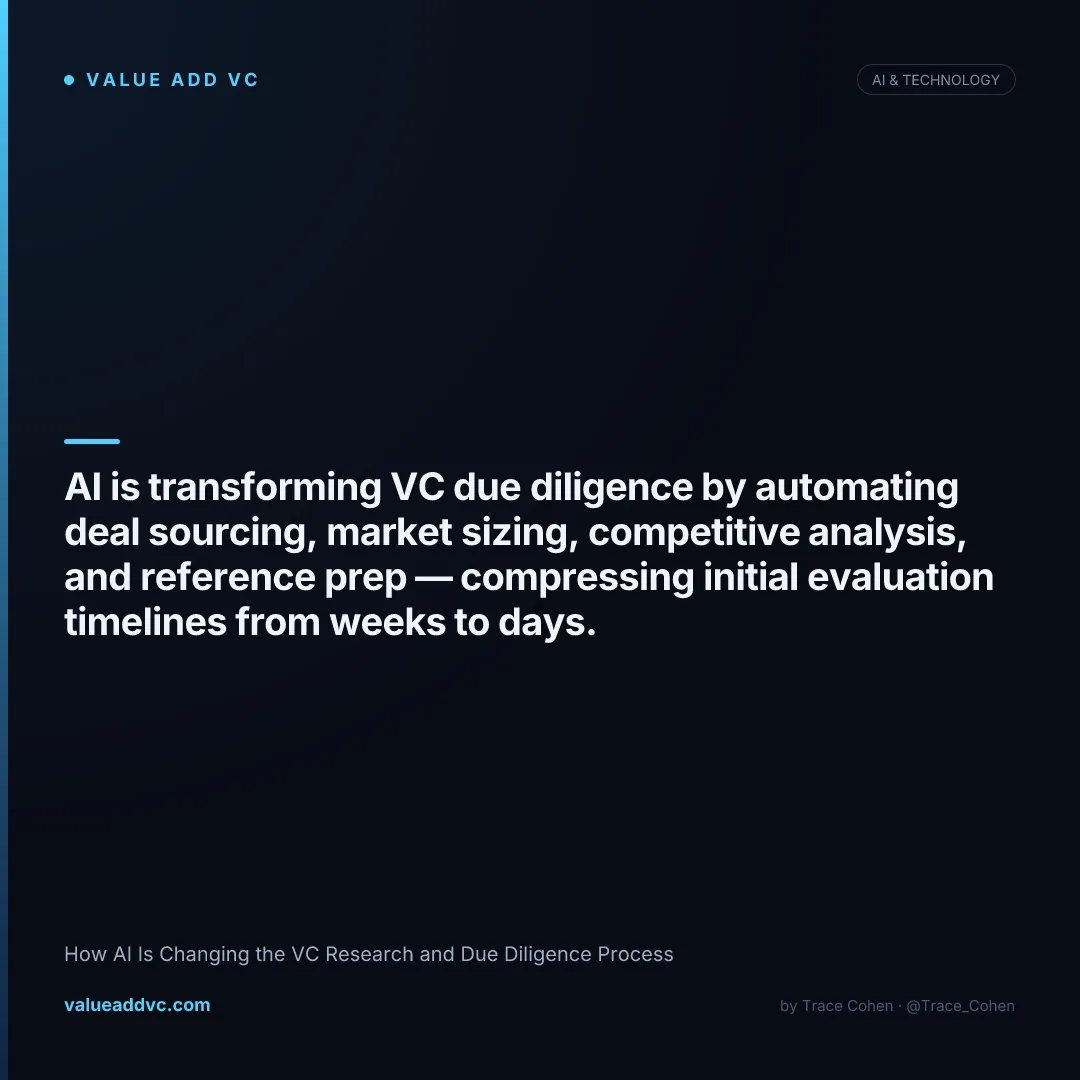
The average top-tier VC fund screens 1,000–1,500 companies per year and writes checks into 5–10. That ratio — 200:1 or worse — is the core operational problem of venture capital.
For decades the solution was pattern matching from memory, warm intros, and analyst hours. AI is replacing all three, not by making better decisions but by compressing the cost of getting to a decision. I've now watched this shift reshape due diligence across the 65+ companies I've backed, and the change is real — not hype.
The Sourcing Layer Has Already Been Automated
Deal sourcing used to mean relationships, demo days, and LinkedIn. Today the best-sourced funds are tracking company signals six to twelve months before a formal fundraise — before the deck exists, before the company has sent a cold email to anyone.
Harmonic, which raised a $32M Series B to build deal intelligence infrastructure, ingests hiring signals, technical output, product launches, web traffic changes, and customer reviews across millions of companies. Affinity, valued at $1.5B after its $100M Series C, automates relationship mapping so a fund can see which portfolio founders or LPs already know a target company's team before the first outreach.
On the warm-intro side, Happenstance takes a different angle — you describe the person you're looking for in plain English and it searches across your Gmail, LinkedIn, and X connections to surface the shortest warm path, something even a well-maintained CRM misses when the connection lives in a contact your team forgot about.
The result: proactive sourcing has displaced reactive sourcing at every serious firm. If you're waiting for companies to find you, you're already late to the competitive deals.
What AI Has Compressed in Initial Diligence
The first-pass memo used to take a junior analyst two to three days. Now it takes two to three hours. Here is what is getting automated:
Market sizing
Before: 3–5 analyst days
After: 45 min with AI-assisted research + sanity checks
Competitive landscape
Before: 2–3 days of manual mapping
After: 2 hours via Perplexity + Pitchbook + custom scraping
Founder background check
Before: Manual LinkedIn + news search
After: Automated signal aggregation across 15+ data sources
Technical diligence (first pass)
Before: Senior engineer 1–2 weeks
After: AI review of GitHub, patents, job descriptions in hours
Reference prep
Before: Ad hoc question drafting
After: AI-generated question trees from public signals and network context
Comparable deal analysis
Before: Pitchbook manual queries
After: AI-enhanced comp set with anomaly flagging
None of this eliminates the need for human judgment. It eliminates the information gap that used to justify delay. If a fund still takes three months to run a first-pass diligence process, the bottleneck is no longer research — it's decision-making culture.
The Pattern Matching Problem
Here is where I have a strong opinion that most AI-in-VC coverage misses entirely: pattern matching on historical data systematically underweights the best investments.
The most important companies in any cycle — the ones that produce 50-100x fund returns — look like nothing that came before. They have first-time founders in markets that didn't exist, raising at valuations that seem insane by any comparable, with product theses that look contrarian to conventional wisdom at time of investment. An AI trained on past patterns will discount all of these features. The best human investors are trained to weight exactly these signals.
This is not a knock on AI in VC. It is a constraint that every fund building AI-driven processes needs to architect around. Use AI to accelerate and de-risk the research layer. Reserve human conviction for the decisive moments where the data says no but the pattern says yes.
Where Human Judgment Is Still Irreplaceable
- →
Founder character under pressure
No amount of data predicts how a founder behaves when the company hits the wall at month 18. Reference calls with people who have seen the founder fail — not just succeed — are irreplaceable.
- →
Timing conviction
Why now is the most important question in investing and the hardest to model. Market timing requires a thesis, not a regression. AI can surface that infrastructure costs dropped 10x; it cannot tell you whether that is the enabling condition for a category to exist.
- →
Proprietary network thesis
The best deals are not in the data yet. They come from relationships built over years with founders, domain experts, and operators who share information before it becomes public signal.
- →
Contrarian conviction
Writing a $5M check into something every other smart investor has passed on requires a level of personal conviction that no model produces. This is where the best fund returns are built.
The New VC Stack
Funds that will outperform over the next decade are not the ones replacing partners with models. They are the ones using AI to operate with the research bandwidth of a 20-person team at the economics of a 5-person team — and then deploying the time savings into higher-quality relationship building, deeper founder support, and faster decision-making cycles.
The emerging VC tech stack looks like this:
Harmonic, Affinity, proprietary scrapers, LinkedIn Sales Navigator + AI enrichment
LLM-assisted memo drafting, AI market sizing, automated competitive mapping
Pitchbook + CB Insights for comps, GitHub analysis, NLP on customer reviews and job postings
AI-generated question frameworks, network mapping to find warm intros to references
Automated KPI dashboards, signal-based early warning systems for churn and burn
The funds that will lose to AI are not the ones that adopt it too slowly.
They are the ones that confuse AI-accelerated research with AI-driven conviction — and stop doing the hard human work of building relationships, developing contrarian views, and making uncomfortable bets.
Latest from the Pulse
Get VC data most people never see
— 100% free
Weekly benchmarks, valuations, and fund data. Join 5,000+ investors. No spam.