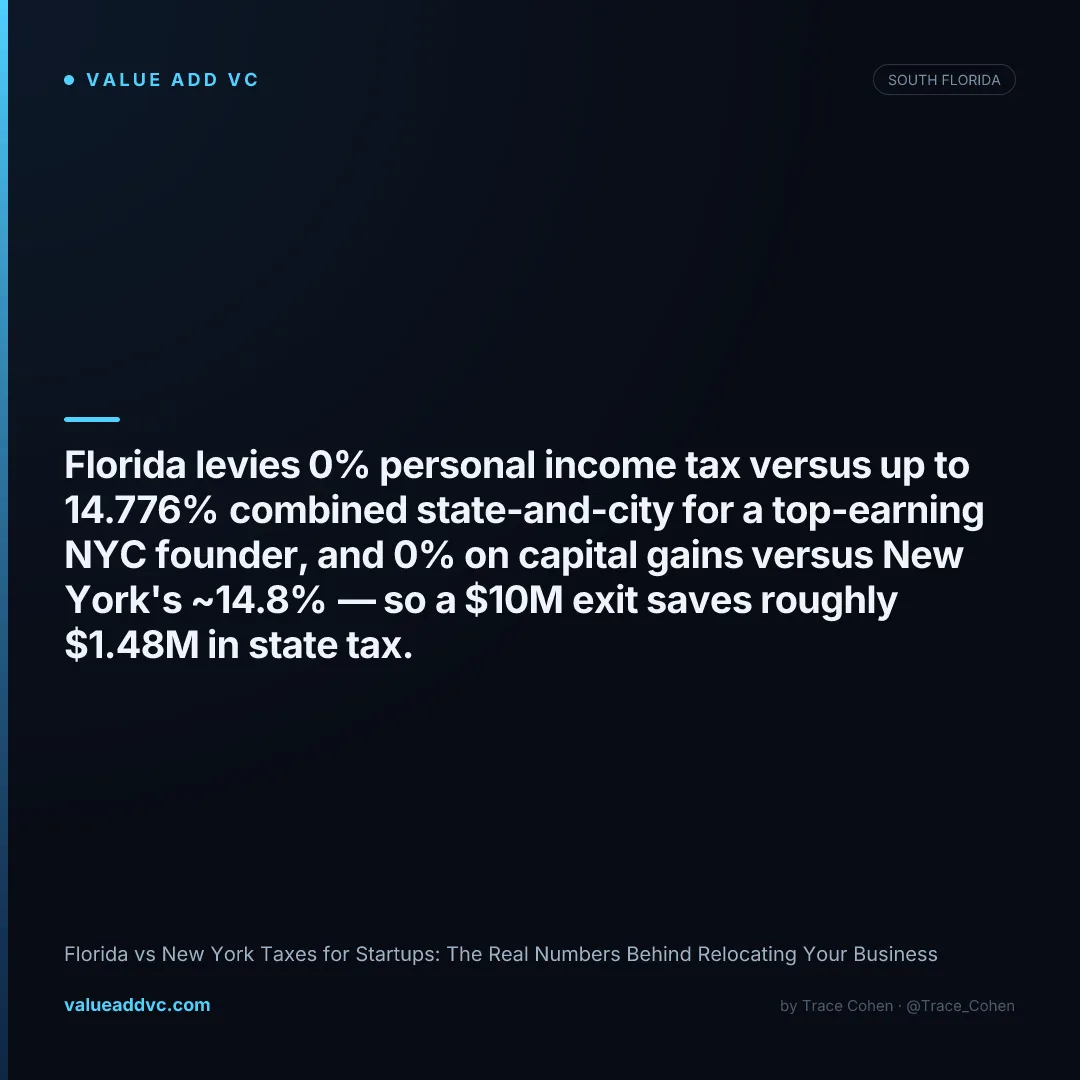
A startup founder who relocates from New York City to Florida keeps up to 14.776% more of every dollar of income — and pays $0 in state tax on a startup exit that would cost roughly $1.48 million in New York on a $10 million gain.
That's the short answer. The longer answer is more interesting — because Florida quietly charges a 5.5% corporate income tax that New York founders sometimes forget exists, New York is brutally aggressive about residency audits, and "moving" on paper while keeping your apartment and your life in Manhattan can leave you paying New York tax anyway. Here are the real numbers, line by line, and where the savings actually show up.
Florida vs New York Taxes for Startup Founders: The Direct Comparison
Florida imposes no personal income tax and no tax on capital gains, while New York taxes both as ordinary income at up to 10.9% statewide — rising to 14.776% for New York City residents. For a startup founder, that gap means a multimillion-dollar exit triggers six- or seven-figure state tax in New York and zero in Florida. The tradeoff sits on the corporate side, where Florida levies a 5.5% income tax that New York founders often overlook.
| Tax | Florida | New York (NYC resident) | Edge |
|---|---|---|---|
| Personal income tax (top) | 0% | Up to 14.776% (10.9% state + 3.876% city) | Florida |
| Long-term capital gains (state) | 0% | Up to 14.776% (taxed as ordinary income) | Florida |
| Corporate income / franchise tax | 5.5% flat (first $50k exempt) | 7.25% state + 8.85% NYC | Florida |
| Sales tax (typical combined) | ~7.0% | 8.875% (NYC) | Florida |
| Estate tax | None | Up to 16%, ~$7.16M exemption (cliff) | Florida |
| Property tax (effective rate) | ~0.80% | ~1.40% statewide | Florida |
| New-employer unemployment tax | 2.7% on first $7,000 | ~4.1% on first ~$12,800 | Florida |
Figures are 2026 estimates blended from the Florida Department of Revenue, the New York State Department of Taxation and Finance, the Tax Foundation, and NYC Department of Finance schedules. Personal-income figures show the top combined marginal rate for a New York City resident; Florida levies no personal income tax. Property-tax rates are state effective averages.
What Florida vs New York Taxes Mean for a Startup Exit
The single biggest number in this whole comparison is what happens at a liquidity event. New York taxes capital gains as ordinary income — there is no preferential long-term rate at the state level. So a New York City founder who sells equity for a $10M gain pays the full combined marginal rate of up to 14.776%, or about $1.48M, to the state and city on top of the federal bill. In Florida, that same gain costs $0 in state tax.
Scale that up and it gets serious fast. On a $50M founder exit, the New York State-and-city tax is roughly $7.4M; on a $100M exit, close to $14.8M. That's real, spendable money — the kind that funds your next company or your first fund. It's why so many founders quietly establish Florida residency in the 18–24 months before an anticipated sale, not the week of the closing.
One important nuance: federal QSBS (Section 1202) can wipe out federal tax on up to $10M (or 10x basis) of qualified gain in both states. New York conforms to the federal exclusion at the state level, so a New York founder with fully qualified QSBS may already owe little state tax on the first $10M — which narrows the gap on smaller exits but not on the gains above the QSBS cap. You can see how the New York rules work in detail on our NY QSBS tracker.
The Corporate Catch: Florida Is Not a Zero-Tax State for Companies
Here's the part that gets glossed over in the "Florida has no taxes" tweets: Florida does levy a 5.5% corporate income tax on C-corporations (with the first $50,000 of net income exempt). It just has no personal income tax. For most early-stage startups this is irrelevant — a pre-revenue or unprofitable C-corp owes little or nothing — but it matters once you're generating real taxable profit.
Even so, Florida still wins on the corporate line. New York charges a 7.25% franchise tax on businesses with income over $5M (6.5% below that), and a company operating in New York City stacks an additional 8.85% general corporation tax on top — pushing the combined effective corporate rate well into the mid-teens for a profitable NYC company. There's also an MTA surcharge of roughly 30% of the state tax in the metropolitan commuter district. Florida's flat 5.5% is simply cheaper at every level of profit.
The practical takeaway: where your company is incorporated (most startups choose Delaware regardless) is different from where it's taxed, which follows where you have employees, offices, and economic nexus. A Florida-headquartered startup with no New York operations escapes New York's corporate franchise and city taxes entirely.
Florida vs New York Taxes: The Residency Trap That Eats the Savings
New York is one of the most aggressive states in the country on residency audits, and the savings above only materialize if you genuinely change your domicile. Two tests matter. First, the 183-day rule: spend more than 183 days in New York while maintaining a "permanent place of abode" there, and you can be taxed as a statutory resident on your entire income — Florida residency or not. Second, the domicile test, which looks at where your home, family, business, and "near and dear" possessions actually are.
Founders lose these audits constantly by keeping a Manhattan apartment, a New York driver's license, doctors, and kids in New York schools while claiming Florida. To make the move stick, you need to relocate in substance: change your license and voter registration, buy or lease a Florida home, move your primary bank and advisors, spend the majority of your days in Florida, and document it. New York also taxes New York-source income regardless of residency — so a Florida founder still owes New York tax on a New York salary or a business physically operating in New York.
This is why the timing matters. Establishing clean Florida residency well before a liquidity event — ideally a full tax year or more — is the difference between a defensible $0 state-tax exit and a six-figure audit assessment plus penalties. We walk through the operational mechanics in moving your startup to South Florida.
Beyond Income Tax: The Costs That Move With You
Income tax is the headline, but the rest of the ledger reinforces the move. Estate tax is a quiet one: New York imposes an estate tax of up to 16% with a roughly $7.16M exemption — and a notorious "cliff" that taxes the entire estate, not just the excess, once you exceed about 105% of the exemption. Florida has no estate tax at all, which for a founder building real net worth can be worth far more than the annual income savings.
On day-to-day costs, Florida's sales tax runs about 7% combined versus NYC's 8.875%, effective property tax averages around 0.80% versus roughly 1.40% in New York, and the new-employer unemployment tax is 2.7% on the first $7,000 of wages versus New York's ~4.1% on a higher wage base. None of these individually rivals the income-tax gap, but together they compound — especially for a growing team where payroll-linked taxes scale with headcount.
The honest counterweight: New York City still concentrates capital, talent, and customers in a way South Florida is only beginning to match, and a lower tax bill is worthless if it costs you the next great hire or lead investor. We laid out that tradeoff candidly in cost of living in Boca Raton vs NYC, and you can gauge where the talent and funding actually sit on our unicorn tracker.
The Bottom Line
On personal income and capital gains, Florida wins decisively — 0% versus up to 14.776% — and a $10M exit alone saves roughly $1.48M in state tax. But the win is only real if you actually move.
Florida is not a no-tax paradise — its 5.5% corporate income tax and ~7% sales tax are real — but for founders the personal-income and capital-gains advantage is enormous, and the absence of an estate tax compounds it over a lifetime. The catch is execution: New York's residency auditors are relentless, the 183-day rule is unforgiving, and New York-source income follows you regardless. If I were a founder eyeing a liquidity event, I'd establish clean Florida residency a full tax year ahead, document everything, and treat the move as a real relocation — not a mailbox in Miami. Done right, the tax savings are among the highest-ROI decisions a founder can make.
Track founder-friendly tax rules, QSBS eligibility, and the South Florida startup ecosystem on the NY QSBS, Unicorns, and VC Performance dashboards at Value Add VC. This is general information, not tax advice — consult a CPA before relocating. Originally published in the Trace Cohen newsletter.
Latest from the Pulse
Get VC data most people never see
— 100% free
Weekly benchmarks, valuations, and fund data. Join 5,000+ investors. No spam.