The traditional VC fund structure — 10-year limited partnership, 2% management fee, 20% carry, $250K+ LP minimums — was designed in the 1970s. It works for a specific type of company, investor, and outcome. It was never meant to serve everyone.
Today's early-stage market looks nothing like the 1970s. Building a software company costs $50K, not $5M. AI tools let one founder do what five people did in 2018. And hundreds of thousands of founders need $250K–$5M — an amount that is too small for traditional fund economics to bother with, but too large to get from family and friends. Flexible VC models exist because the market demanded structures that traditional funds structurally cannot offer.
Why Traditional VC Leaves Gaps
The math of a traditional fund requires portfolio companies to reach $500M+ valuations at exit for the numbers to work. On a $50M fund targeting 10% ownership per company, a $500M exit returns $50M — just 1x the fund. You need multiple $1B+ outcomes to generate the 3x DPI that LPs expect.
Outcome size
Companies returning $20–$100M are great for founders but irrelevant to a $100M+ fund
LP access
Institutional $250K+ minimums exclude 99% of potential investors from participating
Capital velocity
Founders who need $200K today can't wait 12–18 months for a fund to close
Revenue-positive businesses
SaaS companies with $2M ARR that don't want dilution have no good equity option
These gaps are not being filled by traditional funds getting more creative — they're being filled by entirely different structures.
The Main Flexible VC Models
1. Rolling Funds
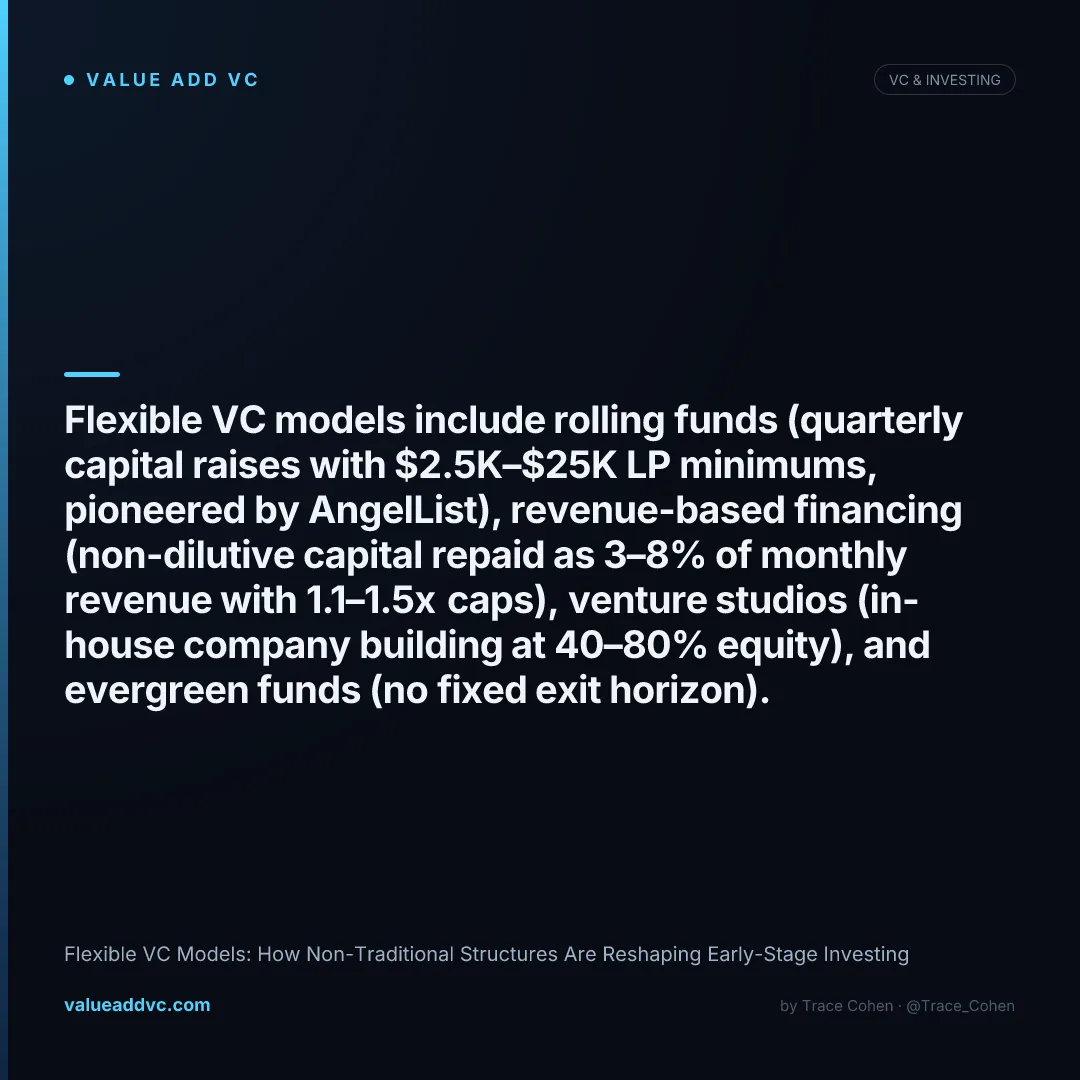
AngelList launched rolling funds in 2020 and fundamentally changed LP access. Instead of raising a fixed fund over 6–18 months, GPs raise quarterly — investors subscribe for $2.5K–$25K per quarter and can cancel with 30 days' notice. AngelList has facilitated over $500M through the model.
The upside for GPs: dramatically lower LP minimums, continuous capital deployment, and no dependence on a single fund close. The downside: you're constantly re-selling existing LPs while also finding new ones. Many rolling fund managers burn out maintaining quarterly momentum. The structure also creates complex pro-rata math when different LP cohorts hold different positions in the same companies.
2. Revenue-Based Financing (RBF)
RBF providers offer $50K–$5M in non-dilutive capital repaid as 3–8% of monthly revenue until the borrower has paid back 1.1–1.5x the original amount. Lighter Capital has deployed $400M+ using this model. Capchase, Pipe, and Clearco (formerly Clearbanc) operate similar vehicles.
This model works for SaaS companies with $500K–$10M ARR, 70%+ gross margins, and predictable monthly revenue. It is explicitly wrong for pre-revenue companies, hardware businesses, biotech, and any model where cash doesn't flow monthly. The 2022–2023 period exposed the structural risk: when growth slowed, revenue-linked repayments stretched into extended periods and several portfolio companies struggled with the ongoing drag.
3. Venture Studios
Studios like Atomic, Human Capital, eFounders (now Hexa), and Pioneer Square Labs build companies in-house: they generate the idea, test it, recruit a CEO, and own 40–80% of the resulting company at launch. There are roughly 600+ studios globally as of 2026, up from about 100 in 2017 according to the Global Accelerator Network.
The economic thesis: if you own 60% of 10 companies instead of 15% of 10 companies, you need much smaller exits to return the same capital. But studios require the GP to be an operator, not just an investor. The average studio has 8–15 staff. That changes the fund management skill set entirely — and explains why most studios outside the top tier underperform.
4. Evergreen / Permanent Capital Funds
Traditional VC funds have a hard 10-year end date, forcing GPs to exit even great companies prematurely. Evergreen funds have no fixed end date — profits recycle back into new investments, compounding over decades. Berkshire Hathaway is the extreme version of this model applied to public equities; several early-stage funds are replicating the structure.
The challenge: LPs in evergreen funds sacrifice liquidity for long-term compounding. Most institutional LPs have their own distribution commitments and can't hold illiquid assets indefinitely. Evergreen models work better with family offices and high-net-worth individuals who have longer time horizons than pension funds or endowments.
5. Operator Syndicates and SPVs
SPVs (special purpose vehicles) and deal-by-deal syndicates allow GPs to raise capital one investment at a time, sharing deal access with LPs who can choose which deals to participate in. AngelList, Assure, and Sydecar have made SPV formation a commodity — typical fees are $8K–$25K for a $1M–$10M SPV.
The syndicate model has democratized early-stage investing more than any other innovation in the last decade. Operators with strong networks but no institutional LP relationships can build a following of 50–200 LPs and deploy $500K–$5M per deal on carry alone. Track the economics on the VC Performance dashboard to understand how syndicate returns compare to fund returns.
What the Performance Data Actually Shows
| Model | Typical Return Target | Liquidity | Best For |
|---|---|---|---|
| Traditional Fund | 3x DPI / 20%+ IRR | None (10 years) | Institutional LPs, unicorn-trajectory companies |
| Rolling Fund | Similar to traditional | Quarterly opt-out | Individual/HNW LPs, operators with deal flow |
| Revenue-Based Financing | 1.3–1.7x capital | Revenue-linked | SaaS with $500K+ ARR, 70%+ margins |
| Venture Studio | 5–10x on concentrated bets | None (10+ years) | Operator GPs, serial company builders |
| Evergreen Fund | Long-term compounding | Very low | Family offices, patient capital LPs |
| SPV / Syndicate | Deal-specific | None per deal | Operators with one-off deal access |
Rolling fund IRR data is limited due to the model's 2020 vintage. RBF performance degraded sharply in 2022–2023 as growth decelerated across SaaS portfolios.
Which Flexible Model Is Right for You?
If You're a Founder
- ✓ $500K+ ARR, don't want dilution → Revenue-based financing
- ✓ Pre-revenue, want speed → Rolling fund or SPV syndicate
- ✓ Want heavy operator involvement → Venture studio
- ✓ Long-term capital partner → Evergreen fund
If You're an Emerging Manager
- ✓ Strong operator network, no institutional LP access → Rolling fund
- ✓ One great deal per year → Build an SPV syndicate
- ✓ Want to build companies, not just invest → Venture studio
- ✓ Have institutional LP interest → Traditional fund (better economics)
Flexible VC models are not better or worse than traditional funds.
They are optimized for different founders, LPs, and outcomes — and choosing the wrong structure costs everyone.
Track how different fund structures perform on the VC Performance dashboard. For SPV economics and modeling, see the SPV Calculator at Value Add VC. Originally published in the Trace Cohen newsletter.
Latest from the Pulse
Get VC data most people never see
— free to subscribe
Trace's notes on venture, AI and startups, a few times a week. Join 5,000+ subscribers. No spam.
No spam, unsubscribe anytime. Sent via Substack · Privacy · or subscribe on Substack ↗