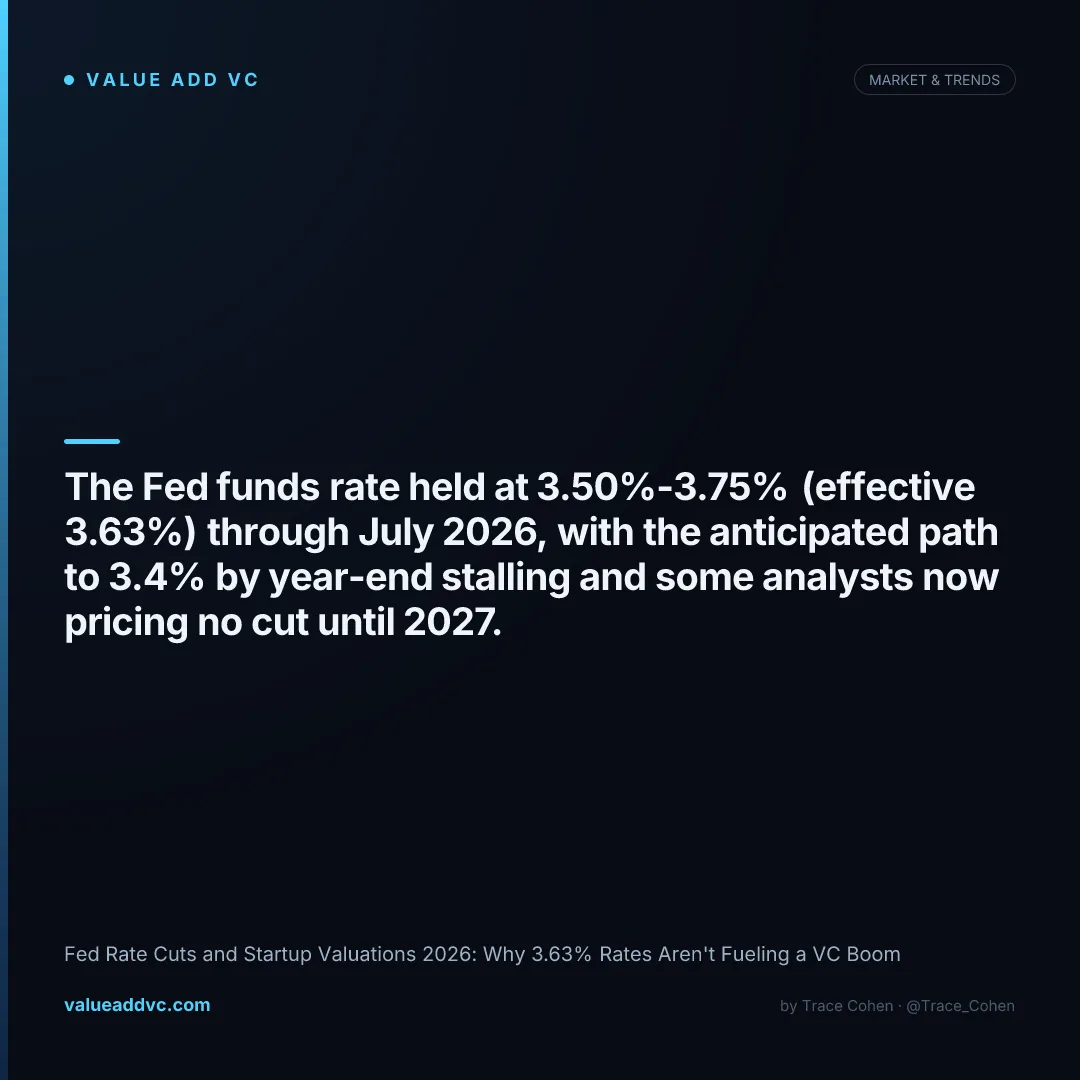
The Fed funds rate sits at 3.50%-3.75% in July 2026, and the cuts VCs were counting on to fuel a funding rebound have largely stalled. Seed valuations still rose 14% year over year anyway.
Every VC LP memo written in late 2025 assumed the same macro tailwind: the Fed would keep cutting, discount rates would fall, and startup valuations would get a lift the way they did in 2020-2021. That hasn't played out on schedule. We track how this macro backdrop feeds into pricing on our SaaS valuations dashboard, and the July 2026 data tells a more complicated story than "rates fall, valuations rise."
Figures are July 2026 data blended from Federal Reserve H.15 releases, FRED (DGS10), and the Q1 2026 PitchBook-NVCA Venture Monitor. Seed and Series A valuation figures reflect Q3 2025 primary round data, the most recent full-cycle figures available.
How Fed Rate Cuts Affect Startup Valuations in 2026
Fed rate cuts affect startup valuations by lowering the discount rate applied to a company's projected future cash flows, which mechanically raises the present value of that company today — the same math that drove valuations up when rates fell near zero in 2020-2021. In 2026, that mechanism is muted: the Fed funds rate has held at 3.50%-3.75% instead of falling toward the 3.4% year-end target some forecasters expected, so the rate-driven valuation tailwind hasn't materialized the way the 2025 playbooks assumed.
Instead, valuations rose anyway — just not because of rates. Median seed valuations hit $16 million in Q3 2025, up 14% year over year, and Series A valuations rose 19% over the same span, driven almost entirely by AI-focused rounds. That's the key disconnect: the rate environment stayed restrictive, but a narrow set of AI companies commanded such large premiums that they pulled the aggregate valuation numbers up regardless of what the Fed did.
Why the Fed Rate Cut Tailwind for Startup Valuations Hasn't Arrived
Three things are keeping the expected rate-cut tailwind from showing up broadly across private markets. First, the Fed itself hasn't delivered the cuts that were priced in — the July 29, 2026 FOMC meeting carries a 25-30% market-implied probability of a hike, not a cut, and some forecasters now don't expect meaningful easing until 2027. Second, the 10-year Treasury yield sits around 4.56%, keeping a genuinely competitive risk-free return available to the same LPs who fund venture capital, which is part of why overall VC fundraising growth is expected to slow in 2026 even as headline deal value hits records.
| Metric | 2021 Cycle | July 2026 | Direction |
|---|---|---|---|
| Fed funds rate | 0.00%-0.25% | 3.50%-3.75% | Still restrictive |
| 10-year Treasury yield | ~1.5% | ~4.56% | Still elevated |
| Median seed valuation | $8.5M (approx.) | $16M | +14% YoY, rising |
| Median Series A valuation | Record highs | +19% YoY | Rising, AI-driven |
| Quarterly VC deal value | $96B (Q4 2021 peak) | $267.2B (Q1 2026) | Above 2021 peak |
| Deal value ex-top-5 deals | Broad-based | -73.2% if excluded | Highly concentrated |
| AI share of VC deal value | Minor category | ~86% of H1 2026 total | Dominant |
Figures are 2026 estimates blended from Federal Reserve H.15 releases, FRED (DGS10), Carta primary round data, and the Q1 2026 PitchBook-NVCA Venture Monitor. 2021 seed valuation figure is a directional estimate from Carta's historical seed benchmarks.
The Real Driver: AI Concentration, Not Rate Policy
The 2026 data makes the concentration point unmissable. US venture funding hit $412.7 billion in H1 2026, with AI capturing roughly 86% of that total. Q1 2026 alone saw $267.2 billion in deal value — the second-highest quarter on record behind only 2021 — but more than half of the quarter's megadeals were AI companies, and excluding just the five largest deals and exits of the quarter, total deal value falls 73.2% and exit value falls 86.6%.
That's a market being priced almost entirely by a handful of AI outliers, not by a broad-based response to interest rate policy. Q1 2026 AI venture funding alone reached $255.5 billion, already surpassing the full-year 2025 AI total of $254.4 billion in a single quarter. Fund managers benchmarking this cycle against 2021 should note the difference: 2021's boom was rate-driven and broad; 2026's is AI-driven and narrow, which is a materially different risk profile for anyone reading headline deal-value numbers as a market-wide signal.
What Founders and LPs Should Actually Do With This Data
For founders outside the AI category, the rate environment matters more than the aggregate deal-value headlines suggest. With the Fed funds rate stuck at 3.50%-3.75% and the 10-year Treasury near 4.56%, investors still have a real risk-free alternative, and non-AI rounds are getting priced with that discount rate in mind — not against 2021-style near-zero rates. Founders raising outside AI should benchmark against sector-specific comps, not the AI-skewed aggregate seed and Series A medians, since a $16M seed median is being pulled up by a subset of the market that isn't representative of a typical B2B SaaS or vertical software raise.
For LPs, the practical read is that 2026 fund performance benchmarking needs an AI-exposure adjustment. A fund's paper markups this year are far more explained by AI portfolio concentration than by the macro rate environment, and we track how that shows up in actual fund return data on our VC performance dashboard. Treat any 2026 vintage-year IRR or TVPI figure as partly a bet on AI concentration risk, not a clean read on manager skill, until rate cuts actually resume and broaden the picture beyond a handful of mega-rounds.
There's also a duration mismatch worth flagging for anyone underwriting a new fund commitment this year. A 10-year fund life assumes some number of rate cycles will play out over its holding period, and a GP pitching a 2026 vintage on the assumption that today's 3.50%-3.75% rate is a temporary plateau before renewed easing is making a directional bet, not stating a fact. If the Fed genuinely holds through 2027, as some forecasters now expect, LPs should model exit multiples on a higher discount-rate baseline than the 2020-2021 comps most pitch decks still lean on.
How This Fed Cycle Compares to Past Rate-Cut Cycles for Startups
The Fed cut rates from 5.33% in 2023 down to roughly 3.90% by the end of 2025, and that easing cycle is exactly what LPs were pricing in when they wrote 2025 and 2026 fund models. What actually happened in the first seven months of 2026 was a pause, not a continuation: the effective rate has sat at 3.63% since the spring, four consecutive FOMC meetings without a change, and the July 29, 2026 meeting is now priced with a 25-30% chance of a hike rather than the cut the earlier dot plot implied. Compare that to 2019, the last "mid-cycle adjustment" era, when the Fed cut three times in five months and venture deal value barely moved — the correlation between Fed policy and startup valuations has always been weaker than the popular narrative suggests, and 2026 is reinforcing that.
The one place the rate environment does bite is on fund economics, not portfolio-company valuations. A GP holding LP capital in a fund with a 3.50%-3.75% risk-free alternative faces a much higher bar to justify illiquid venture returns than a GP operating in a near-zero-rate world. That's part of why fundraising, as distinct from deployment, is still soft: $47.8 billion was raised across 172 new VC funds in Q1 2026, which annualizes below the $66.7 billion raised across all of 2025. Deployment is at records: fundraising is not. That split — hot on the deal side, cold on the fund-formation side — is the clearest fingerprint of a market being driven by a handful of AI outcomes rather than a genuine macro tailwind.
Bottom line: The Fed funds rate has held at 3.50%-3.75% through July 2026, well above the near-zero rates that fueled 2021's valuation boom, and the cuts that were supposed to arrive this year have largely stalled. Startup valuations rose anyway — seed up 14% YoY to a $16M median, Series A up 19% — but that's an AI concentration story, not a rate-policy story: Q1 2026's $267.2 billion in deal value falls 73.2% once you strip out the five largest deals. Anyone modeling 2026 private-market pricing off the old "rate cuts lift valuations" playbook is using the wrong variable. The variable that actually matters this cycle is how much AI exposure a fund or company has, not what the Fed does next.
Latest from the Pulse
Get VC data most people never see
— free to subscribe
Trace's notes on venture, AI and startups, a few times a week. Join 5,000+ subscribers. No spam.