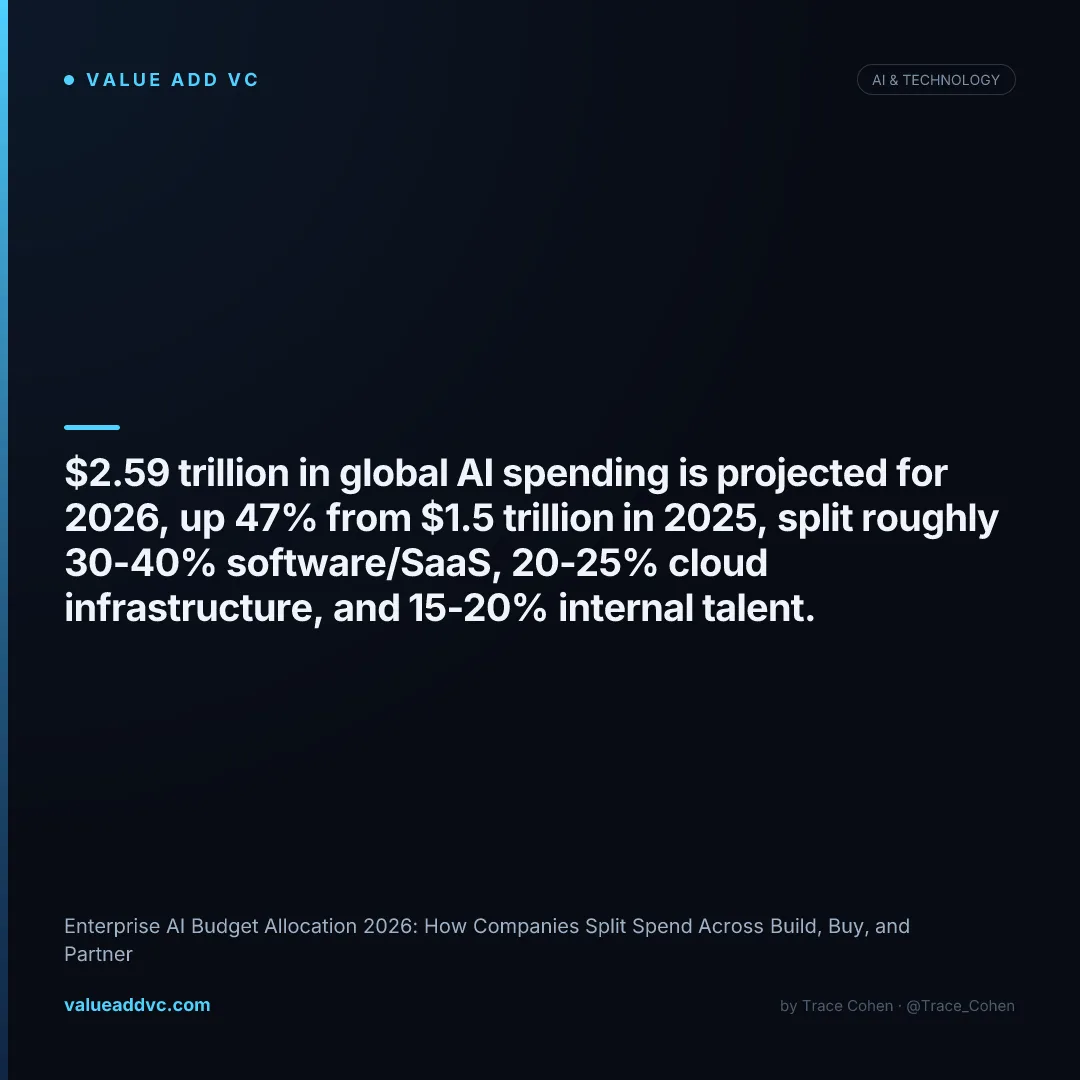
$2.59 trillion in AI spending is projected worldwide for 2026, up 47% from $1.5 trillion in 2025, according to Gartner. Follow the allocation, though: most of that money is now going to vendors rather than internal build teams — vendor-led or partnered AI projects succeed roughly 67% of the time, versus about 33% for pure in-house builds.
AI spending stopped being an experimental line item sometime in the past 18 months. Enterprise leaders surveyed by a16z now expect their LLM budgets to grow roughly 75% over the next year, and the share of that budget earmarked for pure innovation experiments has fallen from 25% to just 7% — the rest has moved into core operating expense. We track how this capital flows into company valuations on our AI valuations dashboard, and this post breaks down exactly how enterprise AI budgets are being allocated across build, buy, and partner in 2026.
Figures blended from Gartner AI spending forecasts, a16z's 2026 enterprise CIO survey, S&P Global AI initiative tracking, and Ramp transaction data, as of July 2026.
How Enterprise AI Budgets Are Being Allocated in 2026
Enterprise AI budgets in 2026 are allocated roughly 35% to software and SaaS AI tools, 22% to cloud infrastructure, 17% to internal AI talent, and the remainder split across implementation, data platforms, and governance — with buy-first strategies now dominating over from-scratch builds for anything outside a company's core differentiator.
That split reflects a real shift from 2024, when a much larger share of AI spend sat in experimental pilot budgets with no clear owner. In 2026, 86% of IT decision-makers report they're already deploying copilots, agentic AI, or fully autonomous systems in production — meaning most of this money is now funding live systems, not proofs of concept. Total worldwide IT spending is forecast to exceed $6 trillion in 2026, growing 9.8%, which means AI's 47% growth rate is running roughly five times faster than IT spending overall.
Build vs. Buy vs. Partner: What the Success Rates Actually Show
The build-vs-buy debate has a clear empirical answer in 2026: partnering or buying wins on success rate by roughly two to one. Vendor-led and co-build partnerships succeed approximately 67% of the time, while pure internal builds succeed only about 33% of the time — a gap driven mostly by talent scarcity, MLOps complexity, and the pace at which foundation models improve out from under a custom-trained system.
| Attribute | Build (In-House) | Buy (Vendor Platform) | Partner (Co-Build) |
|---|---|---|---|
| Reported success rate | ~33% | ~67% | ~67% |
| Upfront cost | $300K–$1.5M+ | $50K–$500K/yr license | $150K–$800K |
| Ongoing annual cost | 20–30% of build cost | Predictable subscription | Shared with vendor |
| Time to first production use | 6–18 months | 4–12 weeks | 8–20 weeks |
| Control over IP / data | Full | Limited | Negotiated |
| Talent required | Dedicated ML/MLOps team | Minimal | Moderate |
| Best for | Core competitive moat | Commodity workflows | Differentiated but non-core |
Figures are 2026 estimates blended from Octopus Builds, TechAhead, and Keyhole Software build-vs-buy cost research, plus S&P Global project success-rate tracking. Cost ranges reflect mid-market to large-enterprise deployments.
AI Project Success Rate: Build vs. Buy/Partner
Aggregated enterprise AI deployment studies, 2026
Why 42% of Companies Scrapped Their AI Initiatives in 2025
S&P Global's research found that 42% of companies scrapped the majority of their AI initiatives in 2025, up sharply from just 17% the year before — a jump that budget-allocation data helps explain. Companies that funded pilots heavily but under-invested in the data, governance, and change-management layers saw those pilots stall out before reaching production. The BCG 10/20/70 rule — 10% of budget on algorithms, 20% on technology and data, 70% on people and process — is now the most-cited framework precisely because it corrects for that failure pattern.
The economics reinforce the point. A custom enterprise AI platform typically costs $300,000 to $1.5 million or more upfront, plus another 20-30% of that figure every year for compute, model updates, and monitoring. Smaller, task-specific custom builds run $75,000 to $120,000 for mid-complexity work. When a team underestimates that ongoing 20-30% tax — treating AI as a one-time capex project rather than a recurring opex commitment — the project gets flagged for cancellation the moment budgets tighten.
The Hybrid Model Is Winning the Enterprise AI Budget Allocation Debate
The dominant 2026 pattern isn't build or buy — it's both, applied selectively. Enterprises buy the foundation model and core infrastructure, then build proprietary data layers and task-specific agents on top of that base for differentiation. The rule of thumb circulating among enterprise architects: let a vendor platform get you 70-80% of the way there, then invest custom engineering only in the remaining 20-30% that's actually tied to a competitive advantage — pricing engines, underwriting logic, or proprietary customer data.
This shows up directly in the budget numbers: 30-40% of AI spend goes to software and SaaS tools (the "buy" layer), while 15-20% goes to internal AI talent (the "build" layer), with implementation and consulting spend — often the "partner" layer — sitting at 10-15%. We break down how this spending flows into the balance sheets of the AI companies capturing it on our big tech earnings tracker, since enterprise AI budgets are the demand side of every hyperscaler and AI vendor's revenue growth story.
What This Means for Startups Selling Into Enterprise AI Budgets
For founders selling AI products into the enterprise, the budget-allocation data is a roadmap. The 67% vs 33% success-rate gap between vendor-led and in-house projects is the single strongest argument a sales team can make against a prospect's internal build option — cite it directly. The median AI-spending business already puts about 15% of its software budget toward AI tools per Ramp's transaction data, and that share is rising as innovation-bucket spending (down from 25% to 7% of LLM budgets) converts into permanent line items.
The clearest opportunity sits in the 8-12% of budget going to governance and security and the 8-12% going to data platforms — both categories that grew as a share of spend once AI moved from pilot to production, and both still underserved relative to the software/SaaS layer that captures 30-40% of the total. Startups building compliance tooling, data pipeline infrastructure, or MLOps observability are selling into a budget line that's growing faster than the AI software category itself, even if it's smaller in absolute dollars today.
The other practical takeaway is on deal structure, not just category. Because implementation and consulting spend sits at 10-15% of budget and time-to-first-production-use runs 4-12 weeks for a bought platform versus 6-18 months for a build, startups that can compress that onboarding window with pre-built integrations, templated agents, or fixed-fee implementation packages are pricing directly against the metric enterprise buyers now weigh most heavily: how fast the tool reaches production, not just its list price.
Which Vendors Are Capturing the "Buy" Share of AI Budgets
Most of the 30-40% of budget that goes to software and SaaS AI tools is concentrated in a small number of platforms. Microsoft, through Azure OpenAI Service and Copilot licensing, and Salesforce, ServiceNow, and SAP through embedded AI add-ons, are absorbing a large share of the "buy" layer because they already sit inside the procurement relationships enterprises use for everything else. That's a structural advantage over point-solution AI startups, who typically have to win a net-new budget line rather than an upsell to an existing contract — one reason enterprise sales cycles for standalone AI tools still run 4-12 weeks even in a market growing 47% year over year.
Cloud infrastructure spend, the 20-25% of budget behind software in size, splits mostly across AWS, Azure, and Google Cloud, with a growing minority going directly to model labs — OpenAI, Anthropic, and xAI — for API consumption billed outside the traditional cloud contract. That direct-to-lab spending line barely existed in enterprise budgets two years ago and is now big enough that CFOs track it as its own category rather than folding it into general cloud spend, which is part of why governance and security jumped to 8-12% of budget: finance and security teams needed a dedicated line to track and cap a fast-growing, usage-billed expense they hadn't budgeted for before.
Bottom line: Enterprise AI budgets crossed $2.59 trillion globally in 2026, up 47% from $1.5 trillion in 2025, and the money increasingly flows toward buying and partnering rather than building from scratch — vendor-led projects succeed roughly twice as often (67% vs 33%) as pure in-house builds, and 42% of companies scrapped most of their 2025 AI initiatives when that math didn't work out. The winning pattern for 2026 is hybrid: buy the foundation layer, build only what's genuinely proprietary, and budget for the 70% people-and-process cost that BCG's framework says most companies still underfund. For investors, that split is also the clearest signal of where enterprise AI dollars are actually landing — and it's not evenly, or where the hype suggests.
Latest from the Pulse
Get VC data most people never see
— free to subscribe
Trace's notes on venture, AI and startups, a few times a week. Join 5,000+ subscribers. No spam.