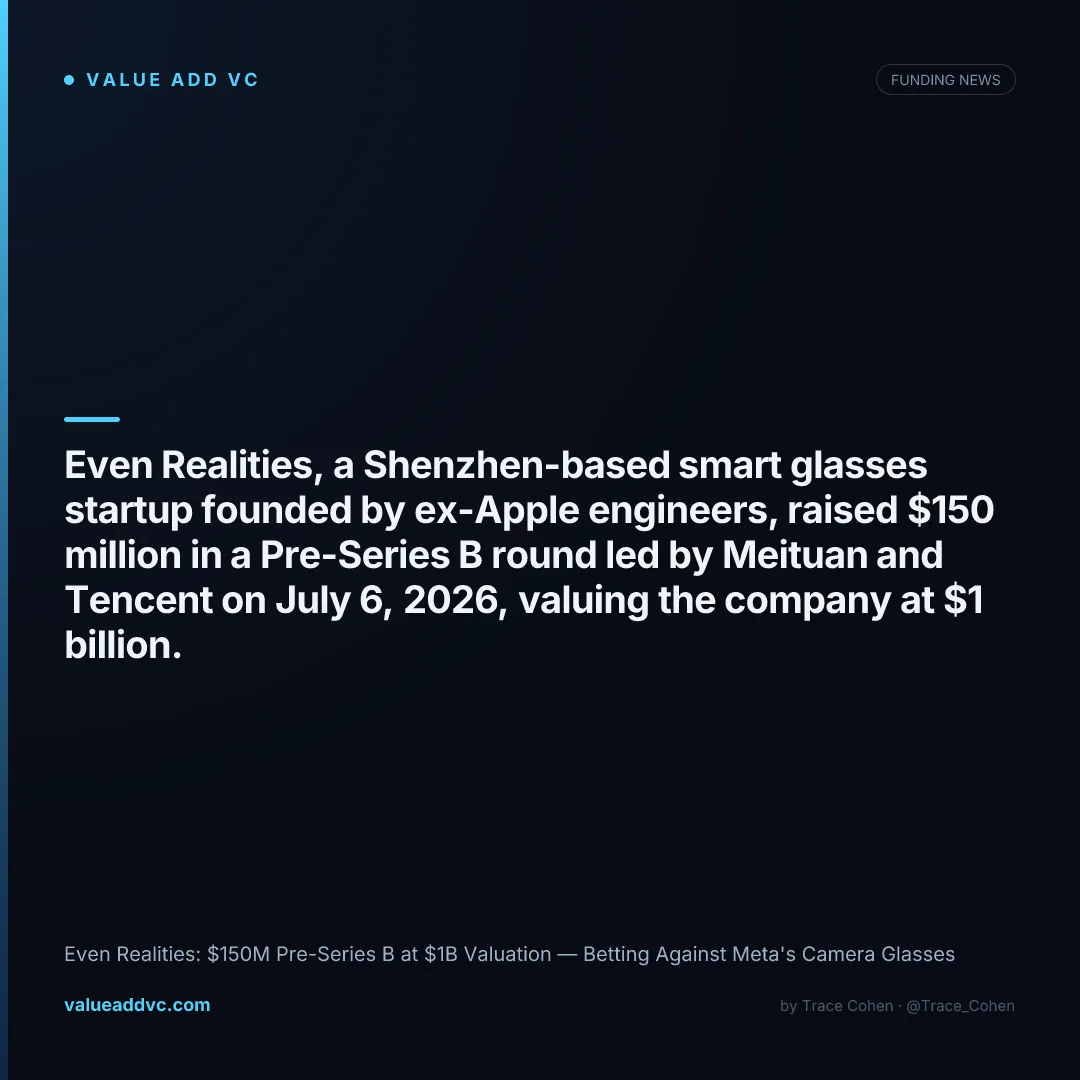
Even Realities raised $150 million at a $1 billion valuation led by Meituan and Tencent. That's the short answer. The longer answer is more interesting.
A three-year-old startup founded by an ex-Apple engineer just became a unicorn by building the one thing every other AI glasses company is racing to add: a pair of glasses with no camera at all. While Meta pours billions into Ray-Ban devices built for photo and video capture, Even Realities is betting that the winning smart glasses category isn't about capturing the world — it's about not being watched while you use it.
Figures from TechCrunch, CNBC, and SiliconANGLE reporting on the July 6, 2026 funding announcement.
Even Realities $150 Million Funding Round: Terms and Lead Investors
Even Realities announced a $150 million Pre-Series B on July 6, 2026, led by Meituan with participation from existing investor Tencent, valuing the Shenzhen-based smart glasses maker at $1 billion. The round makes Even Realities one of the newest unicorns in a wave of nearly 90 companies to cross the $1 billion mark in 2026, and one of the few backed by both of China's largest consumer-tech conglomerates in the same round.
Why a Startup With No Camera Just Beat Meta at Its Own Valuation Game
Every major smart glasses launch since 2023 — Meta's Ray-Ban Meta, the Ray-Ban Display, dozens of Chinese fast-followers — has centered on the same feature: a camera. Capture the moment, ask the AI what you're looking at, post it later. It's a compelling demo. It's also the exact reason a huge share of people won't wear the things indoors, at work, or around anyone who values not being secretly filmed.
Even Realities' flagship G2 glasses skip the camera entirely. No recording hardware, period. Instead, a micro-display embedded directly in the lens beams notifications, turn-by-turn navigation, and live translation straight into the wearer's field of view — a heads-up display model closer to a fighter-jet visor than a body camera. Founder and CEO Will Wang, who spent years on the Apple Watch and iPhone teams before starting the company in 2023, has been explicit that this isn't a limitation the company plans to fix. It's the entire pitch.
That bet just got validated with real capital. Meituan, which runs one of the largest consumer platforms in China, and Tencent, a repeat backer, didn't fund a scrappy alternative to Meta — they funded a company explicitly positioned against the category leader's core design decision.
Even Realities G2 vs. Meta Ray-Ban Display: Core Design Bet
Company disclosures via TechCrunch and CNBC, July 2026
The U.S. Market Is Where This Fight Actually Happens
Even Realities is headquartered in Shenzhen and backed by two Chinese conglomerates, but its user base tells a different story: more than half of Even's customers, and roughly 80% of its developer ecosystem, are in the United States. That's not a company quietly serving a domestic market — it's a direct challenger sitting in Meta's backyard, competing for the same wrists, faces, and app-developer attention that Meta has spent billions trying to lock up with Ray-Ban.
It also means the round is a signal about where large platform companies think the next hardware interface is heading. Meituan doesn't typically write $150 million pre-Series B checks into hardware plays outside its core delivery-and-local-services business unless it sees a path to owning distribution in a category before it matures. Backing the camera-free contrarian, rather than a Ray-Ban clone, is a bet that the winning design language in smart glasses hasn't been settled yet — and that privacy concerns, not battery life or price, could be the actual bottleneck holding back mainstream adoption.
Early-stage valuation figures are directional estimates based on typical seed-to-unicorn trajectories; only the 2026 $1B figure is confirmed by the company. Sources: TechCrunch, CNBC, July 2026.
What This Means for Founders Building Hardware Right Now
The lesson here isn't “remove features to win.” It's that in a category where the dominant player has defined the default design, the fastest way to a differentiated valuation is often to take the opposite position on the feature everyone assumes is mandatory — provided you can prove real usage, not just a thesis.
Category-defining incumbents create room for contrarian bets
Meta has effectively standardized the camera-first smart glasses format. Even Realities didn't try to out-Meta Meta — it staked out the opposite end of the design spectrum and found a real, underserved audience there.
Strategic investors bet on distribution, not just product
Meituan and Tencent aren't generic VCs. Their participation signals a bet on owning a platform relationship in a hardware category before the winner is obvious, similar to how strategic rounds increasingly replace pure financial Series A capital.
Unit sales, not just funding, drove this round
Even Realities became the first company in its category to sell over 10,000 pairs before this raise — real revenue and adoption data, not just a pitch deck, is what got two of China's largest platforms to write checks.
Privacy as a feature is a genuine wedge, not just marketing
As camera-equipped wearables proliferate, businesses, schools, and public venues increasingly restrict them. A no-camera design isn't a compromise in those environments — it's the only smart glasses format that gets let in the door.
The Bigger Pattern: 2026's Unicorn Wave Isn't Just Software
Even Realities lands alongside nearly 90 companies that crossed the $1 billion mark in 2026, a wave dominated by AI software but increasingly spilling into physical hardware categories — robotics, wearables, and industrial AI. That's consistent with a broader trend we've tracked: capital is chasing differentiated product bets faster than ever, and traditional fundraising sequencing is bending to accommodate companies that can show real usage numbers ahead of a priced round.
For a fuller picture of how 2026's funding environment compares to prior years, see our State of VC Funding 2026 breakdown, and for founders mapping out their own raise, our Pre-Seed vs Seed vs Series A guide covers what typically triggers each stage.
Bottom line: Even Realities turned the absence of a camera into a $1 billion valuation, proving that in a category Meta effectively defined, the biggest opportunity may be the design choice everyone else assumed was non-negotiable. Track more live funding data on our Funding Dashboard, and explore more market analysis at Value Add VC.
Latest from the Pulse
Get VC data most people never see
— free to subscribe
Trace's notes on venture, AI and startups, a few times a week. Join 5,000+ subscribers. No spam.