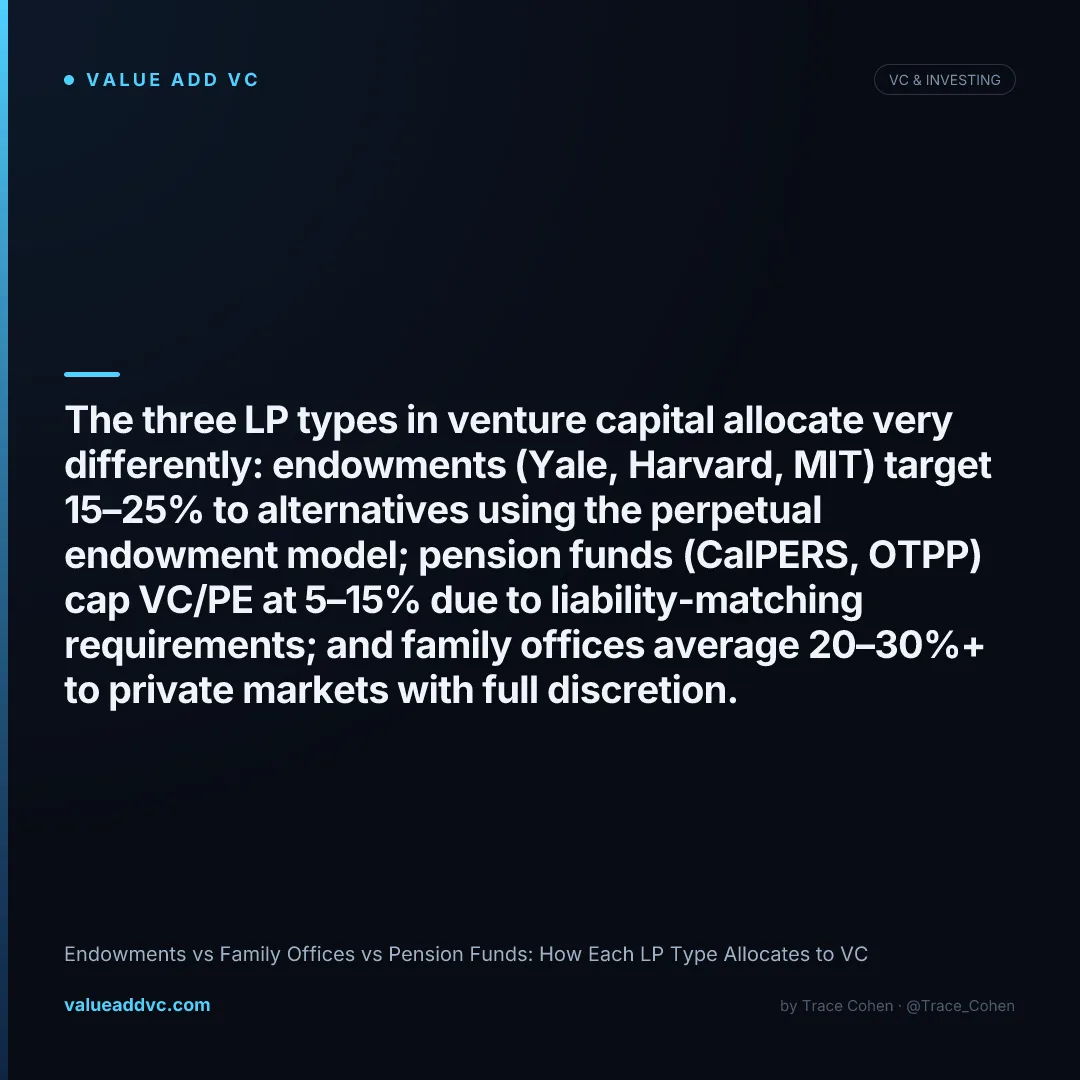
When you're raising a VC fund, not all capital is equal — and not all LP types are compatible with your strategy.
Endowments, pension funds, and family offices each bring different capital, different expectations, and different processes to the table. Treating them the same in your LP outreach is one of the most common mistakes emerging managers make. The check sizes differ by an order of magnitude. The due diligence timelines differ by 6–18 months. And what they need to see in a fund manager is fundamentally different. Here's how to actually think about LP types in venture capital.
LP Types at a Glance: The Key Differences
| LP Type | Typical AUM | VC/PE Allocation | Typical Check Size | Lock-Up Tolerance |
|---|---|---|---|---|
| University Endowment (large) | $1B–$50B+ | 15–25% | $10M–$100M+ | High (perpetual) |
| Foundation Endowment | $500M–$5B | 10–20% | $5M–$25M | High (perpetual) |
| Public Pension Fund | $10B–$500B+ | 5–15% | $50M–$500M+ | Moderate (cash flow matching) |
| Corporate Pension Fund | $1B–$50B | 3–10% | $10M–$100M | Low–Moderate |
| Single-Family Office | $100M–$5B | 20–40%+ | $1M–$20M | High (perpetual) |
| Multi-Family Office | $500M–$10B | 15–25% | $5M–$50M | Moderate–High |
Endowments: The Yale Model and the Most VC-Friendly Capital
University endowments pioneered aggressive VC allocation. David Swensen's Yale Endowment Model — which shifted from 60/40 stock/bond portfolios to heavy alternatives exposure — became the template for every major endowment over the past 30 years.
Yale Endowment VC Target
~23.5%
FY2023 target allocation to venture capital
Harvard Endowment Alternatives
~39%
Private equity + VC + real assets combined
MIT Endowment Returns (10yr)
~15.3%
Driven heavily by VC/PE outperformance
Avg Endowment >$1B VC Alloc
11–17%
Cambridge Associates universe, 2023 data
What makes endowments ideal VC LPs: they have perpetual time horizons (no payout obligations to a defined group of beneficiaries), high illiquidity tolerance, and deep relationships with top-tier managers built over decades. The challenge for emerging managers is that the largest endowments are locked into established fund relationships and rarely make first-time commitments above $5–10M.
Smaller endowments ($100M–$500M) are often more accessible and can serve as anchor LPs for a first-time fund. They're constrained by their own staff capacity — most run lean investment teams — but they're incentivized to find emerging managers before they're oversubscribed.
Pension Funds: Scale With Strings Attached
Pension funds are the largest pool of institutional capital in the world — the US alone has roughly $35T in pension assets — but they're also the most constrained when it comes to VC. Their mandate is liability matching: they must generate enough return to pay defined benefit obligations to retirees on a known schedule. That creates structural friction with 10-year lockup fund structures.
CalPERS
Largest US public pension; recently recommitted to PE after 2009 exit
~13%
~$500B
Ontario Teachers (OTPP)
Runs direct PE and infrastructure alongside VC fund commitments
~28% alternatives
~$243B (CAD)
CPP Investments
One of the most sophisticated in-house PE programs globally
~33% private equity + real assets
~$590B (CAD)
CalSTRS
Private equity target includes VC, growth, buyout
~13%
~$340B
The "denominator effect" hit pensions hard in 2022–2023: when public equity portfolios fell 20–30%, the private market allocation (which marks to model quarterly, not daily) suddenly appeared over-weight relative to policy targets. Many pensions were technically over their PE allocation limit even without deploying new capital, which paused commitments to new funds.
For fund managers: pension funds are generally not realistic LP targets for funds under $150–200M. They require institutional-grade operations, ESG reporting, ILPA-aligned terms, and extensive legal/compliance diligence. The upside is check sizes of $25M–$500M+ and stable, multi-fund relationships once you earn one.
See the VC/PE Performance dashboard for how pension fund-backed managers have performed vs. benchmarks.
Family Offices: The Most Flexible LP Type in VC
Family offices are the fastest-growing LP category in venture capital. There are an estimated 10,000+ single-family offices globally with $6T+ in combined AUM (Campden Research, 2024), and they're allocating more aggressively to private markets than ever before.
Avg Family Office PE Allocation
22%
J.P. Morgan Global Family Office Report 2024
Family Offices Investing in VC
~65%
Share doing direct/fund VC investments
Avg Direct Deal Allocation
~14%
Bypassing funds for co-invest & direct
What distinguishes family offices from endowments and pensions is discretion. A single-family office principal can write a $5M check in 2 weeks. They don't have investment committees with 90-day calendars, ILPA reporting requirements, or ESG compliance teams. The decision is often personal — they're backing you as much as the fund.
The tradeoff: family offices can also pull back fast. When a patriarch retires, when a family business is sold, when there's a generation transition — the investment strategy can flip overnight. They're the LP type most likely to ask for co-investment rights, and increasingly they want to learn the VC craft themselves, which means the relationship is more bidirectional than transactional.
What Family Offices Want From VC Fund Managers
- ✓ Co-investment rights on your best deals (non-negotiable for many)
- ✓ Access and transparency — they want to know what's in the portfolio
- ✓ GP-friendly economics — they often accept standard 2/20 without pushback
- ✓ Strategic value-add — introductions to portfolio companies they can partner with
- ✓ Proof of concept — they often invest in Fund I if you can show traction in Fund II track record
How Each LP Type Evaluates Fund Managers Differently
Endowments
6–24 months for first commitment- • Track record: verifiable TVPI and DPI, ideally 2x+ realized
- • Manager access: will they get allocation in future funds?
- • Strategy differentiation: are you covering something they can't access elsewhere?
- • Team stability: investment committees want continuity over 10-year fund cycles
Pension Funds
12–36 months; often require 3 audited fund years- • Institutional process: documented investment policy, compliance, and reporting
- • ILPA-aligned terms: standardized reporting, no unusual fee structures
- • Diversification: does the fund reduce overall portfolio risk?
- • ESG integration: required for most public pensions since 2020
Family Offices
2–12 weeks when interested; can drag years if not a priority- • Personal relationship: often won or lost based on principal-to-GP chemistry
- • Co-invest pipeline: explicit co-investment rights in the side letter
- • Network value: can the GP's network benefit the family business?
- • Fund I flexibility: more willing to back first-time managers than endowments
Building the Right LP Mix for Your Fund
For most emerging managers raising their first or second fund ($25M–$150M), the realistic LP base is a mix of family offices (50–70%), foundations and smaller endowments (20–30%), and a handful of institutional LPs (10–20%) as signaling anchors. The sequencing matters: land a credible anchor (a known endowment or institutional name), then use that to open family office conversations.
Fund I ($25–75M)
70% family offices + HNW, 20% foundations, 10% small endowments
Speed and flexibility matter most
Fund II ($75–200M)
50% family offices, 30% endowments + foundations, 20% small pensions
Track record unlocks institutional doors
Fund III+ ($200M+)
30% family offices, 40% endowments, 30% pensions + sovereign
Diversified, stable, institutionalized
Use the LP Match tool to identify which LP types are most likely to commit to your fund given your strategy, vintage, and check size range.
The LP type shapes the entire fund-manager relationship — from diligence timeline to co-invest expectations to how you report quarterly.
Match your capital raise strategy to the LP type, not just the check size.
Track fund performance benchmarks by LP type on the VC Performance dashboard and Fund Benchmarking tool at Value Add VC. Originally published in the Trace Cohen newsletter.
Latest from the Pulse
Get VC data most people never see
— 100% free
Weekly benchmarks, valuations, and fund data. Join 5,000+ investors. No spam.