There are over 10,000 family offices globally managing an estimated $5.9 trillion in assets — and roughly 35–40% of them are now making direct investments in startups.
That's not a rounding error. That's a structural shift in who sits on your cap table. Family offices have quietly become one of the most consequential — and most misunderstood — capital sources in venture. Founders who know how they operate raise faster and with better terms. Most founders don't know.
The Scale of Family Office Investing in Startups
The numbers are substantial. Per the Campden Wealth Global Family Office Report 2023, the average single-family office (SFO) allocates 14–18% of assets to private equity and venture combined. For a $500M family office, that's $70–90M earmarked for private markets.
| Family Office Type | Avg AUM | PE/VC Allocation | Direct Investment Rate |
|---|---|---|---|
| Single-Family Office (large) | $500M–$5B+ | 14–18% | ~45% |
| Single-Family Office (mid) | $50M–$500M | 10–15% | ~30% |
| Multi-Family Office | Varies | 8–12% | ~20% |
| Embedded Family Office | $25M–$200M | 5–10% | ~15% |
Source: Campden Wealth Global Family Office Report 2023, UBS Family Office Survey 2024.
The trend line matters as much as the snapshot. In 2015, fewer than 10% of family offices made direct startup investments; per the UBS Global Family Office Report, that figure reached 38% as of 2024 — with a median direct check of roughly $1.2M (Campden Wealth). And per PitchBook data, family office participation in US venture rounds grew from 8% of pre-seed deals in 2018 to over 22% as of 2024, and from 12% to 28% at seed. Family offices are now a primary capital source at early stage, not a supplement.
How Family Offices Think Differently From VCs
If you pitch a family office like you pitch a VC, you'll lose them. The operating logic is fundamentally different. VCs are optimizing for power-law returns across a portfolio within a 10-year fund window. Family offices are optimizing for long-term capital preservation, selective concentration, and alignment with the family's broader interests and expertise.
Time horizon
VC: 10-year fund cycle with LP return pressure
Family Office: Evergreen or 15–20+ year patience
Portfolio construction
VC: 20–50 companies per fund, power-law model
Family Office: 5–15 direct positions, concentrated bets
Decision speed
VC: 3–6 week term sheet typical
Family Office: 6–18 months from first meeting
Follow-on discipline
VC: Reserved in fund model, pro-rata rights standard
Family Office: Discretionary, often skips rounds
Board/governance
VC: Board seat common at Series A
Family Office: Information rights only, rarely takes board seat
Return target
VC: 3x+ fund, 20%+ net IRR
Family Office: Preserve and grow capital; 15–20% IRR acceptable
What Family Offices Actually Look For in Startup Investments
I've sat across from enough family office principals to know their real filter is rarely the pitch deck. It's the founder and the relationship. That said, there are consistent patterns in what gets them to yes.
Sector alignment with family wealth origin
A family that built wealth in real estate wants proptech, not biotech. Their due diligence is faster and their network is an actual asset to you.
Capital efficiency and clear use of proceeds
Family offices hate sloppy fundraising. If you're raising $10M but only need $6M to hit the next milestone, they want the $6M story.
Relationship provenance
Warm intros from trusted co-investors convert at 10–15x the rate of cold outreach. Family office deal flow is almost entirely relationship-gated.
Conservative valuation sensitivity
Many family offices passed on 2021-era 50x ARR rounds. They come back when rounds are priced reasonably — which, in 2026, means they're active again.
Alignment on governance and control
They don't want to run the company or manage the founder. Information rights, observer seat if any, and quarterly updates. That's the deal.
The Family Office Deal Process: What Founders Should Expect
The single biggest mistake founders make with family offices is expecting VC timing. They don't have the same deployment pressure. A Goldman Sachs survey found that, as of 2024, 46% of family offices planned to increase VC and PE allocations — but "increase" means over 12–24 months, not the next 90 days.
Typical family office process looks like this: initial introduction (month 1), exploratory call (month 2–3), sector and founder reference diligence (month 3–6), internal family review (month 6–9), documentation and close (month 9–12+). The founders who win are the ones who keep them warm between touchpoints with investor updates and milestone news — not the ones who push for a faster decision.
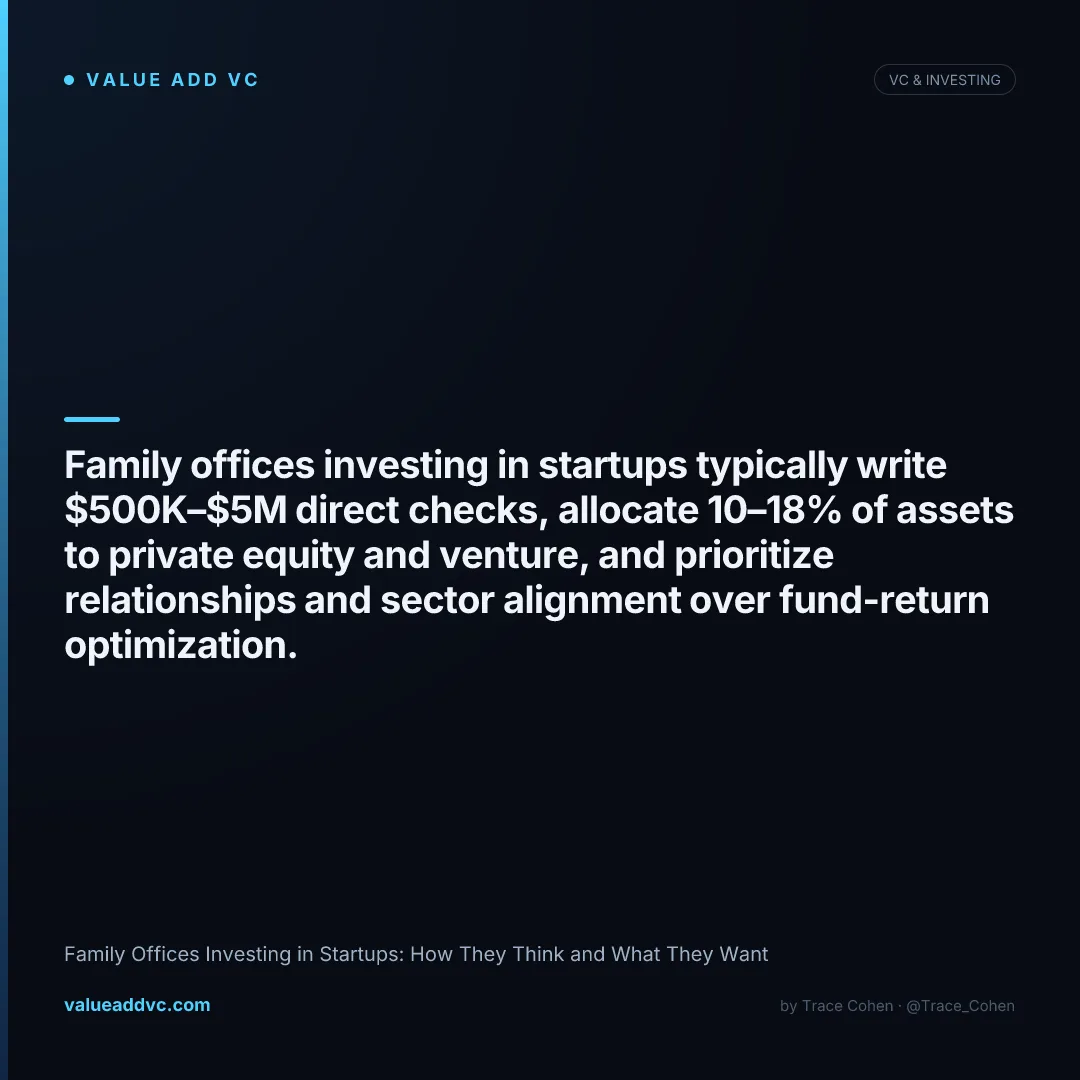
Check sizes for direct startup investments cluster at $500K–$5M, with the largest single-family offices going up to $10–20M for later-stage deals. Most family offices won't lead a round — they prefer to co-invest alongside a recognized VC. That means your job is to get the VC on board first, then bring in the family office as a strategic co-investor, often through co-investment rights negotiated into the LP agreement.
Use the LP Match tool on Value Add VC to identify family offices aligned with your sector and stage.
Why Family Office Capital Is Underrated on a Cap Table
Here's what I've seen after 65+ investments: family office LPs and co-investors are the quietest, most stable capital on any cap table. They don't participate in inside round drama. They don't push for secondary sales at inopportune times. They don't call during a down quarter asking you to accelerate a sale process.
Some of the most valuable family office relationships I've seen came in the form of an introduction to one industry client that turned into $2M in ARR. Or a board contact at a Fortune 500 that opened a strategic partnership. That's the non-obvious upside — domain network access, not just capital.
The right family office on your cap table is also an LP signal to future institutional VCs. It says someone with real operating experience in a specific domain bet on you. That carries weight in a room where everyone is trying to separate signal from noise.
Where VCs Still Have the Edge — and the Hybrid Cap Table
None of this makes family offices a wholesale replacement for institutional VCs. The gaps are real and matter depending on your stage and ambitions.
Brand and signaling
A16z, Sequoia, or Benchmark on your cap table opens enterprise doors that no family office can match. Signaling still matters, especially in B2B SaaS.
Portfolio infrastructure
Top VC platforms offer talent sourcing, portfolio intros, PR support, and dedicated operators. Family offices rarely have any of this — you're getting capital, not a platform.
Follow-on capacity at scale
A Series B or C round of $50M+ requires institutional LP capital. Family offices can participate, but they can't anchor a large round the way a Tier 1 fund can.
Governance discipline
For companies heading toward IPO scale, experienced VC board members who have seen 50+ similar companies compound in your favor.
The most interesting pattern I'm seeing as of 2025–2026 is the hybrid cap table: a lead VC for signaling and governance, filled out with 2–4 family offices for the bulk of the capital. For founders raising right now, the practical implication is that family office outreach and VC outreach should happen in parallel — not sequentially. Treating family offices as a fallback when VCs say no is leaving real money on the table.
Family offices don't optimize for fund metrics. They optimize for relationship, sector fit, and patient compounding.
The founders who understand that raise better rounds — and build better boards.
Track the venture fundraising landscape on the VC Fundraises 2026 Dashboard and find LP match opportunities at LP Match on Value Add VC.
Get VC data most people never see
— 100% free
Weekly benchmarks, valuations, and fund data. Join 5,000+ investors. No spam.