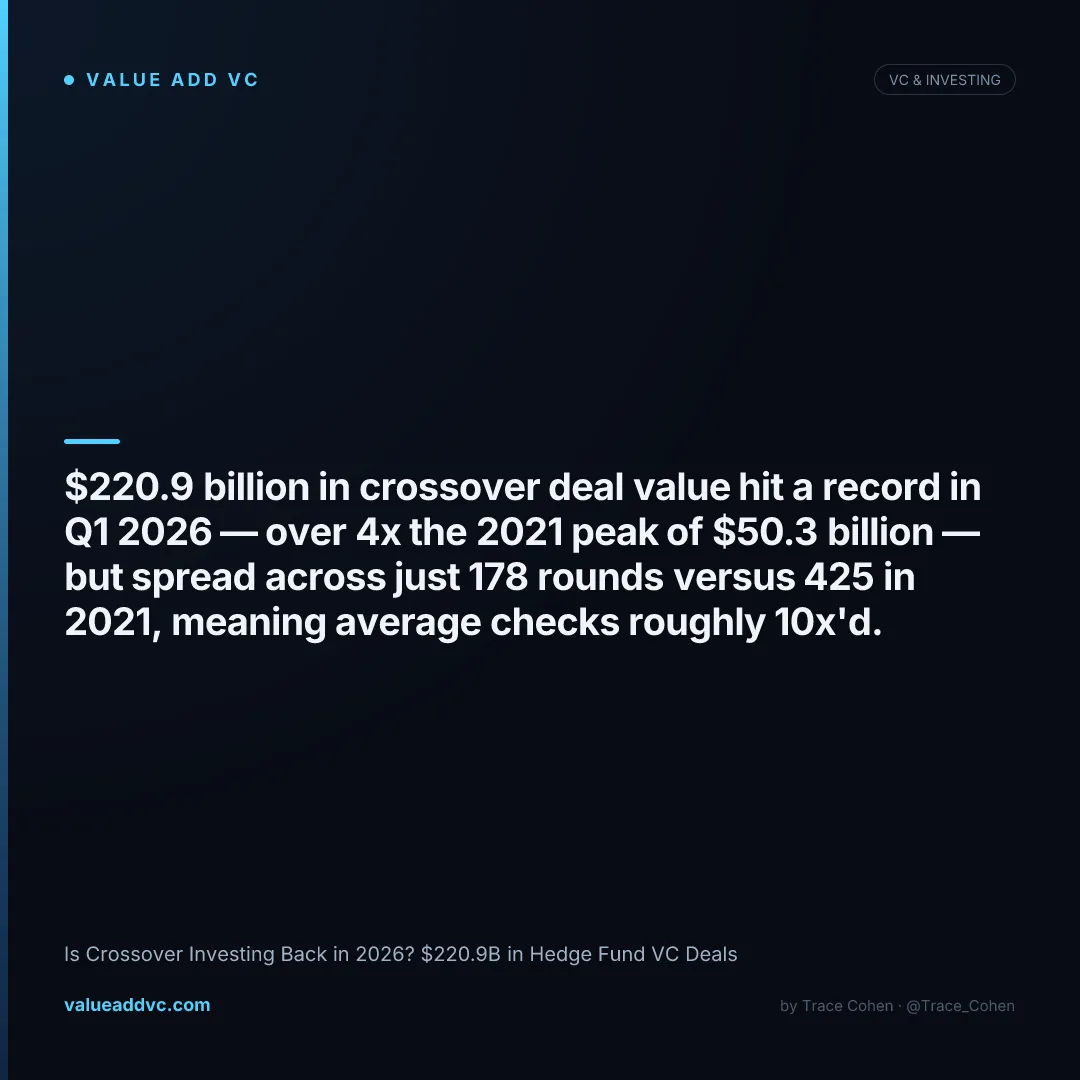
$220.9 billion in crossover deal value hit a record in Q1 2026, over 4x the 2021 peak — and I don't think that number means what most headlines are implying. That's the short answer. The longer answer is that this is a concentration story, not a comeback story.
I've watched crossover funds cycle in and out of venture twice now — the 2021 blowup and the 2022-2023 retreat — and the pattern rhyming in 2026 is worth being precise about. Hedge funds like Coatue, Tiger Global, and Altimeter are absolutely writing checks into late-stage private companies again. But they're writing far fewer, far bigger checks into a much narrower set of AI-anchored names, and by Q2 2026 several of them had already started pulling back from that same activity. That's not "crossover investing is back." That's crossover investing making one very concentrated bet.
Is crossover investing back in 2026?
Not broadly, no. Crossover deal value did hit a record $220.9 billion in Q1 2026 — more than 4x the prior 2021 peak of $50.3 billion — which is the number driving the "crossover is back" narrative. But that capital landed in just 178 rounds, down from 425 in 2021, and by Q2 2026 several of the hedge funds behind those checks had already started pulling back. The honest read is that crossover capital is concentrated in a handful of AI mega-rounds, not broadly re-entering venture the way it did pre-2022.
How much crossover capital actually flowed into venture deals in 2026?
$220.9 billion is the Q1 2026 figure, and it's a record by a wide margin — PitchBook data puts the prior full-year peak at $50.3 billion in 2021. The gap between those two years is the whole story: 2021's capital was spread across 425 rounds, spanning consumer, fintech, and enterprise software broadly, while 2026's record was built almost entirely on a small number of AI mega-rounds, including OpenAI's $110 billion raise. Average check size has effectively gone from roughly $118 million in 2021 to roughly $1.24 billion in Q1 2026 — a jump of nearly 10.5x.
Why did hedge funds pull back from venture deals after Q1 2026?
Tiger Global's own numbers tell the pullback story better than any commentary could. Its 2026 vintage venture vehicle, PIP 16, closed at $2.2 billion — down 82% from the $12.7 billion fund it raised in 2022, and a fraction of the firm's roughly $95 billion assets-under-management peak. Tiger now manages an estimated $50-60 billion across strategies. After a 56% flagship loss in 2022 and 340 venture deals done at the top of the market in 2021, the firm has spent 2026 deploying into "a market that finally rewards discipline," in the words of its own strategy shift — which in practice means far fewer, far more selective checks: 28 rounds in the trailing 12 months as of July 2026, against a 791-company portfolio built over a decade.
Which hedge funds are most active in venture capital right now?
Coatue, Tiger Global, Altimeter, D.E. Shaw, Fidelity, and T. Rowe Price are the six names that keep showing up across 2026's largest private rounds, per PitchBook and Institutional Investor reporting. Coatue is the most prolific of the group by deal count, having participated in 48 funding rounds in the trailing 12 months as of July 2026 — more than double the pace of most peers — including a Series C into Cadence alongside Spark Capital and Thrive Capital in June 2026. Here's how the most active crossover investors compare on scale and cadence right now.
| Firm | Est. AUM | Portfolio companies | Rounds, trailing 12mo | 2026 posture |
|---|---|---|---|---|
| Coatue | ~$70B | 320 | 48 | Most active by deal count |
| Tiger Global | $50-60B | 791 | 28 | Selective, PIP 16 down 82% |
| Altimeter Capital | ~$13B | 86 | 9 | Concentrated in AI leaders |
| D.E. Shaw | ~$60B | Not disclosed | Not disclosed | Mega-round anchor checks |
| Fidelity | ~$5.8T (firm-wide) | Not disclosed | Not disclosed | Marks up, rarely leads |
| T. Rowe Price | ~$1.7T (firm-wide) | Not disclosed | Not disclosed | Follows anchor rounds |
Figures are 2026 estimates blended from PitchBook, Tracxn, Institutional Investor, and firm disclosures. Portfolio and round counts reflect trailing-12-month activity as reported as of July 2026; AUM figures for diversified asset managers (Fidelity, T. Rowe Price) reflect firm-wide totals, not venture-specific allocations.
What's different about crossover investing in 2026 versus the 2021 peak?
178 rounds versus 425 is the single number that separates the two eras. In 2021, crossover funds were spreading capital across a broad swath of software, fintech, and consumer companies at growth-stage valuations that, in hindsight, were disconnected from fundamentals — the flagship losses that followed (Tiger Global's 56% drawdown among them) are the direct consequence. In 2026, the same class of investor is writing dramatically bigger checks into a much smaller set of companies, almost all tied to frontier AI labs or AI infrastructure. That's a fundamentally different risk profile: fewer, larger, higher-conviction bets rather than broad diversification.
Is crossover investing concentrated in AI mega-rounds?
Yes — the majority of Q1 2026's $220.9 billion in crossover deal value traces back to a handful of AI mega-rounds, anchored by OpenAI's $110 billion raise with participation from Coatue, Altimeter, and D.E. Shaw among others. Market forecasts for Q3 2026 expect four to seven additional $1 billion-plus rounds, with the strong majority going to Anthropic, OpenAI, xAI, and Mistral. That concentration is exactly why I'd push back on framing this as venture capital broadly recovering — it's a small number of firms making a small number of extremely large bets on a small number of companies, which is a very different market than the one "crossover investing is back" implies. You can track how these valuations stack up against actual revenue on the AI Valuations Dashboard.
Should founders court crossover investors for their next round?
Only if you're raising $100 million or more at a stage where a $1 billion-plus round is plausible — crossover funds in 2026 are built for concentrated, high-conviction checks, not the smaller bets traditional Series A and B VCs make. I've sat across the table from enough of these processes to say: if you're not already generating meaningful revenue or sitting in the AI infrastructure or frontier-model category, a crossover fund is the wrong investor to chase, and the fundraising time is better spent with funds whose value-add matches your actual stage. For everyone else, this data is useful mainly as a signal of where late-stage AI capital is concentrating, not as a target list.
There's a second-order effect worth flagging too: when six firms are responsible for the majority of $1 billion-plus rounds, the terms on those rounds start to look similar — structured preferred stock, information rights modeled on public-market disclosure, and board observer seats rather than full board seats. If you do end up in a room with Coatue, Tiger Global, or D.E. Shaw, expect a diligence process that moves fast on the model and slow on governance, because these firms are underwriting a public-market exit, not a decade-long partnership. That's a different negotiating posture than a traditional Series B lead, and founders who don't prepare for it tend to give up more than they realize on secondary terms.
The Bottom Line:
Crossover investing isn't broadly back — $220.9B in Q1 2026 deal value is real, but it's 178 rounds' worth of concentrated AI mega-round conviction from Coatue, Tiger Global, and a handful of peers, not a return to 2021's 425-round, spread-the-bets approach.
Track how late-stage and crossover capital is being deployed on the AI Valuations Dashboard and see fund-level performance on VC & PE Performance at Value Add VC. Originally published in the Trace Cohen newsletter.
Get VC data most people never see
— 100% free
Weekly benchmarks, valuations, and fund data. Join 5,000+ investors. No spam.